
DNA replication is one of those IB Biology topics that feels obvious right up until you try to explain it under exam pressure. You know the phrase “semi-conservative.” You’ve drawn the diagram. But then a question asks why it has to be that way, and suddenly your brain offers: “Because… that’s what it is?”
Semi-conservative replication isn’t just a label you memorize. It’s a design choice with consequences: accuracy, repair, stability, and the quiet continuity that lets a cell copy a 3-billion-letter instruction manual without turning it into nonsense.
Quick checklist: what to say in an IB Biology answer
When IB Biology asks why DNA replication is semi-conservative, aim for a compact chain of logic:
-
Each daughter DNA molecule contains one parental strand and one new strand
-
The parental strand acts as a template for complementary base pairing
-
This enables high fidelity copying and supports proofreading
-
It helps cells maintain genetic continuity during cell division
-
It can also help preserve patterns like DNA methylation across generations of cells
If you want the syllabus-aligned version before practicing, start with IB Biology Topic D1.1: DNA Replication and the dedicated D1.1 DNA Replication Notes.
What “semi-conservative” actually means (and why it matters)
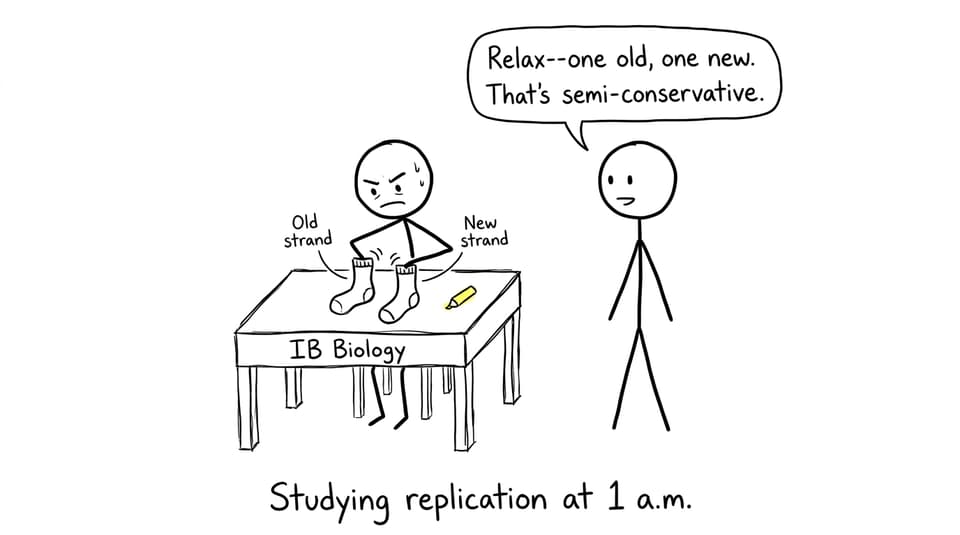
In IB Biology language, semi-conservative replication means: each new DNA double helix keeps one original (parental) strand and builds one newly synthesized strand.
That “half old, half new” structure is not a quirky detail. It’s what makes replication a read-and-copy process instead of a risky guess.
Here’s the key idea: when the two strands separate, each parental strand carries the original base sequence. DNA polymerase can then build a new strand by matching nucleotides using complementary base pairing (A with T, C with G). One old strand becomes the reference. Without a reference, “copying” becomes more like improvising.
For a crisp, exam-friendly explanation of this exact point, review Semi-conservative Nature of DNA Replication (D1.1.2 Notes).
IB Biology reason #1: templates make accuracy possible
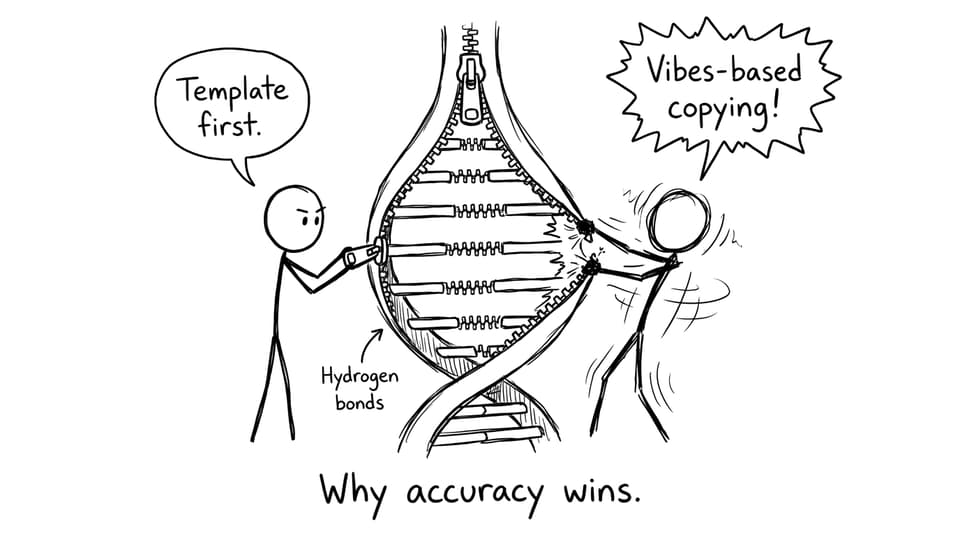
Semi-conservative replication is essentially a built-in checking system. Because every new strand is built against a parental template, the cell doesn’t need to “remember” the DNA sequence. The sequence is physically present.
That matters because IB Biology exam questions often test the link between:
-
Complementary base pairing
-
Hydrogen bonding and shape fit
-
DNA polymerase accuracy
Correct pairings form stable hydrogen bonds and fit neatly in the helix geometry. Wrong pairings tend to distort the shape, making them easier for polymerase to reject or remove.
If you want to connect this to higher-mark explanations, How DNA Polymerases Maintain Replication Accuracy is the cleanest bridge between “A pairs with T” and “mutation rates stay low.”
IB Biology reason #2: proofreading and repair depend on “one strand staying true”
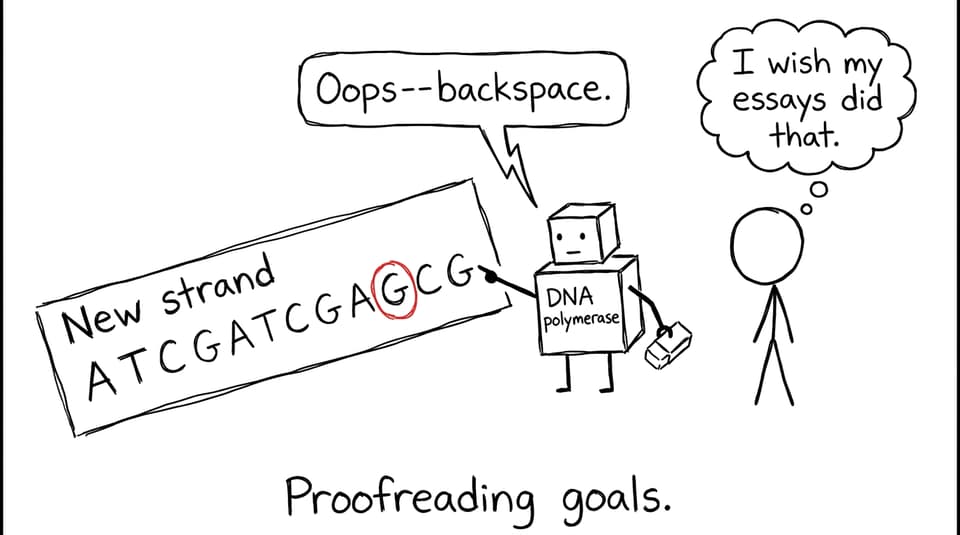
In IB Biology, you’re expected to know that DNA polymerase has proofreading ability (especially in HL extensions). Proofreading works because polymerase compares what it just added to the template strand. A mismatch is detectable precisely because the parental strand provides a correct reference.
Semi-conservative replication keeps that reference intact in each daughter molecule. It’s like copying a page while keeping the original beside you, not shredding it and hoping your memory fills the gaps.
To deepen this idea with the full enzyme team at the replication fork, connect it to How Enzymes Coordinate DNA Replication. And if you’re revising the full unit in context, 2.7 DNA replication, transcription and translation is a helpful map.
IB Biology reason #3: stability (including epigenetic continuity)
Semi-conservative replication isn’t only about copying letters. Cells also carry chemical “notes in the margins,” such as methyl groups that affect gene expression.
Because each new DNA molecule contains one parental strand, there is a partial inheritance of these patterns. Enzymes can use the old strand’s chemical marks as a guide to modify the new strand, keeping gene regulation more consistent across cell generations. You don’t need to overexplain this in most IB Biology answers, but mentioning epigenetic stability can be a strong extra point when relevant.
IB Biology reason #4: faithful inheritance before cell division
The last reason is the one students feel but don’t always phrase well: semi-conservative replication supports reliable inheritance in mitosis and meiosis because every copy is anchored to an original template during synthesis.
If you want a syllabus-aligned sentence for this, tie it to the idea that replication must happen before division so each daughter cell receives the full genetic blueprint. See DNA Replication as a Prerequisite for Cell Division (D2.1.5 Notes).
Bring it home with RevisionDojo
Semi-conservative replication is the kind of IB Biology concept that rewards calm clarity: one old strand stays, one new strand is built, and that simple structure makes accuracy and inheritance possible.
If you want to revise this topic with less stress and more precision, use RevisionDojo as your system: Study Notes for the core logic, Flashcards for definitions, the Questionbank for exam-style practice, Mock Exams to train timing, Predicted Papers to focus revision, and the Coursework Library plus Tutors when you need targeted support. Start with IB Biology Resources and keep your IB Biology revision moving in one direction: forward.