


DNA copying is one of those quiet miracles you only notice when it goes wrong. Imagine rewriting a 3-billion-letter book, at speed, in dim light, while someone keeps shaking the desk. Yet most cells do it with barely a typo. For IB Biology students, that miracle has a name: DNA polymerase fidelity. Understanding how DNA polymerases maintain replication accuracy turns a memorization topic into a story about quality control, second chances, and systems that assume mistakes will happen.
If you want the syllabus-aligned version of the core process, start with IB Biology Topic D1.1: DNA Replication and then test yourself using the D1.1 DNA Replication Questionbank.
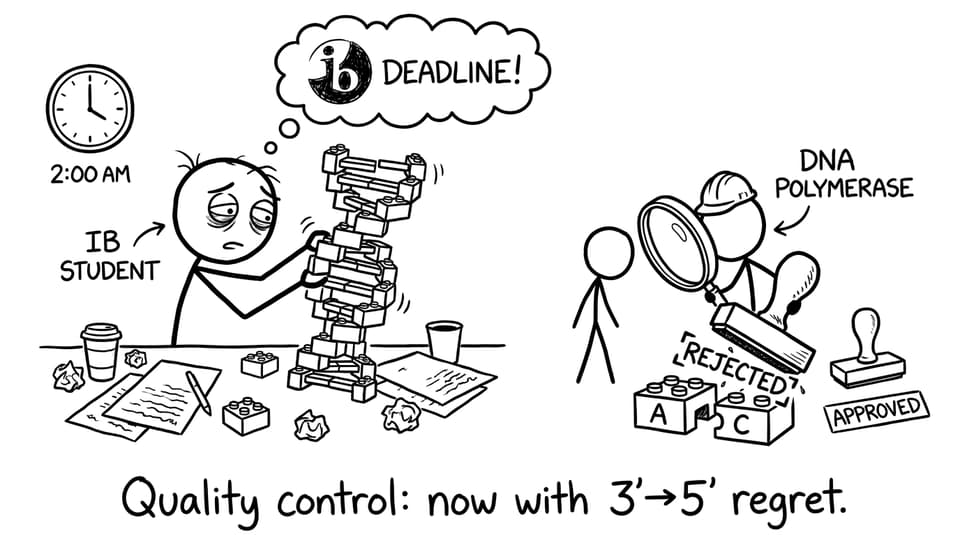
The replication accuracy checklist (what examiners want)
For IB Biology, replication accuracy usually comes down to a layered explanation. Keep this short checklist in mind:
-
Complementary base pairing makes the “right” nucleotide the easiest choice.
-
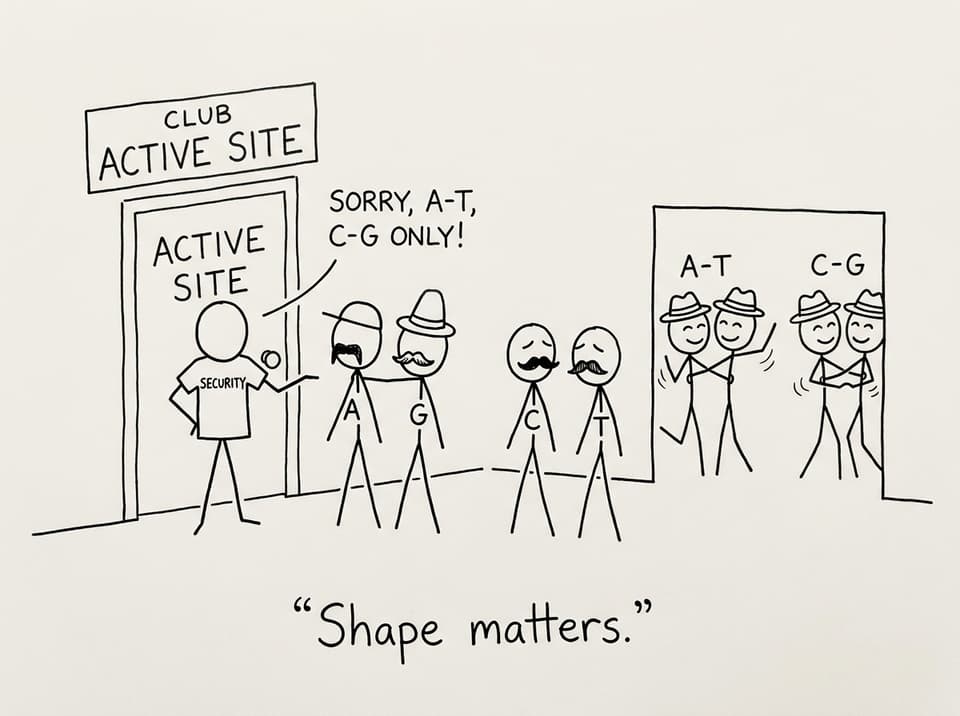
Active site geometry rejects many wrong matches before bonding.
-
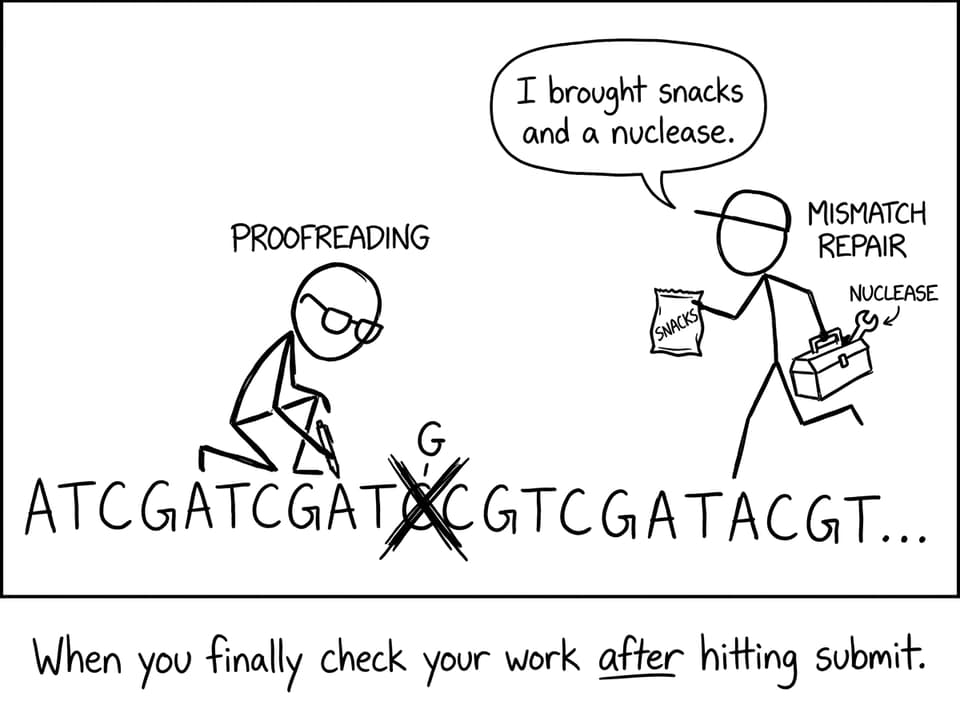
Proofreading (3'→5' exonuclease) fixes errors immediately after insertion.
-
Mismatch repair catches the leftovers after replication.
-
Balanced nucleotide availability reduces pressure toward misincorporation.
For a quick refresher on semi-conservative logic (often linked to accuracy questions), review D1.1.2 Semi-conservative Nature of DNA Replication Notes.
IB Biology: How DNA polymerases choose the right base most of the time
The first safeguard is deceptively simple: A pairs with T, and C pairs with G. Chemistry nudges the correct nucleotide into place because the hydrogen-bonding pattern and overall shape fit cleanly.
But polymerases do not “think” in letters. They “feel” in shapes. The polymerase active site is structured so a correct base pair fits like a well-cut key. A mismatched pair often has awkward geometry, which slows catalysis and increases the chance the wrong nucleotide falls away before it becomes permanent.
If you want this process step-by-step in one place, use D1.1.1 DNA replication (topic hub) and the concise Notes for D1.1 DNA replication.
Proofreading: the built-in “wait…that looks wrong” feature
Even with strong base pairing rules, errors happen. The real magic for IB Biology is proofreading.
Many replicative DNA polymerases have a 3'→5' exonuclease function. After adding a nucleotide, the enzyme checks whether the newest base pair is stable. If it is mismatched, the polymerase shifts the new strand into a proofreading site, removes the incorrect nucleotide, and then returns to synthesis.
In exam language: proofreading can reduce the error rate dramatically (often taught as around a ~100-fold improvement). The key idea is not the exact number, but the mechanism: remove the last added base, then continue.
To connect polymerase accuracy to the bigger “team at the fork” story, read How Enzymes Coordinate DNA Replication and drill terms with Flashcards for the role of helicase and DNA polymerase.
Mismatch repair: the cleanup crew after replication
Proofreading is immediate. Mismatch repair is delayed quality control.
After replication, repair proteins scan the DNA for distortions caused by mispaired bases. When found, the system identifies the newly synthesized strand, cuts out a short segment containing the mismatch, and uses DNA polymerase to resynthesize it correctly. The result is a second layer that catches what proofreading missed.
This is a favorite IB Biology framing: accuracy is not one perfect mechanism, but multiple “good-enough” mechanisms stacked together.
Exam tip: link accuracy to why replication matters
A common mistake is explaining accuracy without saying why it matters. Mutations can alter proteins, disrupt regulation, or be neutral, but the point is that high fidelity protects genetic continuity.
For a clean syllabus link, review D2.1.5 DNA Replication as a Prerequisite (notes).
Bring replication accuracy into your revision system
Replication accuracy becomes easier when you practice it the way polymerases do: in layers. Read the concept once, test it, fix errors, and retest.
On RevisionDojo, you can do that loop fast with Study Notes, Flashcards, and the Questionbank, then raise the bar using Mock Exams, Predicted Papers, and Grading tools. If you get stuck, AI Chat can walk you through markscheme-style wording, and the Tutors and Coursework Library help you build confidence beyond a single topic. Make IB Biology feel predictable, and let replication accuracy be the chapter you actually enjoy explaining.


