


A replication fork is teamwork under pressure
If you have ever tried to do a group project the night before the deadline, you already understand the central drama of IB Biology DNA replication: speed is useless without coordination.
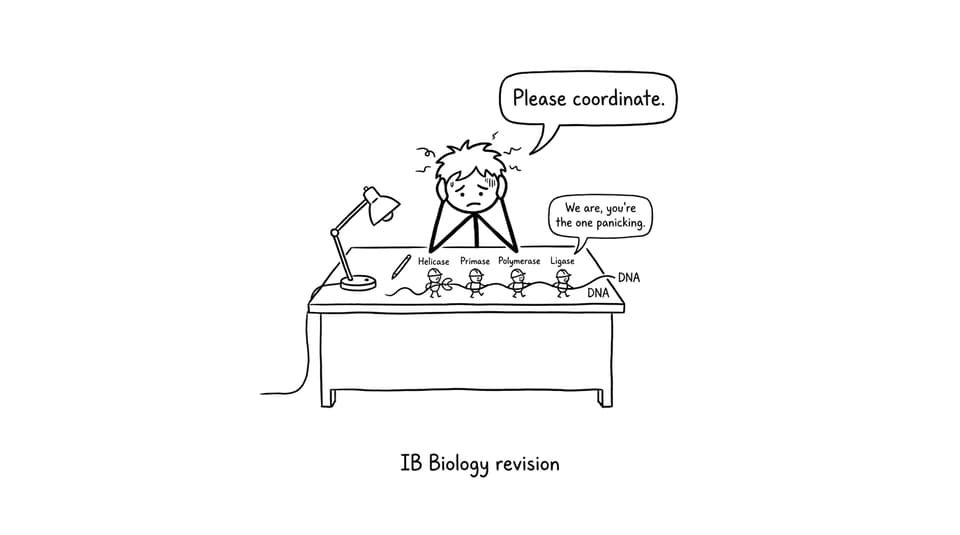
At the replication fork, enzymes do not just “work”, they negotiate timing. One enzyme opens the DNA, another stabilizes it, another lays a starting point, and another stitches fragments into a finished strand. Miss one handoff and the whole system slows, stalls, or becomes error-prone.
Quick checklist: who does what at the fork?
For IB Biology exam answers, you want a clean, enzyme-by-enzyme story:
-
Helicase unwinds the double helix (breaks hydrogen bonds).
-
Single-stranded binding proteins (SSBs) stop strands re-annealing.
-
Primase builds short RNA primers.
-
DNA polymerase extends new DNA 5′-3′ (continuous on leading, discontinuous on lagging).
-
Topoisomerase prevents supercoiling ahead of the fork.
-
Primer removal + replacement swaps RNA for DNA (DNA pol I in prokaryotes; RNase H + polymerase in eukaryotes).
-
DNA ligase seals the sugar-phosphate backbone between fragments.
If you want the syllabus-aligned version of this sequence, start with IB Biology Topic D1.1: DNA Replication.
How enzymes coordinate DNA replication (step by step)
Helicase sets the pace, SSBs keep order
Replication begins when helicase pries the two DNA strands apart. That opening creates exposed single-stranded DNA that is chemically “tempted” to snap back together or fold into awkward shapes.
That is where SSBs quietly do the unglamorous work: they bind to single strands and keep templates readable. In IB Biology, it helps to describe SSBs as preventing re-annealing and secondary structure formation.
Primase creates the starting line for DNA polymerase
DNA polymerase is powerful, but it has a limitation that shows up constantly in IB Biology markschemes: it cannot start from nothing. It needs a free 3′ hydroxyl group.
Primase solves this by building a short RNA primer. The leading strand needs one primer to get going. The lagging strand needs many primers, because synthesis happens in fragments.
For a dedicated primer explanation, revise with Why DNA Replication Needs RNA Primers.
DNA polymerase keeps both strands moving (even when they disagree)
Both new strands must be made 5′-3′, but the templates run antiparallel. So the fork uses two different strategies:
-
Leading strand: continuous synthesis toward the replication fork.
-
Lagging strand: discontinuous synthesis away from the fork in Okazaki fragments.
To stay coordinated, the lagging-strand machinery effectively “loops” so polymerase can work in the same overall direction as the fork. It is a simple idea with a big exam payoff: coordination prevents the lagging strand from falling hopelessly behind.
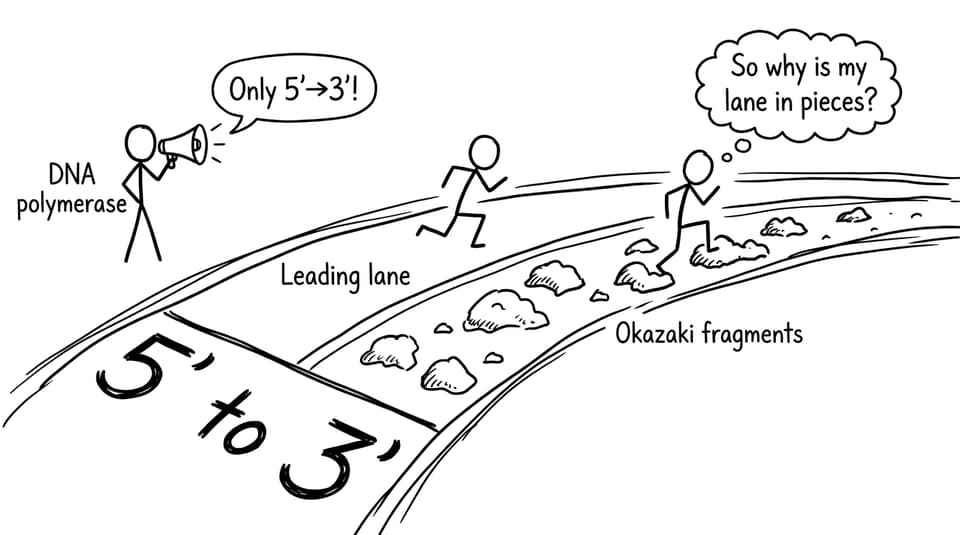
If 5′-3′ directionality still feels slippery, consolidate it with Why DNA Replicates Only 5′ to 3′.
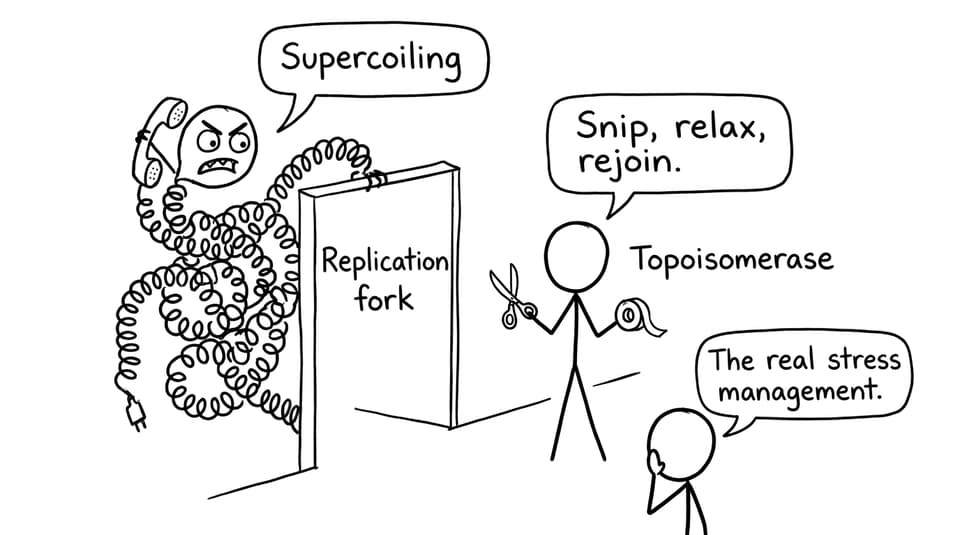
Topoisomerase prevents the “telephone-cord problem”
As helicase unwinds DNA, the region ahead of the fork gets overwound, like twisting a rope until it snarls.
Topoisomerase prevents replication from stalling by cutting DNA, relieving torsional strain, and rejoining it. In IB Biology, that “cut, relax, rejoin” phrasing is usually enough.
Primer removal and ligase finish the job
Once fragments are made, the temporary RNA primers must be removed and replaced with DNA. Then DNA ligase seals remaining nicks by forming phosphodiester bonds.
This final coordination step matters because the lagging strand is not truly complete until fragments become one continuous, stable DNA strand.
To drill this with exam-style practice, use D1.1 DNA Replication Questionbank and then reinforce definitions with Flashcards on helicase and DNA polymerase.
Common IB Biology exam angles (and how to answer)
-
If asked why the lagging strand needs more coordination: mention antiparallel strands, 5′-3′ synthesis, Okazaki fragments, repeated priming, and ligation.
-
If asked what happens without topoisomerase: mention supercoiling buildup and fork stalling.
-
If asked why primers are required: mention polymerase needs a 3′-OH and cannot initiate de novo.
For broader syllabus context and connected concepts, see D1.1.2 Semi-conservative nature of DNA replication Notes and Why DNA Replication Is Semi-Conservative.
Bring it all together with RevisionDojo
The fastest way to feel confident in IB Biology is to practice explaining coordination at the replication fork in short, markscheme-friendly sentences, then immediately test yourself. RevisionDojo makes that loop easy: use the Study Notes, drill the Questionbank, lock in terminology with Flashcards, and clarify confusion with AI Chat. When you are ready to simulate pressure, build Mock Exams, check understanding with Grading tools, and target weak spots using Predicted Papers and the Coursework Library (plus Tutors if you want guided feedback).
Start your focused revision here: IB Biology Resources, and make enzyme coordination feel as predictable as your own study routine.


