


If you have ever stared at a replication fork diagram and thought, Why does biology insist on this one-arrow rule? you are not alone. In IB Biology, “DNA synthesis occurs 5′ to 3′” can feel like a line you memorise, write once in an exam, and forget. But the direction is not a preference. It is a constraint baked into chemistry, energy, and error-correction.
The good news: once you understand why DNA replicates only 5′ to 3′, leading vs lagging strands stops being a confusing exception and becomes the inevitable outcome.
The 30-second checklist (what examiners want)
For IB Biology marks, keep this tight chain of logic:
-
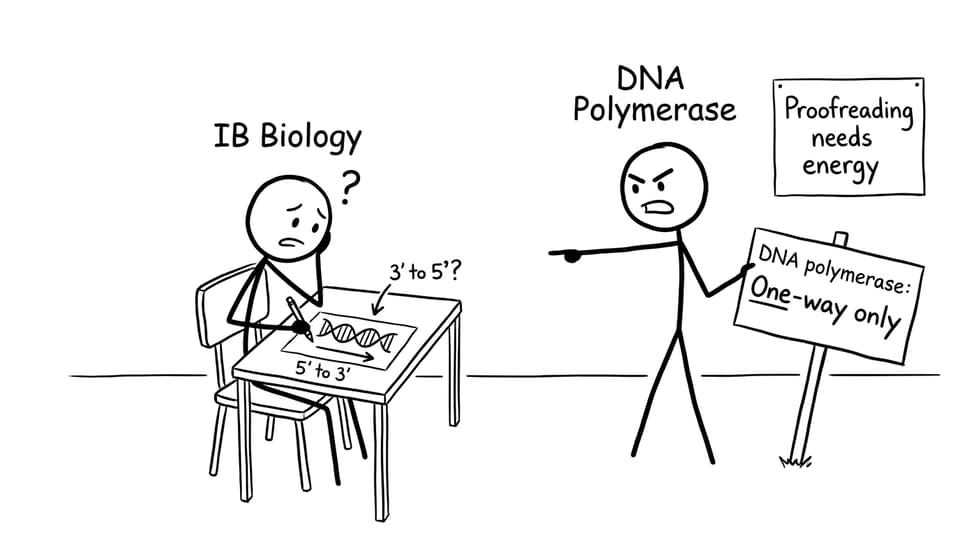
DNA polymerase can only add a nucleotide to a free 3′-OH.
-
Incoming nucleotides arrive as nucleoside triphosphates (high-energy).
-
Bond formation releases energy (phosphate bonds break) to drive polymerisation.
-
Proofreading works because removing a wrong base does not destroy the energy source for the next addition.
-
Antiparallel templates force a leading strand (continuous) and lagging strand (Okazaki fragments + ligase).
For syllabus-aligned notes and practice, start with IB Biology Topic D1.1: DNA Replication.
The real reason: polymerase can only extend from a 3′-OH
DNA polymerase is like a builder who will only attach a new brick onto one specific connector. In molecular terms, that connector is the 3′ hydroxyl group (-OH) at the end of the growing strand. The incoming nucleotide carries three phosphates. When polymerase adds it, a phosphodiester bond forms and energy is released as phosphates are removed.
That detail is the whole story. Because addition happens at the 3′ end, the new strand must grow 5′ to 3′. There is no “mirror mode” available for normal DNA polymerases.
If you want a clean, IB-friendly walkthrough of the overall pathway, pair this article with the structured Notes for D1.1 DNA replication.
Why 3′ to 5′ replication breaks proofreading
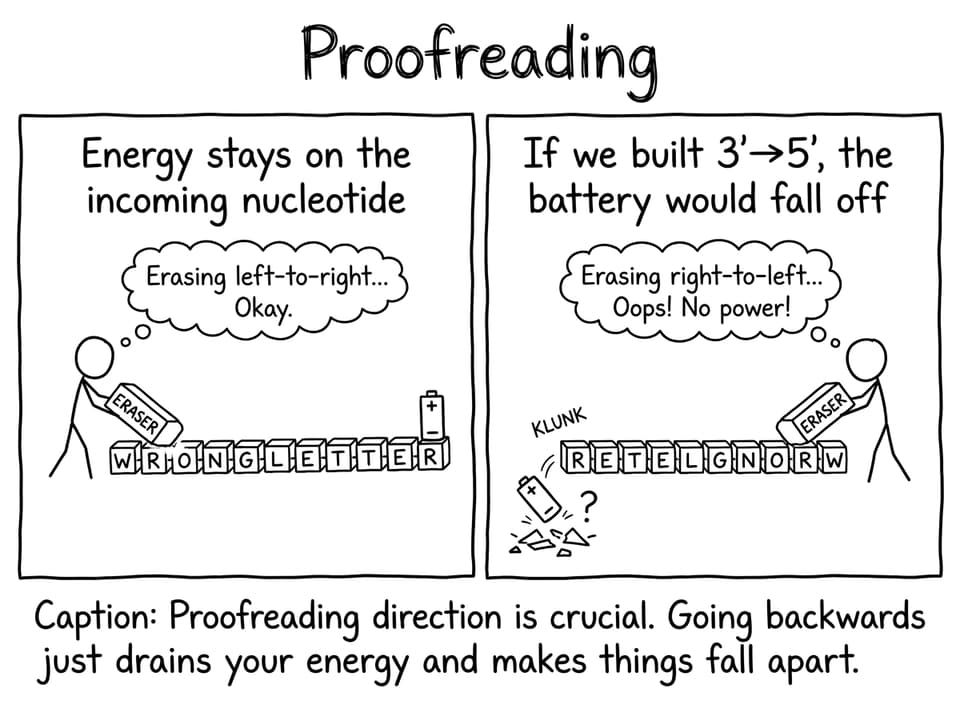
In IB Biology, accuracy is never a side note. DNA polymerase is fast, but it is also careful. Many polymerases have proofreading (3′→5′ exonuclease activity) that removes a mispaired nucleotide soon after it is added.
Here is the key idea: with 5′ to 3′ synthesis, the energy is on the incoming nucleotide, not stored precariously on the growing DNA strand. So if the enzyme removes a wrong nucleotide, it can still add the correct one next, because the next incoming nucleotide brings its own energy.
If synthesis happened 3′ to 5′, removing a mistaken nucleotide would remove the “activated” end that would have powered the next bond. Proofreading would stall replication, or force a totally different chemistry that is not observed in cells.
For a deeper accuracy-focused explanation that connects well to exam questions, see How DNA Polymerases Maintain Replication Accuracy.
Leading vs lagging strands: the fork’s compromise
Because DNA is antiparallel, the two template strands point in opposite directions. Polymerase still insists on 5′ to 3′ building, so the fork solves a coordination problem:
-
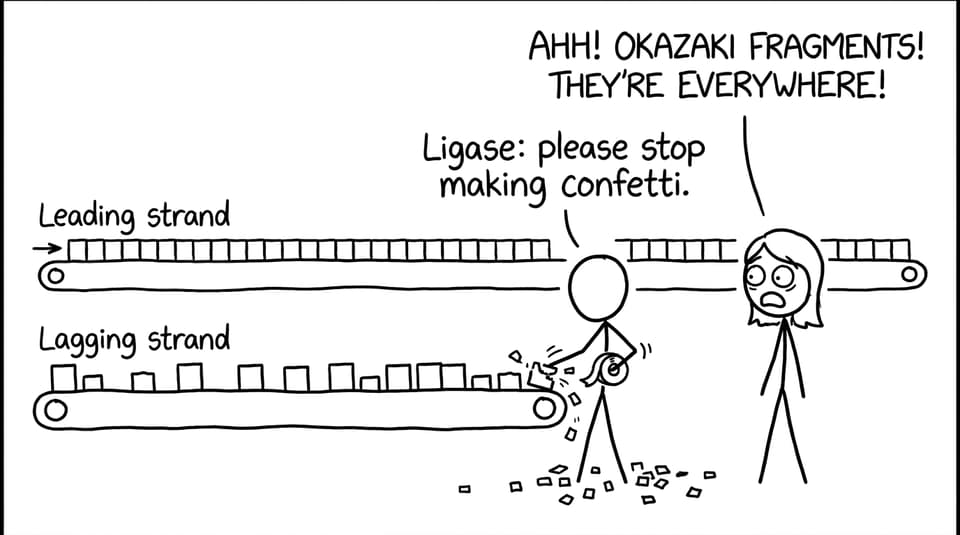
Leading strand: template runs 3′ to 5′ into the fork, so polymerase can move forward continuously.
-
Lagging strand: template runs 5′ to 3′ into the fork, so polymerase must build short pieces away from the fork.
Those pieces are Okazaki fragments, started repeatedly by primase (RNA primers), then later stitched into a continuous strand by ligase.
To connect antiparallel structure to replication logic in an exam-ready way, read How Antiparallel DNA Ensures Accurate Replication. And if you are revising enzymes at the fork, How Enzymes Coordinate DNA Replication is a strong companion.
How to practise this in IB Biology (without rote learning)
Understanding is great, but IB Biology exams reward retrieval under pressure. A useful routine:
-
Read the core explanation in 2.7 DNA replication, transcription and translation if that is the route your class uses.
-
Drill directionality specifically with IB Biology Topic D1.1: DNA Replication Questionbank.
-
Lock in definitions and quick explanations using D1.1.2 Semi-conservative nature of DNA replication Flashcards and the broader Flashcards for Cell biology.
On RevisionDojo, this becomes a loop: Study Notes for clarity, Flashcards for active recall, Questionbank for exam timing, plus AI Chat when a markscheme line confuses you. Add Mock Exams and Predicted Papers for full-length stamina, and use Grading tools to see what the examiner would actually award. If you are working on internal assessments too, the Coursework Library and Tutors help you stay precise without drifting off-syllabus.
Closing: make the direction feel inevitable
Once you see the logic, “DNA replicates 5′ to 3′” stops being trivia and becomes the spine of the entire replication story: energy arrives with the incoming nucleotide, polymerase extends only from a 3′-OH, proofreading stays possible, and the leading/lagging split becomes unavoidable. That is exactly the kind of explanation IB Biology examiners reward: short, chemical, and connected.
If you want to turn this into points quickly, practise it the RevisionDojo way: review the IB Biology Topic D1.1: DNA Replication notes, then pressure-test your understanding in the D1.1 Questionbank using timed sets and AI feedback. That is how concepts become marks.


