
Water rarely looks dramatic in a textbook. But on exam day, IB Biology loves the quiet drama: a molecule that can either spread into a film or snap into droplets can decide whether gas exchange works, whether cells stay hydrated, and whether diffusion happens fast enough.
Think about a leaf on a hot afternoon, or the inside of an alveolus during breathing. Both rely on a thin, continuous layer of water. If that layer breaks into beads, the whole surface changes. IB Biology calls the property that keeps water “stuck” to surfaces adhesion, and it’s one of those small ideas that scales up into big biological consequences.
Quick IB Biology checklist: what to say in an answer
When a question asks why adhesion maintains water films on cells, a clean IB Biology response usually includes:
-
Water is polar and forms hydrogen bonds.
-
Adhesion = attraction between water and polar/charged surfaces.
-
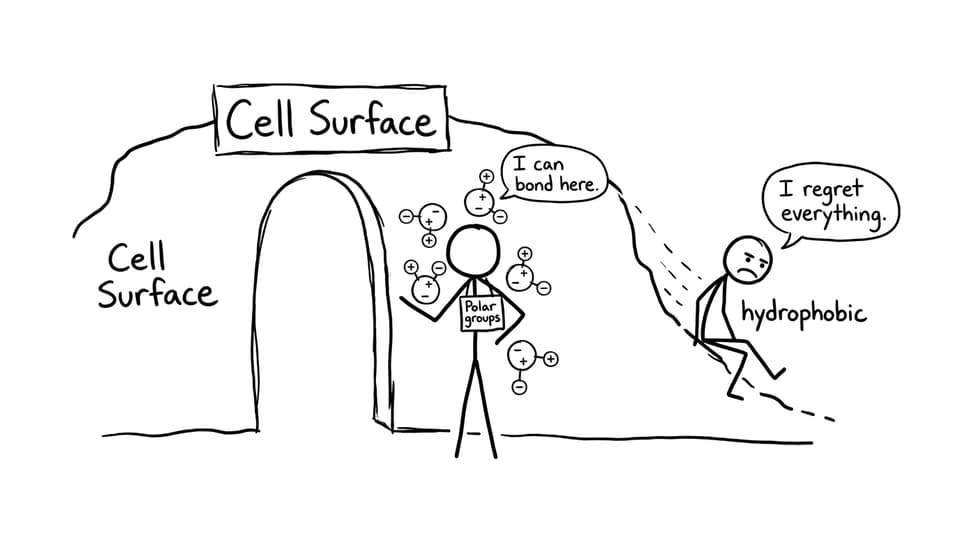
Cell surfaces (membrane heads, proteins, carbohydrates, cell walls) are often hydrophilic.
-
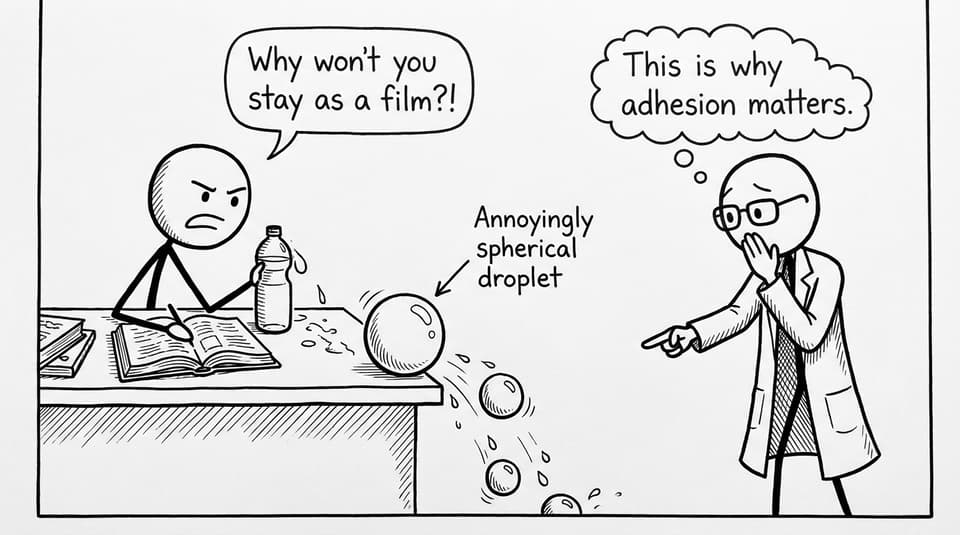
Adhesion helps water spread out into a stable film instead of beading into droplets.
-
The film enables diffusion for gas exchange and supports transport and hydration.
For syllabus-aligned phrasing, keep RevisionDojo’s core hub open: IB Biology Topic A1.1 Water Notes & Questions.
What adhesion really means in IB Biology
In IB Biology, adhesion is not “water being sticky” in a vague way. It’s a consequence of polarity.
Water has a partial negative charge on oxygen and partial positive charges on the hydrogens. That uneven charge distribution lets water form hydrogen bonds not only with other water molecules (cohesion) but also with other polar or charged substances.
Cell surfaces are packed with those substances:
-
Phospholipid heads are polar.
-
Many membrane proteins have charged or polar amino acids exposed.
-
Carbohydrates in the glycocalyx have polar groups.
-
Plant cell walls (cellulose and associated molecules) are hydrophilic.
So water doesn’t just sit nearby. Adhesion pulls it into contact and helps it remain as a thin film along the surface.
To lock in the definition in exam language, you can revise directly from Adhesion of water to polar or charged materials (A1.1.4) Notes.
Why water films matter: diffusion starts with dissolving
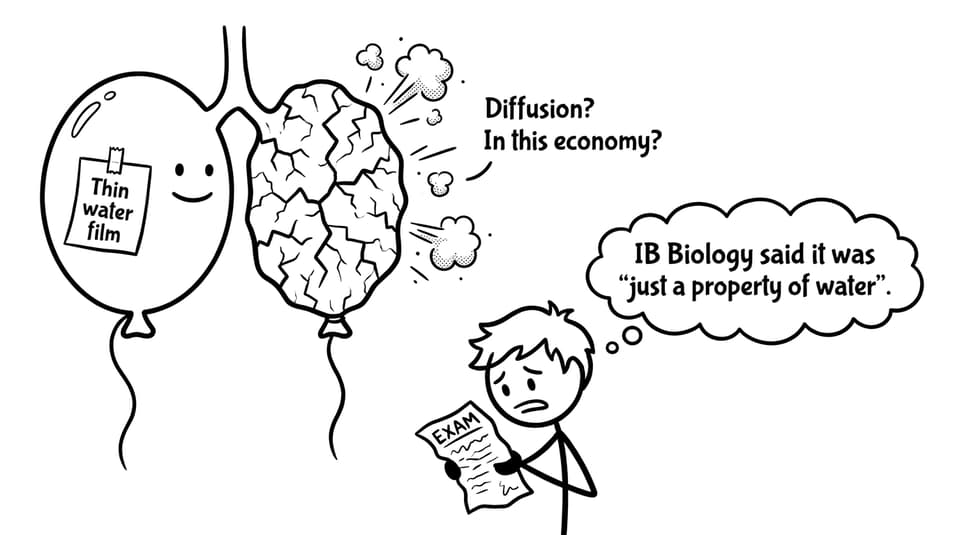
A classic IB Biology trap is to write “oxygen diffuses into the cell” and stop there. At many exchange surfaces, gases first need to dissolve in water before diffusing across membranes.
A thin water film is ideal because it gives gases a medium to dissolve in while keeping diffusion distance short.
Gas exchange in plants
Inside leaves, carbon dioxide must dissolve in the moist layer lining internal surfaces before entering cells for photosynthesis. If water formed droplets instead of a continuous film, the effective area for diffusion would shrink.
To connect this to the broader topic, see B3.1 Gas exchange and the key wording in B3.1.2 Properties of gas-exchange surfaces Notes.
Gas exchange in mammals
Alveoli are moist because gases diffuse efficiently when dissolved. The point isn’t “wet lungs are nice”; it’s that moisture supports diffusion, while surface tension and collapse risks must be managed (this is where surfactant appears elsewhere in the syllabus).
For exam-ready lung adaptation language, use B3.1.4 Adaptations of mammalian lungs for gas exchange Notes.
Adhesion vs cohesion: the sentence IB Biology examiners want
If you can write one clean comparison under pressure, make it this:
-
Cohesion is water-water attraction (hydrogen bonds) maintaining continuous columns.
-
Adhesion is water-surface attraction (polar/charged materials) maintaining films and helping water cling to tissues.
This pairing shows up constantly in plant transport too. If you want an extra example that strengthens your phrasing (and helps you avoid mixing the terms), read IB Biology: How Cohesion Moves Water Through Xylem and IB Biology: Adhesion and Capillary Action in Plants.
The exam angle: how to turn this into marks fast
In IB Biology, short answers score best when they connect property to function:
-
Property: water is polar.
-
Interaction: hydrogen bonding with polar/charged cell surfaces (adhesion).
-
Outcome: stable thin water film, not droplets.
-
Biological payoff: efficient diffusion for gas exchange, stable chemical environment for transport, reduced dehydration.
Then practice applying it. RevisionDojo makes that loop quick:
-
Use A1.1 Water Questionbank to drill exam-style prompts.
-
Reinforce definitions with A1.1 Water Flashcards.
-
If you’re revising multiple units, the full IB Biology Resources hub keeps Notes, Flashcards, AI Chat, Grading tools, Predicted Papers, Mock Exams, the Coursework Library, and Tutors connected in one workflow.
Closing: make adhesion feel inevitable, not memorized
The reason IB Biology returns to adhesion is that it’s a reminder: biology is built from physics that doesn’t announce itself. Water doesn’t maintain films on cells because it “wants to”; it does it because polarity makes hydrogen bonding unavoidable, and cells are designed with hydrophilic surfaces that invite that bond.
If you want this topic to stay exam-ready, do it the RevisionDojo way: learn the definition in A1.1 Water Notes, drill it in the Questionbank, and keep it alive with Flashcards and AI Chat. In IB Biology, adhesion isn’t a detail; it’s one of the hidden hinges that makes living surfaces work.