
A quiet exam trap: the number that looks exact
The most dangerous numbers in IB Math are the ones that look friendly.
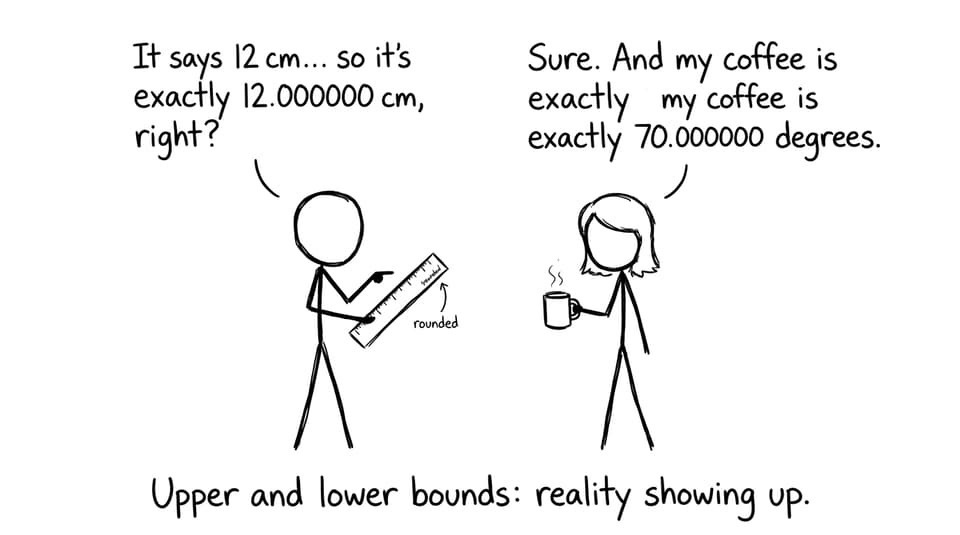
A question gives you a length of 12.3 cm, a mass of 4.1 kg, or a radius of 2 cm and your brain relaxes. You start calculating like the world is tidy. Then the markscheme reminds you of something the real world never forgets: measurements come with uncertainty. In IB Math, upper and lower bounds matter the moment a value is not guaranteed exact.
Quick checklist: when bounds actually matter in IB Math
Use bounds in IB Math when any of these show up:
-
A value is rounded (nearest 0.1, nearest metre, 3 significant figures, etc.)
-
A value is measured (ruler, stopwatch, scale, lab data)
-
The question asks for maximum/minimum possible results
-
The context mentions tolerance, accuracy, error, or “limits”
-
Your final answer must be interpreted realistically, not just computed
If you want a focused refresher on the mechanics (like how to form the interval), keep the AI SL 1.6 Approximating and estimating notes open while you practice.
What upper and lower bounds represent (in one sentence)
Upper and lower bounds in IB Math are the smallest and largest values the true quantity could be, given the stated rounding or measurement accuracy.
That’s it. It’s not about fancy algebra. It’s about being honest about what you actually know.
A strong way to revise this idea is to pair notes with exam-style practice. RevisionDojo’s AI SL 1.6 Questionbank is built for exactly this: lots of small variations, immediate feedback, and repetition until the judgement becomes automatic.
Why bounds feel “rare” but keep appearing
Bounds questions in IB Math often arrive wearing disguises. The exam doesn’t always say “find the upper and lower bounds.” Instead, it drops a phrase like “to the nearest 0.1” inside a modelling or geometry problem and expects you to notice.
Common hiding places include:
-
Area/volume from measured dimensions
-
Multi-step calculations where rounding error compounds (a classic AI move)
-
Word problems where a “reasonable range” is more correct than a single value
If you’ve ever lost marks with perfect calculator work, it may be this exact issue. See Why do rounding errors keep compounding in long IB maths calculations for the pattern.
The real skill: knowing when the examiner expects bounds
A practical rule for IB Math exams:
If a number is presented as if it came from the real world, treat it as suspicious until proven exact.
In other words, bounds matter when the question is about interpretation as much as computation. This is why students in Applications & Interpretation notice bounds more often: AI is full of data, measurement, and modelling.
To sharpen that exam instinct, build mini-drills from the Mathematics Applications & Interpretation hub and force yourself to answer one extra line each time: “What does this rounding imply about the true value?”
Common mistakes that cost easy marks
In IB Math, most bound errors are not “hard math” mistakes. They’re assumption mistakes:
-
Treating a rounded value as exact
-
Using bounds after calculating instead of before
-
Swapping which combinations give the max/min
-
Forgetting that context matters (lengths positive, units consistent)
A surprisingly helpful companion topic here is accuracy language. If significant figures and decimal places blur together under pressure, read Why do students confuse significant figures with decimal places in IB maths.
How RevisionDojo helps you make bounds automatic
RevisionDojo works best when you use it like a training loop.
-
Use the Study Notes to lock the interval idea.
-
Drill the Questionbank until you can spot “nearest…” instantly.
-
Turn tricky ones into Flashcards (especially max/min combination rules).
-
Ask AI Chat to check your interval setup and your interpretation sentence.
-
Build a short Mock Exam set and time yourself.
-
Use Grading tools to see where method marks are leaking.
If you want a clean structure for that loop, follow How to use the Questionbank for targeted Math revision.
The takeaway
Upper and lower bounds in IB Math matter whenever the question quietly admits, “This number isn’t exact.” That happens far more often than students expect, especially in modelling and measurement-heavy problems.
If you want bounds to stop feeling like surprise attacks, build a small routine on RevisionDojo: revise the interval idea, drill exam-style questions, and practice writing interpretations that sound like an examiner wrote them. In IB Math, that habit turns uncertainty from a mark-loser into a mark-winning signal.


