

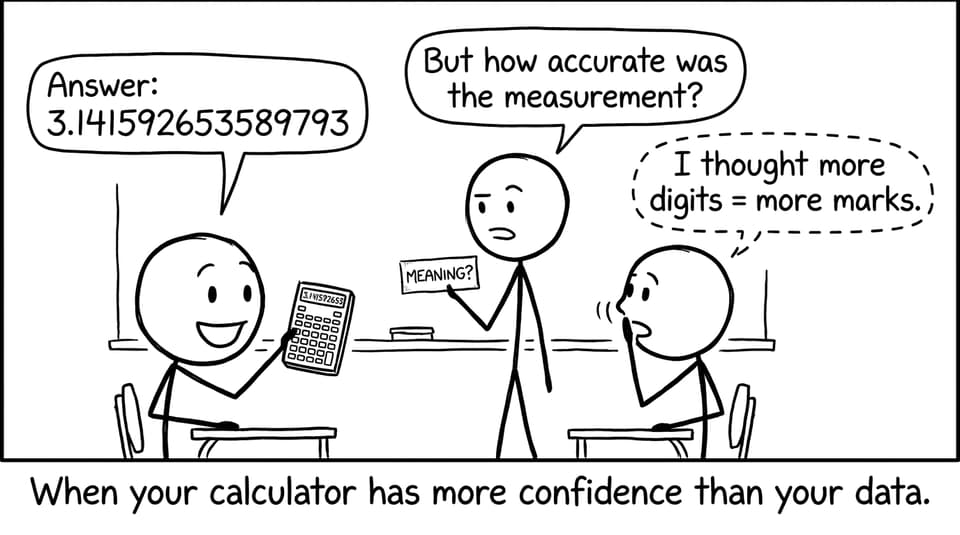
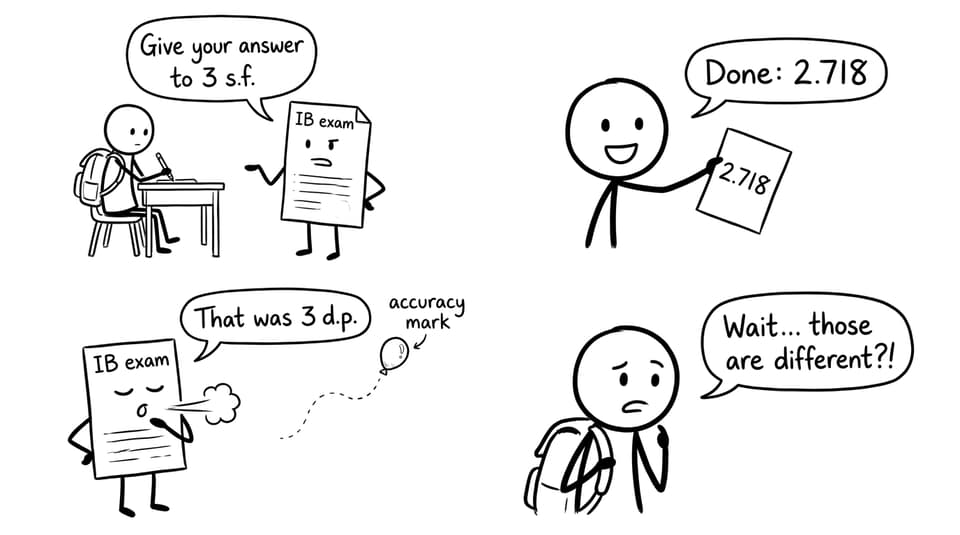
You finish the question, your working is clean, and your calculator looks certain. Then the markscheme quietly disagrees because of “accuracy.” In IB Math, that sting usually comes from one tiny mix-up: treating significant figures and decimal places as the same kind of rounding.
They look similar. They both “shorten” a number. But they communicate different ideas about the world. And IB Math loves testing the moment you have to choose between them.
A quick accuracy checklist for IB Math
Before you round anything in IB Math, ask these questions:
-
Did the question say s.f. or d.p. (or “nearest whole number”)?
-
Is the number a measurement/model output (usually s.f.) or a fixed scale/reporting format (sometimes d.p.)?
-
Am I rounding only at the end, not halfway through?
-
Does my final answer include units and a sensible level of precision?
For targeted practice on this exact skill, the Rounding to Significant Figures question type is built to make the decision automatic.
Why students confuse significant figures with decimal places
Most students learn rounding as a procedure: “look at the next digit, then round up or down.” That approach works until IB Math asks what the rounding means.
The confusion happens because both methods can produce answers that look equally neat. Under pressure, neatness feels like correctness. But in IB Math, rounding is really a judgement about precision, reliability, and how you communicate results.
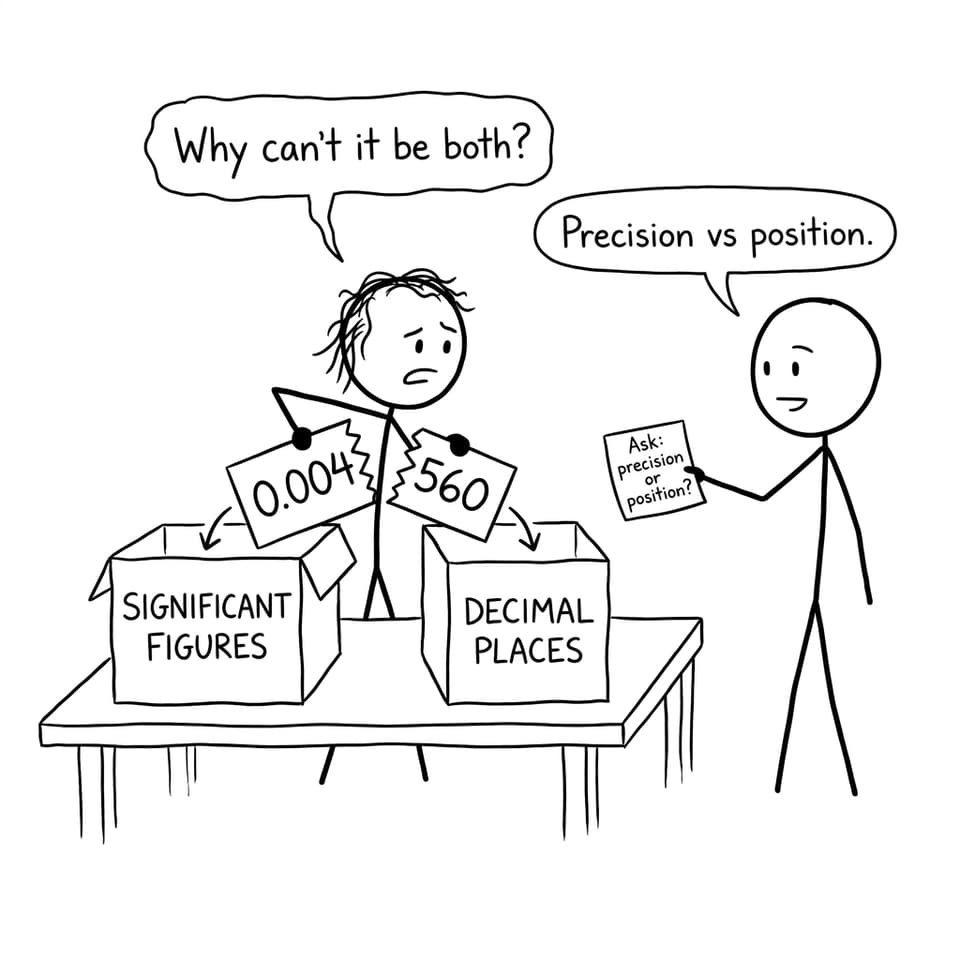
A helpful way to remember it:
-
Significant figures talk about confidence in the digits you keep.
-
Decimal places talk about where you stop on the number line.
Those are different questions. So they deserve different choices.
Significant figures in IB Math mean “precision”
In IB Math, significant figures are about how precise a value is, especially in real contexts like modelling, statistics, and measurements. They’re a way of saying: “These are the digits we can justify.”
For example, if a length is measured as 2.3 m, reporting a final derived result as 2.300000 m is not “extra correct.” It signals false certainty. IB Math often awards accuracy marks for respecting what the data can actually support.
If you’re revising Applications and Interpretation, this thinking shows up everywhere in Approximating and estimating (SL 1.6), where rounding connects directly to bounds and interpretation.
Decimal places in IB Math mean “position”
Decimal places are about location: how many digits appear after the decimal point. They don’t automatically tell you anything about measurement quality.
Decimal places are useful when the question wants consistent formatting or a fixed scale, like currency in some finance contexts, or when an output must match a specified level of detail. But if the value varies across magnitudes (very small vs very large numbers), decimal places can quietly misrepresent precision.
That’s why IB Math will sometimes penalize d.p. answers in contexts where s.f. is the honest language.
How IB Math uses this to test understanding (not just rounding)
Examiners aren’t trying to catch you out for fun. They’re checking whether you can interpret results like a person, not a calculator.
This links closely to why IB Math rewards explanation and judgement. If that theme feels familiar, it’s the same logic described in Why IB cares about interpretation more than precision.
And if you’ve ever lost marks after rounding mid-way, it’s usually the compounding effect. That’s exactly what rounding errors compounding in long calculations explains.
Where this shows up most in exams
In IB Math, the sig figs vs d.p. decision appears often in:
-
statistical summaries and regression outputs
-
modelling and interpretation questions
-
measurement and bounds tasks (see when upper and lower bounds matter)
-
mixed calculator/non-calculator reasoning
To practice in exam-style form, use the Math AI Functions Questionbank or the Math AA SL Graphing Questionbank, where accuracy instructions change on purpose.
Bring it home: make accuracy a habit, not a guess
The fastest way to stop losing “accuracy” marks in IB Math is to treat rounding as interpretation: significant figures for precision, decimal places for position, and calculator output as raw material, not the final truth.
On RevisionDojo, you can train that judgement with the Questionbank, lock it in with Study Notes and Flashcards, and fix recurring mistakes using AI Chat and Grading tools. When exam week gets close, Predicted Papers, Mock Exams, the Coursework Library, and expert Tutors help you practice accuracy the way IB marks it.
If you want a simple study loop that actually sticks, pair this skill with effective study strategies for the IB Math SL exam and make accuracy part of your everyday practice -- not a last-minute patch.