

It usually starts innocently: you get a decimal that looks ugly, you round it to “keep things tidy,” and the next line of working suddenly feels manageable.
Then you reach the end of the question. Your final value is close, but not close enough. And in IB Math, “close” can still be wrong when the examiner expected you to control accuracy like a scientist, not like a neat freak.
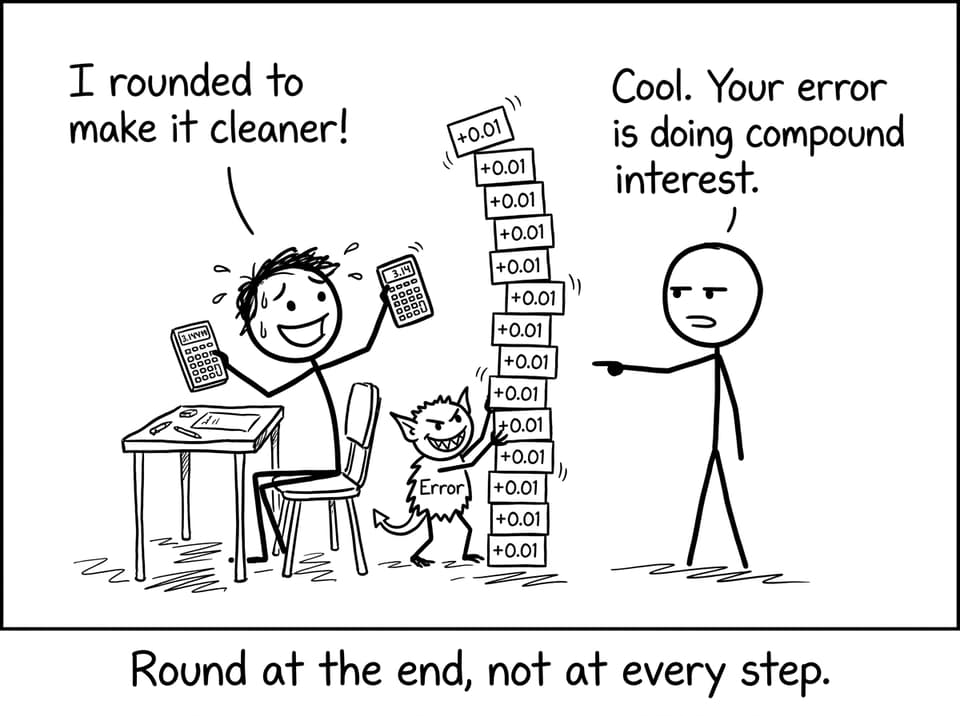
Rounding errors keep compounding in long IB Math calculations because every rounded number becomes the input for the next step. Tiny differences don’t disappear. They get reused, multiplied, exponentiated, and sometimes even fed into statistical formulas where they quietly distort the final result.
A quick checklist for avoiding compounding rounding errors in IB Math
Keep this short list in your head during Paper 1 and Paper 2:
-
Round at the end, unless the question explicitly tells you otherwise.
-
Store values in your calculator (ANS, STO->, memory variables) instead of rewriting decimals.
-
Match the required accuracy: decimal places vs significant figures.
-
If your work is long, do a “sanity check” by re-evaluating a key step with full precision.
-
When interpreting results, use cautious language to acknowledge approximation.
If you want extra practice on rounding habits, the IB Math tag hub is a good place to browse related explanations.
What a rounding error really is (and why IB Math cares)
A rounding error is not “a mistake.” It’s a choice to replace an exact value with an approximation. The problem is that the approximation carries a hidden uncertainty. In a single line of arithmetic, that uncertainty may not matter. But in long IB Math questions, the approximation becomes a dependency.
Think of it like copying a sentence by hand multiple times. If you change one word early, future copies repeat the changed version, not the original. Rounding works the same way: once you round, you are no longer working with the original number.
This is also why topics like bounds show up so often in AI: they formalize the idea that rounded values represent ranges, not perfect points. If you’re revising that concept, see when upper and lower bounds matter in IB exams.
Why rounding errors compound in long IB Math calculations
The compounding effect happens for one simple reason: later steps build on earlier steps.
In IB Math modelling, finance, and statistics, later steps often involve multiplication, powers, or repeated iteration. Those operations don’t just carry the error forward; they can amplify it.
Common places where rounding grows teeth:
-
Compound interest and annuities: small early rounding changes the base of an exponent.
-
Regression: rounding x-values or summary statistics nudges the regression parameters.
-
Standard deviation and variance: tiny shifts can change squared deviations noticeably.
-
Multi-step probability: intermediate rounding shifts the final probability by enough to miss the markscheme’s expected value.
This is one reason IB Math Applications and Interpretation often includes messy decimals on purpose. Real outputs are messy. For the mindset shift, read why students panic when answers don’t look “nice”.
Calculators make it easier to lose marks (if you use them like a notebook)
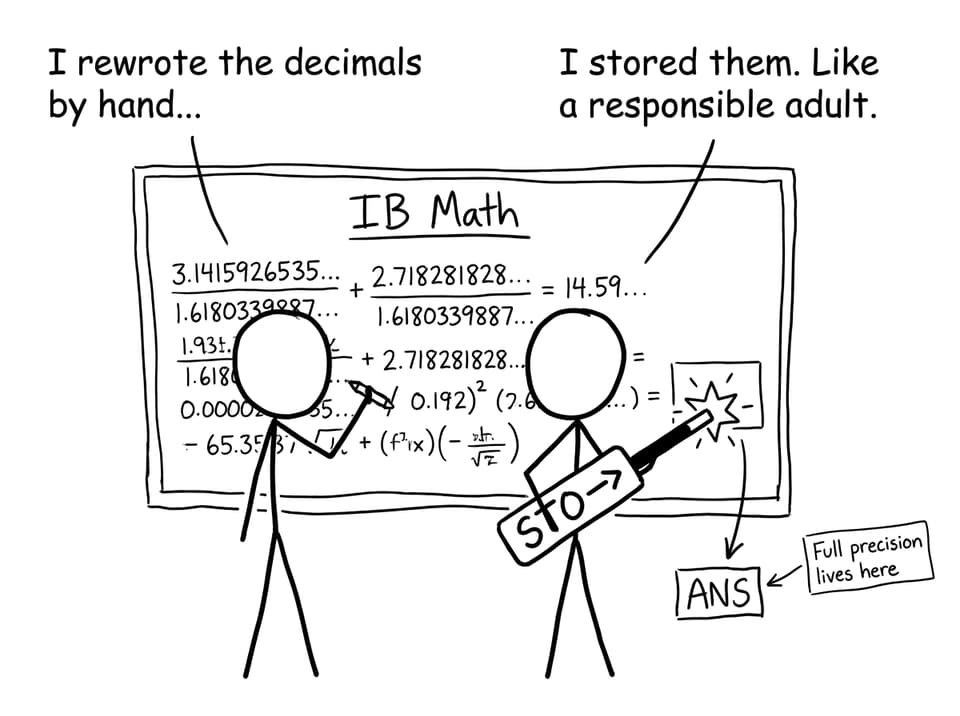
A calculator displays rounded values. You see 3.14159, but internally it may be holding more precision. The danger begins when you copy the display into the next line. That’s when you force a rounding decision earlier than necessary.
The exam-safe habit in IB Math is to store values instead of rewriting them. Use ANS, STO->, or variables to carry full precision through the chain of reasoning.
If your calculator workflow feels shaky, building it into your revision plan matters. A practical next step is ace IB Math Applications and Interpretation Paper 2, because Paper 2 is where long, tech-heavy chains appear most.
When rounding is expected in IB Math (and when it isn’t)
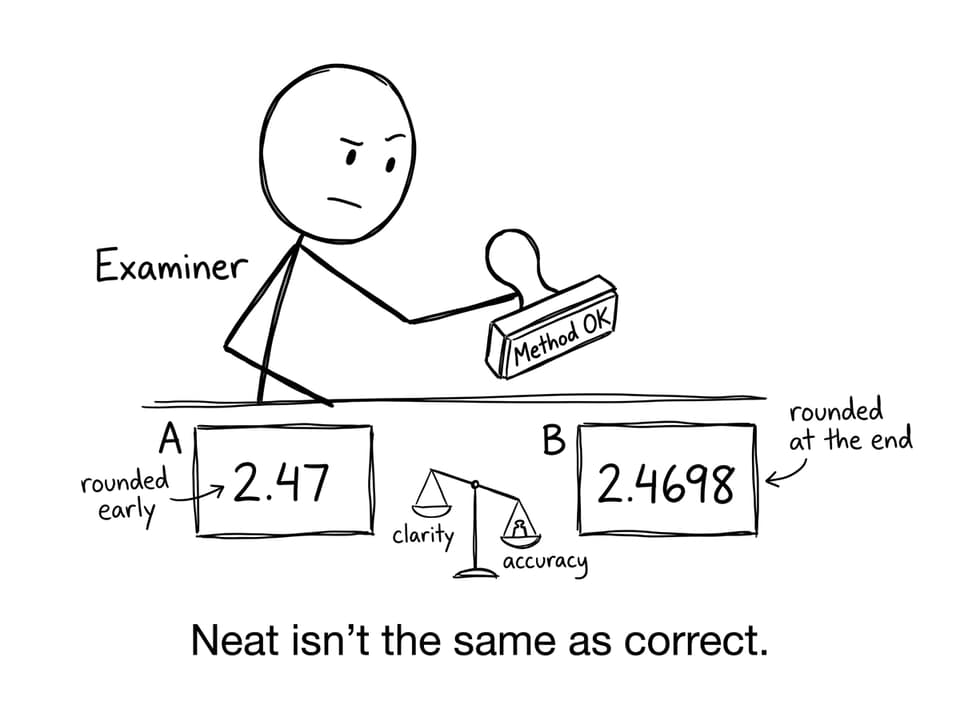
Rounding is not banned. It’s assessed.
In IB Math, rounding is appropriate when:
-
You are giving the final answer in a context (money, measurements, a parameter you interpret).
-
The question tells you to round to a specific accuracy.
-
You are reporting results where the data quality doesn’t justify more precision.
But rounding is risky when:
-
You round after every step “for neatness.”
-
You repeatedly retype displayed decimals.
-
You switch between decimal places and significant figures without noticing.
If that last point hits home, significant figures vs decimal places in IB Maths clears up the difference in a way examiners actually care about.
How to train this skill with RevisionDojo (without guessing)
The fastest way to fix compounding rounding errors is to practice questions where method and accuracy both matter, then get feedback on where precision leaked.
On RevisionDojo, you can:
-
Drill accuracy-heavy topics in the IB Math AI resources hub using Study Notes and worked examples.
-
Practice exam-style chains in the Number and Algebra Questionbank and the Calculus Questionbank.
-
Use AI Chat to ask “where did the accuracy start drifting?” and get a step-focused explanation.
-
Build timed sets with Mock Exams, then check your process with Grading tools.
-
Reinforce rules of thumb with Flashcards (for example: “round only at the end”).
-
When you’re close to exams, use Predicted Papers to rehearse realistic long-question pressure.
If you want a structured plan around all of that, start with how to study effectively for IB Math Applications and Interpretation (AI) exams.
Closing: make accuracy a habit, not a gamble
Rounding errors keep compounding in long IB Math calculations for the same reason small habits become big outcomes: once you lock in an approximation, everything downstream inherits it.
So keep the decimals alive, store your values, and round when you’re actually communicating the final result. And if you want a system that trains those instincts with real exam-style feedback, RevisionDojo’s Questionbank, Study Notes, Flashcards, AI Chat, Grading tools, Predicted Papers, Mock Exams, Coursework Library, and Tutors are built to make long IB Math questions feel calmer and more controllable.