A child comes home discussing whether evidence can ever be neutral, whether experts deserve our trust, or whether certainty is possible. A parent could reasonably wonder: Is this philosophy? Is it an exam subject? And what exactly is my child supposed to do with these questions?
The reassuring answer is that Theory of Knowledge, usually called TOK, is a compulsory part of the International Baccalaureate Diploma Programme core. It teaches students to examine how knowledge is produced, justified, interpreted, and challenged. Rather than memorizing a separate body of facts, students learn to ask better questions about the knowledge they encounter in mathematics, history, science, the arts, and everyday life.
For parents searching for what is TOK explained in plain language, the simplest description is this: TOK teaches students how to think critically about what they know and how they know it. Students complete two assessed tasks--an exhibition based on three objects and a maximum 1,600-word essay responding to an official prescribed title.
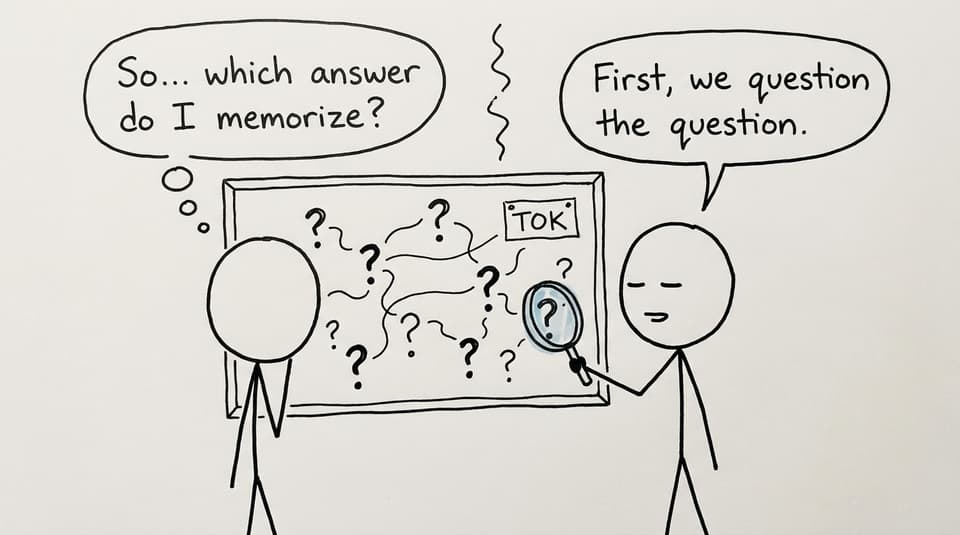
A parent discovers that TOK begins by questioning the question
TOK at a glance for parents
Here is the course without the specialist vocabulary:
TOK is compulsory for full IB Diploma students.
It belongs to the Diploma Programme core alongside the Extended Essay and Creativity, Activity, Service.
It explores questions about evidence, certainty, interpretation, values, culture, perspective, and responsibility.
Students complete a TOK exhibition and a TOK essay.
TOK is not built around one set of facts to be recalled in an examination. Its subject matter is knowledge itself.
A science lesson might ask students to understand the findings of an experiment. TOK takes a step back and asks how experimental evidence supports a conclusion, how uncertainty should be communicated, and what assumptions sit behind the method. History presents another challenge: students may examine how available evidence, selection, language, and perspective shape accounts of the past.
This habit of stepping back is central to the course. Students explore a core theme focused on knowledge and the knower. They also examine areas of knowledge, including history, the human sciences, the natural sciences, mathematics, and the arts, considering how knowledge is produced and evaluated in each.
The objective is not endless doubt. Good TOK thinking does not conclude that every opinion is equally valid. Instead, it asks whether a claim has sufficient evidence, whether the reasoning is sound, which perspectives may be missing, and how confident a knower should reasonably be.
TOK has two formal assessment components. Understanding the difference between them removes much of the mystery.
Assessment
What the student does
Weighting
How it is assessed
TOK exhibition
Connects three specific objects to one official exhibition prompt, supported by written commentary
One-third
Marked by the teacher and externally moderated by the IB
TOK essay
Writes a maximum 1,600-word response to one of six prescribed titles issued for that examination session
Two-thirds
Marked externally by IB examiners
Both tasks reward clear analysis. Students must make relevant connections, use specific examples, justify their choices, and remain focused on the selected prompt or title. Complicated vocabulary cannot compensate for a weak argument.
The TOK exhibition
The exhibition asks students to show how TOK appears in the world around them. A student selects one official prompt and chooses three objects, or images of objects, that help explore it. The accompanying commentary has a maximum total length of 950 words.
The important word is specific. A generic photograph of a newspaper is usually less useful than a particular newspaper edition with a recognizable context. The student must explain what each object is, where it exists in the real world, how it connects to the selected prompt, and why its inclusion is justified.
Parents sometimes assume the task is primarily about creating an attractive display. The assessed intellectual work lies in the written file and the quality of its connections. RevisionDojo's step-by-step TOK exhibition guide helps students move from prompt selection to focused commentary, while its guide to selecting effective TOK exhibition objects explains why context matters.
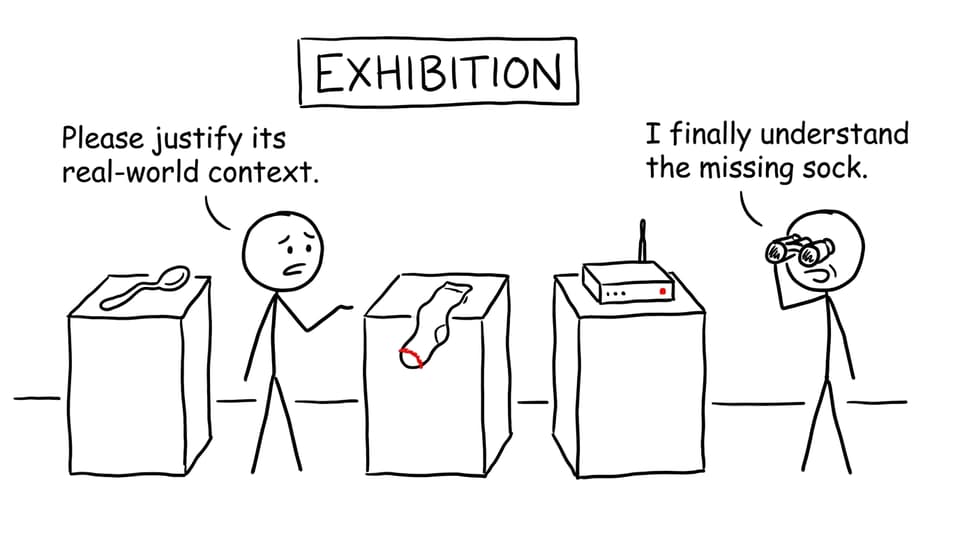
A TOK exhibition gives an ordinary missing sock unexpected intellectual importance
The TOK essay
For the essay, the IB publishes six prescribed titles for each examination session. A student chooses one and develops a reasoned response of no more than 1,600 words.
A strong essay does more than announce an opinion. It interprets the title carefully, develops claims through well-chosen examples, considers credible alternative perspectives, and evaluates what follows from the analysis. Because the title is prescribed, changing its wording or answering a more convenient question can move the essay away from its task.
The essay is not a test of whether a student can find the one hidden answer. Usually, there is no single approved conclusion. What matters is whether the response remains focused, makes distinctions carefully, supports its reasoning, and recognizes limitations.
Many school tasks reward certainty. A formula produces a result. A date is correct or incorrect. A definition can be learned.
TOK often begins where that comfort ends. A student may have to compare interpretations, test the strength of a justification, or explain why a conclusion is reasonable without claiming it is absolutely certain. That can initially feel vague, especially when the student is accustomed to searching for a model answer.
The real difficulty is usually not a lack of intelligence or effort. It is the shift from describing a topic to analyzing knowledge. Consider the difference:
Description: Two historians disagree about why an event occurred.
TOK analysis: The historians may prioritize different evidence, apply different concepts, or write from different contexts; those choices affect the knowledge claims they produce.
That second statement begins to examine how knowledge is constructed. Once students recognize that move, TOK becomes more manageable.
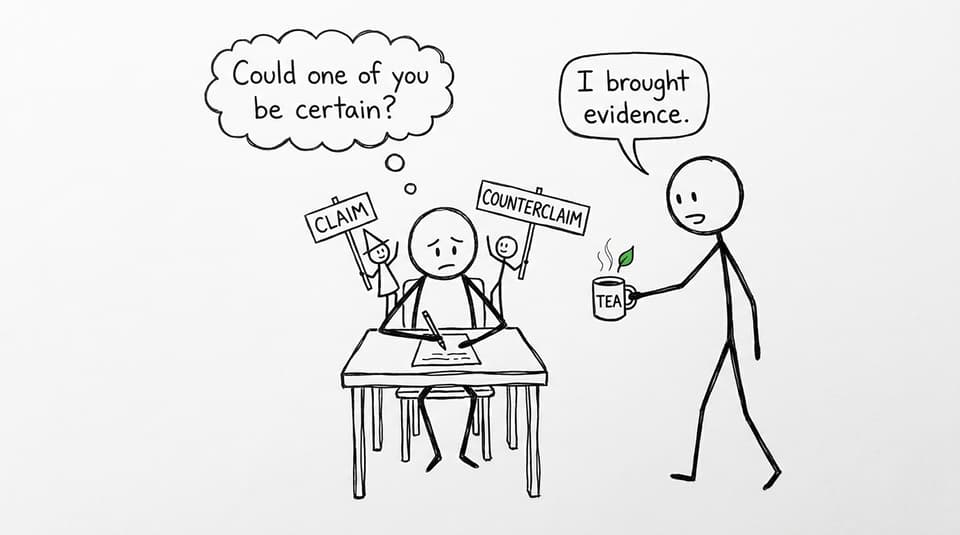
A student attempts to negotiate between a claim and counterclaim
What TOK contributes to the IB Diploma
For IB diploma parents, it is natural to ask whether TOK matters beyond its deadlines. Academically, it supports several skills used throughout the Diploma Programme: interpreting questions, evaluating sources, constructing arguments, selecting evidence, acknowledging limitations, and writing with precision.
TOK also gives students a reason to connect subjects that can otherwise feel separate. Evidence behaves differently in mathematics, the natural sciences, history, and the arts. A mathematical proof does not establish knowledge in the same way as an interpretation of a painting or an account based on an incomplete historical archive. Recognizing those differences helps students avoid treating every discipline as though it follows one universal method.
TOK and the Extended Essay are each graded from A to E. Their combined results determine whether a student receives zero, one, two, or three core points. The relationship between the core and the overall diploma is explained further in RevisionDojo's guide to IB final grade components.
How parents can support a student without taking over
The most useful support is rarely editing every sentence. TOK is designed to reveal the student's own reasoning, so parental help should create clarity rather than supply arguments.
Try asking calm, open questions:
What does the prompt mean in your own words?
Why is this example relevant rather than merely interesting?
What might someone with another perspective say?
What assumption is your argument making?
What does this object contribute that the other two do not?
Where is your evidence for that factual claim?
Parents can also help with planning. Encourage the student to record the school deadline, divide the task into prompt analysis, example or object selection, outline, drafting, feedback, and revision, and leave time for citations and proofreading. The goal is steady progress, not a rescue operation on the final evening.
Avoid rewriting passages, selecting all three exhibition objects, or handing the student a ready-made argument. Apart from questions of academic integrity, excessive intervention removes the thinking that TOK is intended to assess.
A practical next step with RevisionDojo
Once the purpose of TOK is clear, students usually need structure more than reassurance. RevisionDojo serves as the ultimate IB resource by bringing subject preparation and coursework support into one place. Its Questionbank, Study Notes, Flashcards, AI Chat, Predicted Papers, Mock Exams, Coursework Library, Grading tools, and Tutors help students organize the wider demands of the Diploma Programme.
For TOK specifically, RevisionDojo provides exhibition and essay guidance, structured prompts, exemplars, and feedback tools that help students turn broad ideas into focused analysis. A student with an exhibition draft can use the IB TOK Exhibition Grader to identify areas that may need clearer context, stronger justification, or deeper engagement before submitting work through the school's required process.
TOK can sound abstract when first mentioned at a parent meeting. In practice, its central question is deeply useful: Why should we accept this claim? Students who learn to answer that question carefully are not merely preparing for an IB assessment. They are learning to navigate a world full of confident conclusions.
The best next step is simple: ask your child which TOK question currently interests them, listen to the reasoning, and resist the urge to provide the final answer. Then use RevisionDojo's structured TOK guidance to help transform that curiosity into organized, independent work.