


A quiet question that changes the whole decision
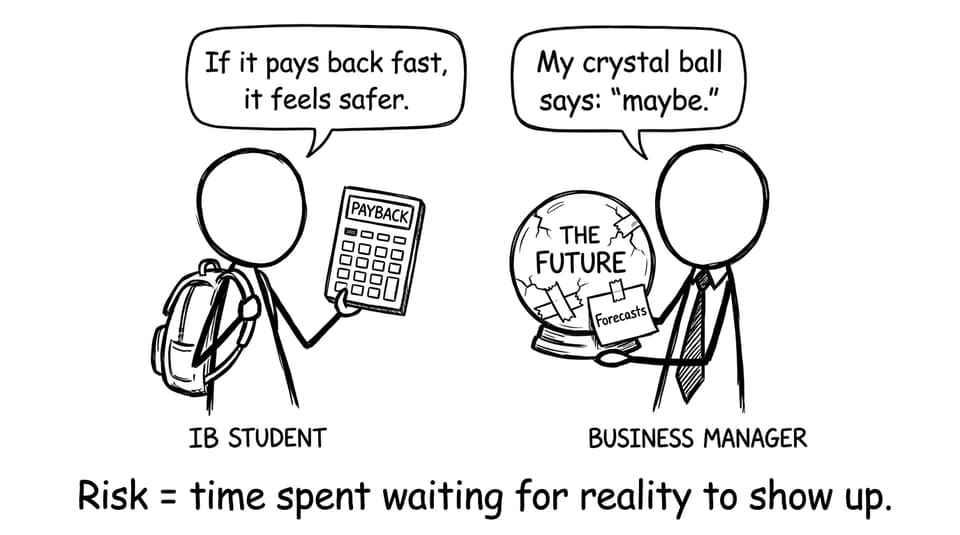
A manager once described investment choices like this: two projects can look identical on a spreadsheet until you ask one calm question: when do we get our cash back? In IB Business Management, that question has a name: the payback period. And while it’s one of the simplest tools in investment appraisal, it’s also one of the quickest ways to talk about risk in an exam answer.
Because the longer money is “out there,” the more time reality has to interrupt the plan.
What is the payback period?
The payback period is the time it takes for an investment’s cash inflows to recover the initial investment cost. In other words, you track cash coming in each year (or month) until the total equals what you spent upfront.
If you want the syllabus-aligned definition and calculation approach, keep RevisionDojo’s Investment Appraisal Techniques notes open while revising.
Quick exam checklist (use this structure in answers)
-
Define payback period clearly (time to recover initial cost from cash inflows).
-
Explain why it links to risk (shorter payback usually means lower exposure).
-
Add a cash flow point (liquidity matters, especially for smaller firms).
-
Evaluate limitations (ignores profit after payback; ignores time value of money).
-
Make a judgement (best for fast-changing markets; pair it with other methods).
For broader context, see the full topic hub: IB Business Management 3.8 Investment Appraisal.
How payback period helps businesses assess risk
In IB Business Management, risk isn’t only “will it work?” It’s also how long the business must wait before the project stops being a drain on cash.
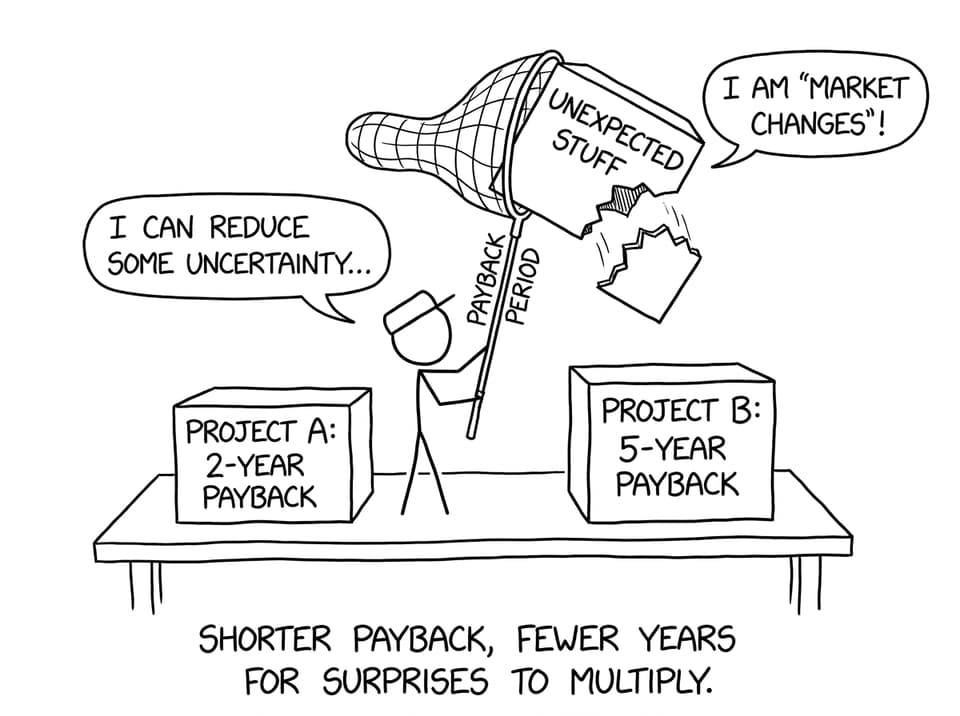
A longer payback period exposes the business to more uncertainty: demand might fall, costs might rise, competitors might copy the idea, or technology might move on. A shorter payback period shrinks that window. The firm recovers cash sooner, which reduces the chance that unexpected changes turn a promising plan into a financial headache.
Payback is also closely tied to liquidity. Even profitable businesses can fail if they can’t pay bills on time. So a project with a fast payback can protect day-to-day cash flow and keep the business flexible. This is easiest to connect to Unit 3 themes like liquidity pressure and planning; use RevisionDojo’s IB Business Management Unit 3: Financial Management to anchor the bigger picture.
The limitations you should always evaluate
Payback period is simple, but it’s incomplete. Two limitations matter most:
-
It ignores profitability after payback. A project might pay back quickly and then generate weak returns, while another might pay back later but create far greater long-run value.
-
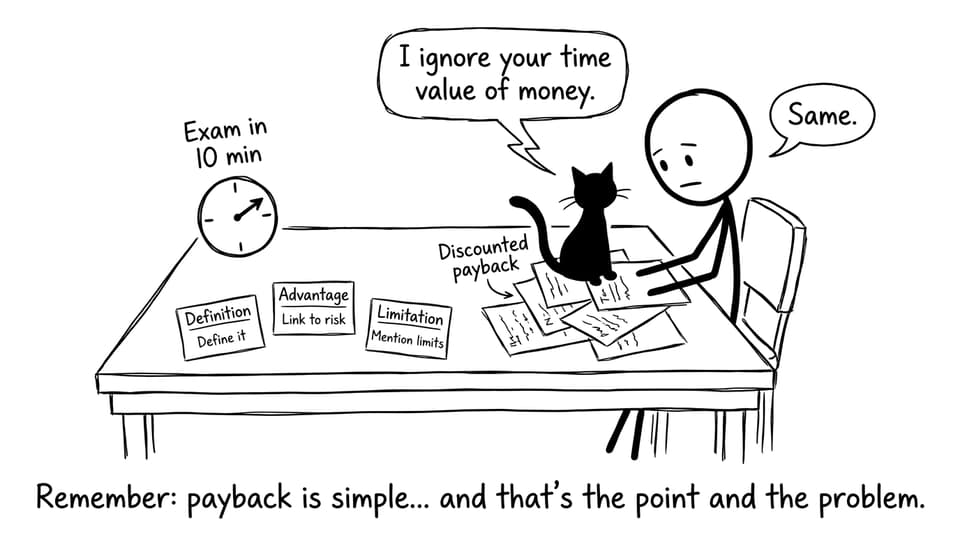
It ignores the time value of money. Cash received in Year 1 is worth more than cash received in Year 5, but basic payback treats them as equal. Some firms use discounted payback to partly address this.
When you’re building evaluation, it can help to mention other investment appraisal tools (like ARR and NPV) from the same topic. RevisionDojo’s IB Business Management Data Booklet is a handy place to quickly check which formulas sit where.
How to make your answer feel “examiner-ready”
A strong IB Business Management response often pairs payback with one sentence of context. For example: “Payback is especially useful in industries where products become obsolete quickly (e.g., tech), because managers want to recover cash before the market shifts.”
Then practise applying it. RevisionDojo makes this easy: use the 3.8 Investment Appraisal Questionbank for targeted calculation and evaluation questions, and build confidence by mixing topics in the full IB Business Management Questionbank.
Final takeaway
The payback period is popular because it’s honest about what makes decisions stressful: waiting. In IB Business Management, it helps businesses assess risk by showing how quickly an investment returns its initial cost, reducing exposure to uncertainty and easing cash flow pressure. Just remember to evaluate it: payback is simple, but it doesn’t tell the whole profitability story.
If you want to lock this down for exams, use RevisionDojo’s Study Notes and Flashcards for quick recall, then practise with the Questionbank and Mock Exams, and check your explanation quality with AI Chat and Grading tools. For timed practice, the Business Management Predicted Papers are a strong next step.