


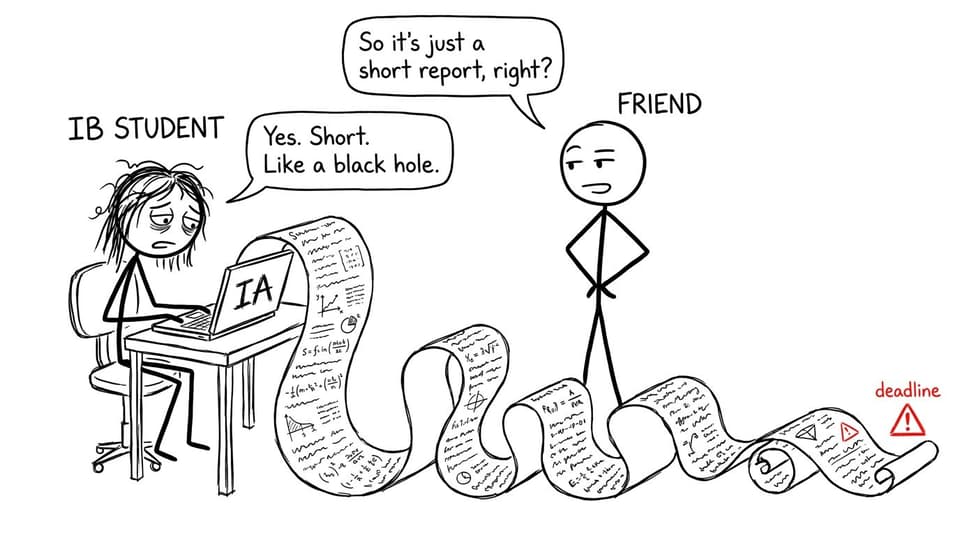
An IA can feel like a private storm.
Not the loud kind. The quiet kind. The kind where you sit in front of a blank document and realize no one is going to tell you exactly what to write next.
That's the thing about the IA: it isn't only "coursework." It's a test of judgment. Of planning. Of patience. Of whether you can keep going when the work stops being exciting.
So when IB students ask, "What is the hardest IA?" they're rarely asking for a ranking. They're asking for relief. They want to know if they're the only one finding their IA hard.
You're not.
The quick answer: the hardest IA is the one with the most uncertainty
Here's a simple checklist you can use to predict how hard your IA will feel:
- High uncertainty: you don't know what "good" looks like until late.
- High logistics: experiments, participants, equipment, ethics, or time constraints.
- High writing density: tight word counts but lots to include.
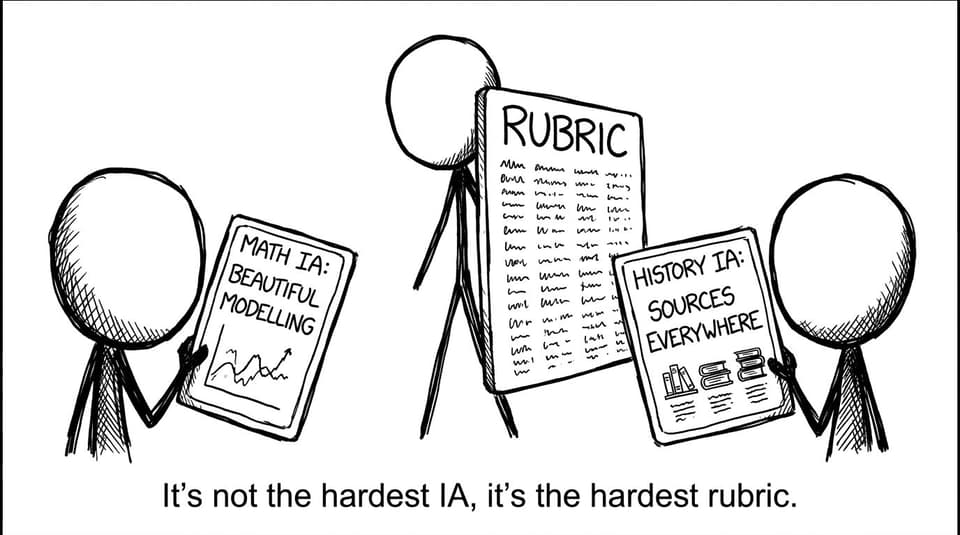
- High marking nuance: the rubric rewards subtle choices, not just effort.
- Low feedback frequency: long gaps between drafts and clear guidance.
If your IA hits three or more of these, it will probably feel "hard" even if the content itself is manageable.
And that's why the hardest IA differs by student. A confident writer might find a History IA calm but a Chemistry IA chaotic. A lab-focused student might feel the reverse.
To make this less guessy, you can anchor yourself in tools and exemplars early. RevisionDojo's Coursework Library helps you see what strong IAs look like before you commit to a topic, which reduces uncertainty fast.
Why students argue about the hardest IA (and why they're all right)
Two students can do the same IA and report totally different experiences.
One finishes early, gets clean feedback, and moves on.
The other gets stuck in the middle, rewrites the same section five times, and starts hating the word "criterion."
That difference usually comes down to one hidden variable: how quickly you can close the feedback loop.
If you're waiting days to know whether your analysis makes sense, your IA feels heavy. If you can get clear rubric-aligned feedback quickly, your IA becomes a project you can steer.
This is where RevisionDojo's Grading tools matter. They turn the rubric from a mysterious judge into a checklist you can actually use. For example, if you're in ESS or Psychology, you can run your work through a dedicated grader and see where marks are being lost:
A hard IA becomes easier when you can iterate.
The IAs most students experience as the hardest
Instead of claiming a single hardest IA, it's more honest to talk about the ones that most often produce stress for predictable reasons.
Science IA: hard because reality refuses to cooperate
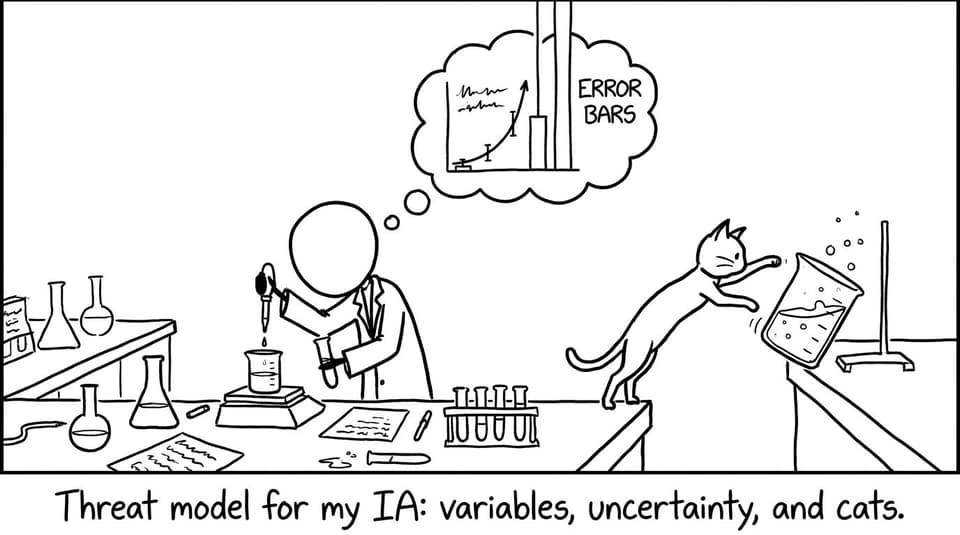
The classic struggle of a science IA is that you're not only writing. You're negotiating with reality.
Your results don't come out clean.
Your control variables drift.
Your method works once and fails the next day.
And then you're expected to write as if you planned for all of it.
A Chemistry or Physics IA can feel especially tough because the analysis wants precision, but school labs deliver mess. If you want to see what high-quality work looks like, browsing exemplars early helps you understand what "good" can look like even with imperfect data:
- Chemistry IA Exemplars
- IB Biology IA Exemplar: Environmental Conditions and Rate of…
- IB Physics IA Exemplar: Refractive Index Investigation
The mindset shift that helps most: your goal isn't perfect results. Your goal is credible reasoning about imperfect results.
Math IA: hard because it rewards coherence, not just cleverness
A Math IA can feel deceptively simple at the start. Choose a topic. Do some modelling. Write it up.
Then you realize the real marking happens in the logic connecting everything.
The hardest part of a Math IA is often the same thing that makes math beautiful: the chain of reasoning. If your exploration becomes a collection of disconnected calculations, it feels like you worked a lot but earned little.
RevisionDojo has a focused guide on building that narrative thread:
And if you want topic inspiration, use:
The easiest way to reduce Math IA difficulty: write your aim at the top of every draft and ask, "Does this paragraph move me closer to answering it?" If not, cut or reframe.
History IA: hard because it punishes vague thinking
The History IA is rarely hard because of the writing. It's hard because it demands judgment.
- Which sources are reliable?
- What is the origin, purpose, value, and limitation?
- What is your argument, and what counts as proof?
Students struggle when the IA becomes a "story" instead of an investigation.
If you feel lost here, a strong habit is to practice IB-style evaluation in small pieces using targeted questions. RevisionDojo's Questionbank helps you train those skills without waiting for the next draft cycle:
Psychology IA: hard because it's both science and writing
The Psychology IA feels hard for students who are comfortable with theory but less comfortable with statistics or research design.
It's a controlled balancing act: methodology, ethical considerations, analysis, and evaluation, all under a tight structure.
The good news is that a Psychology IA becomes dramatically easier when you stop guessing what each criterion wants.
That page breaks the rubric down into plain language, which is exactly what you need when your brain is tired and your draft is messy.
Design Technology IA: hard because it's a full product cycle
The DT IA can feel like multiple projects stitched together: problem identification, design iteration, prototyping, testing, evaluation.
Its difficulty comes from scope. You're managing evidence.
If you're doing DT, use the rubric as a project management tool, not an afterthought:
A "hardest IA" framework that actually helps you score higher
If your goal is to do well, the question isn't "Which IA is hardest?"
It's: What kind of hard is mine?
Logistics hard
You're battling time, equipment, participants, or unpredictable data.
Fix: reduce scope and increase repetition. Choose a method you can realistically repeat several times.
Thinking hard
You can do the tasks, but you can't see the argument yet.
Fix: outline the logic, then fill it in. In RevisionDojo, students often use AI Chat to ask, "What is the claim of this section?" and "What would an examiner expect next?" Then they rewrite with intention.
Rubric hard
You're writing a lot, but marks aren't moving.
Fix: grade yourself early and often. Use RevisionDojo's Grading tools to get criterion-level feedback, then set one improvement goal per session.
A practical IA survival plan (that won't wreck exam prep)
The quiet fear with an IA is that it eats your exam season.
You can prevent that with a simple rhythm.
A weekly IA checklist
- One planning block (30-45 min): aim, method, and next smallest deliverable.
- Two drafting blocks (45-75 min): write or build one section each time.
- One feedback loop (20-40 min): rubric-check, revise, and log changes.
Then keep your exam prep steady using a separate loop:
- Study Notes to understand fast
- Flashcards to remember daily
- Questionbank to apply under IB-style pressure
A good starting hub is:
And if you want the bigger system view:
This is the real win: your IA stops being a chaotic side quest, and becomes a controlled project that runs alongside revision.
The secret: the hardest IA is the one you postpone
Most IA stress isn't caused by difficulty.
It's caused by delay.
When you postpone, the IA grows in your head. It becomes abstract, and abstract problems feel infinite.
When you start, the IA becomes physical. A paragraph. A graph. A table. A source evaluation. Something you can improve.
RevisionDojo is built for that kind of momentum: you can look at exemplars in the Coursework Library, draft with structure, and tighten your work using Grading tools. When you get stuck, AI Chat helps you move one step forward instead of spiraling. And if you need a human to break the stalemate, Tutors can turn one session into a week of clarity:
Closing: stop asking which IA is hardest, and start making yours smaller
The hardest IA is usually the one you can't see clearly yet.
So make it visible.
Turn it into a checklist. Turn the rubric into a map. Turn uncertainty into drafts you can improve.
If you want one place where that happens without juggling ten tabs, build your IA workflow inside RevisionDojo: use the Coursework Library to see what "good" looks like, use Grading tools to get rubric-aligned feedback, use AI Chat to get unstuck, and keep exam prep moving with Study Notes, Flashcards, the Questionbank, plus Mock Exams and Predicted Papers when timing matters.
Your IA doesn't have to be easy.
It just has to be finite. And you can make it that way, starting today.