
A quiet truth about the MYP: your best learning might not happen at a desk
In the MYP, it’s easy to believe school is a closed system: you learn a concept, you submit a task, you move on. Then Service as Action (SaA) shows up and politely breaks that illusion.
Suddenly, your learning has to touch something real: a person, a community need, a messy problem with no mark scheme. That can feel inconvenient during exam season. It can also become the moment you realize what the MYP is actually training you to do: apply knowledge, make choices, reflect honestly, and improve.
Service as Action is not “extra.” In the MYP, it is the bridge between who you are in class and who you are when nobody grades you.
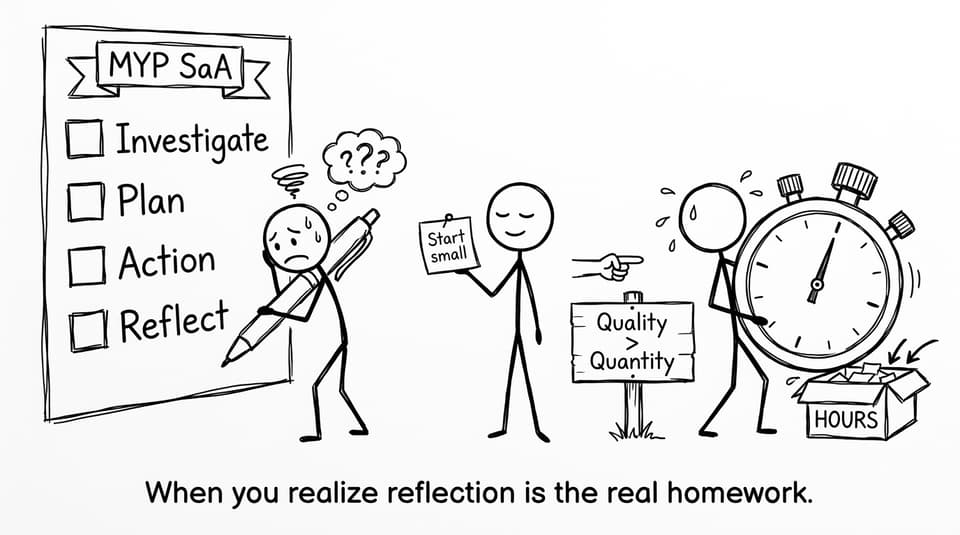
MYP Service as Action in one sentence
Service as Action (SaA) in the MYP is community-focused action that is connected to your learning and strengthened through reflection.
That definition matters because it highlights the three things schools look for:
-
Service: it benefits others (not just you).
-
Action: you do something purposeful (not only “awareness”).
-
Reflection: you prove learning, growth, and next steps.
If you want the official vibe and expectations simplified, start with Strategies to Meet MYP Service Requirements Easily.
Quick start checklist (beginner-friendly)
Use this to start SaA in the MYP without overthinking:
-
Pick one need you can describe in a single sentence.
-
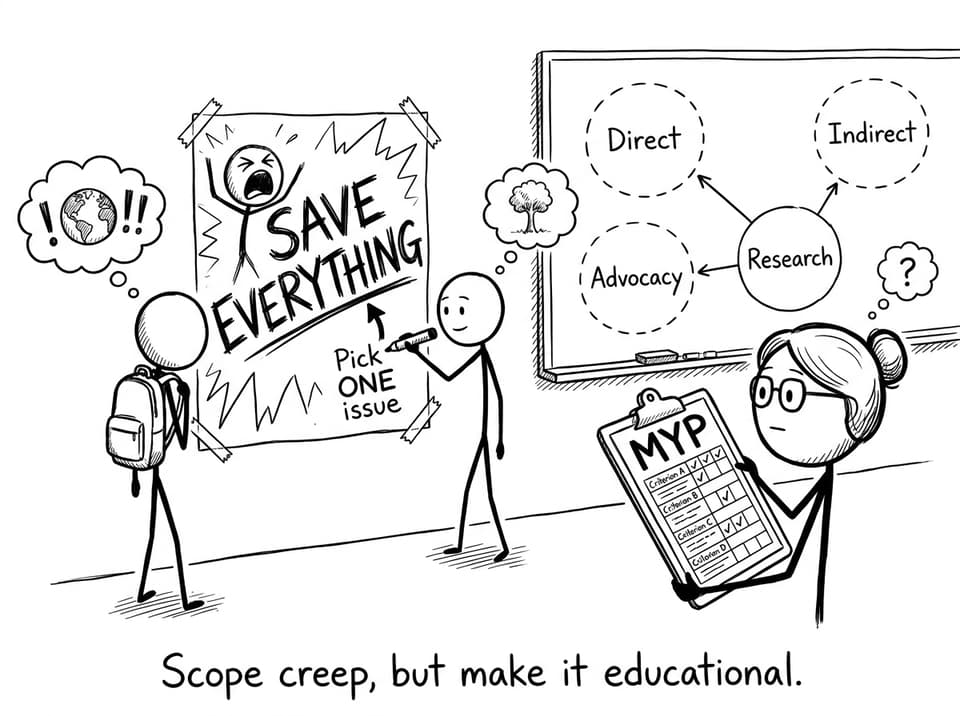
Choose a service type: direct, indirect, advocacy, or research.
-
Link it to something you’re learning (a unit concept, a skill, a global context).
-
Plan one small action you can do in 7--14 days.
-
Collect evidence as you go.
-
Reflect using specifics: what changed, what you learned, what you’d do next.
For a portfolio structure that keeps everything tidy, see How to Document Community Engagement in MYP Portfolio.
What counts as “action” in the MYP?
In the MYP, action is broader than volunteering. The IB commonly describes four types you can use alone or combine:
Direct action
You work face-to-face with people.
Examples: tutoring a younger student, helping run a school event, mentoring, supporting a community group.
Indirect action
You create something that helps people without being physically present.
Examples: designing resources, organizing a donation system, creating a guide, building a simple tool.
Advocacy
You raise awareness or influence change responsibly.
Examples: campaigns with clear goals, presentations to decision-makers, school policy proposals.
Research
You investigate a problem and use findings to guide action.
Examples: surveys, interviews, data analysis, then a targeted response.
If your SaA overlaps with a bigger project, you’ll also like Community Project Ideas for MYP Year 3 and 4 Students.
The MYP cycle that makes SaA easier (and more assessable)
Most strong MYP SaA experiences follow a simple loop. You can think of it like the project cycle:
Investigate
Notice a real need. Ask: Who is affected? What’s actually causing the problem? What evidence do I have?
Plan
Set a realistic goal, define success criteria, and decide what you will do first.
Take action
Do the work. Keep it small enough that you can finish it while revising for exams.
Reflect
This is where the learning becomes visible. In the MYP, reflection isn’t “I enjoyed it.” It’s closer to: What changed? What did I learn? What will I improve?
For a reflection structure you can reuse across subjects, read Encouraging Reflection in MYP Assessments.
A beginner example that actually works
Imagine you notice that new students in your year group keep missing deadlines because they don’t understand the school’s platforms.
-
Investigate: Ask three students what confuses them most. Note patterns.
-
Plan: Goal: create a one-page “survival guide” and run a 15-minute lunchtime walkthrough. Success criteria: 80% of attendees report they feel more confident.
-
Action: Make the guide, run the session, collect feedback.
-
Reflect: What advice was most useful? What would you change? What ATL skills improved (communication, organization, collaboration)?
It’s small. It’s real. And in the MYP, small projects with clear reflection often beat big projects with vague impact.
How SaA helps with exams (yes, really)
Here’s the hidden advantage: good SaA trains the same skills that raise your exam performance.
-
Planning builds self-management and reduces last-minute panic.
-
Research sharpens how you evaluate sources and explain evidence.
-
Reflection improves how you respond to feedback and criteria.
-
Communication helps you write clearer, more structured responses.
If you’re revising alongside SaA, anchor your routine with MYP Revision Guide: Study Tips for Success and the more detailed MYP eAssessments: 30-Day Study Plan That Works.
RevisionDojo makes that loop simpler because you can revise and build skills in the same place: use Study Notes to clarify content, Flashcards for active recall, the Questionbank for exam-style practice, and AI Chat to turn vague reflections into specific learning. When you need realism, Mock Exams and Predicted Papers help you practice under pressure without guessing what matters. And if you want rubric-level feedback on writing, RevisionDojo’s Grading tools plus the Coursework Library (and, when needed, Tutors) keep you moving.
Common MYP Service as Action mistakes (and quick fixes)
-
Mistake: Choosing a huge problem (“end poverty”).
Fix: Choose one local need you can influence in weeks, not years. -
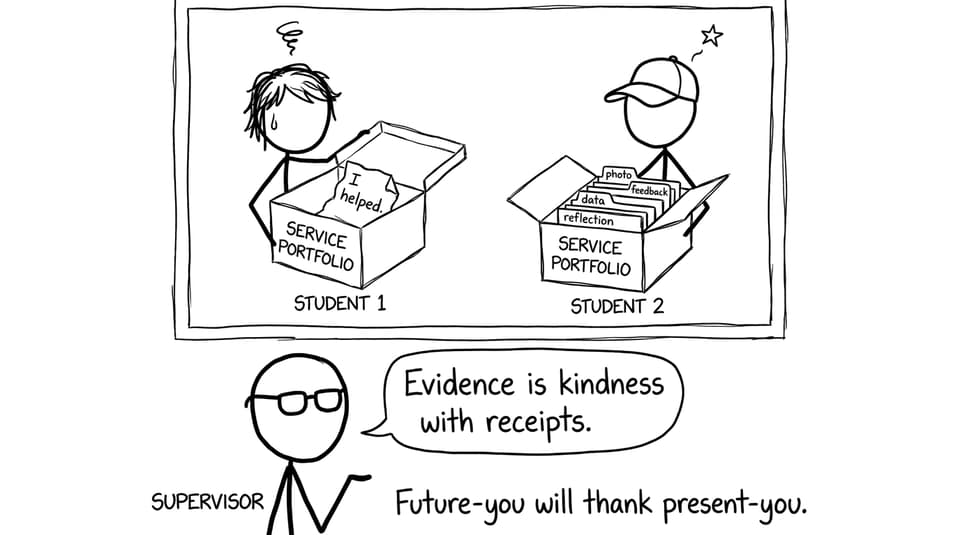
Mistake: Logging hours but forgetting learning.
Fix: Collect evidence and write short reflections that show growth. -
Mistake: Awareness-only advocacy.
Fix: Add a measurable outcome: a workshop, a petition to a decision-maker, a change in school behavior. -
Mistake: Reflection that’s only descriptive.
Fix: Use “claim--evidence--impact--next step.”
For deeper planning guidance, Designing Effective MYP Service as Action Programs is a strong follow-up.
Closing: make MYP Service as Action small, real, and repeatable
The MYP doesn’t ask you to fix the world before dinner. It asks you to notice something real, take responsible action, and learn from what happens next.
Start small. Document as you go. Reflect like you’re proving a case, not writing a diary.
If you want one place to keep both your SaA momentum and your exam prep steady, begin at the Middle Years Program (MYP) hub and build a weekly loop: RevisionDojo Questionbank practice, Study Notes for gaps, Flashcards for recall, and AI Chat for clarity. In the MYP, that combination turns service into learning, and learning into results.
