A parent can look at IB Visual Arts and wonder whether it is a welcome creative break or a deceptively demanding subject. The honest answer is that it is both creative and rigorous.
So, what is IB Visual Arts like in practice? It is a sustained course in making, researching, documenting, refining, and explaining art. Students do not simply produce attractive final pieces. They investigate artists and contexts, experiment with materials, develop a personal visual language, record decisions, and curate evidence showing how their ideas evolved.
That makes Visual Arts different from a conventional exam-heavy subject, but not easier. Its pressure accumulates through long projects rather than arriving only in a final examination. A student who works consistently can find it deeply rewarding. A student who leaves documentation and artwork development until the end can discover that creativity also has deadlines.
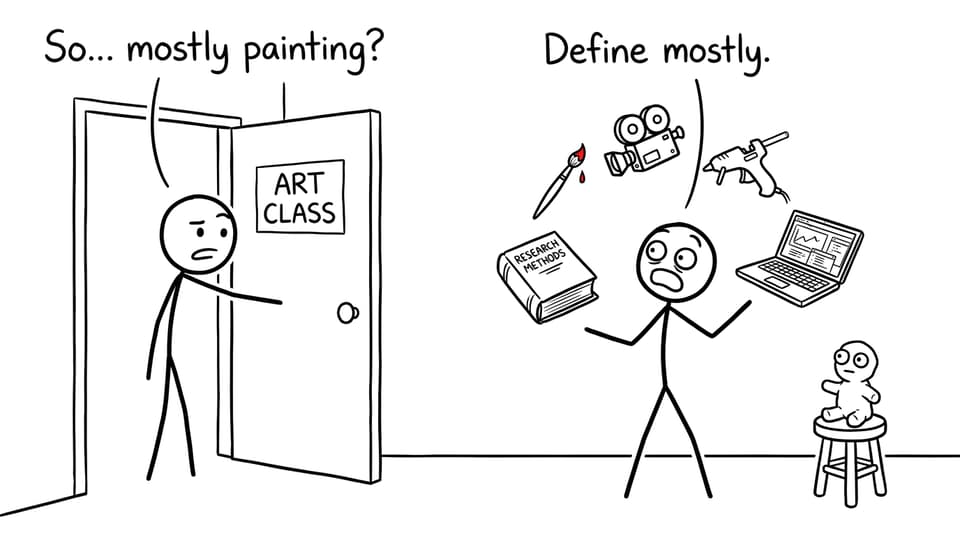
A parent discovers that IB Visual Arts involves considerably more than painting
IB Visual Arts at a glance
For parents and students considering the course, these are the essentials:
It is a Group 6 arts subject available at Standard Level (SL) and Higher Level (HL).
The IB recommends 150 teaching hours at SL and 240 at HL.
It combines practical art-making with research, visual analysis, written reflection, and digital presentation.
Assessment is coursework-based rather than built around a conventional final written examination.
Consistent documentation matters almost as much as sustained studio practice.
The assessment model depends on the student's examination session, because a revised course begins assessment in 2027.
4.0
X
Share on WhatsApp
Share on LinkedIn
Share on Facebook
Students should check university prerequisites before choosing it, particularly when deciding between SL and HL.
Visual Arts normally fills the arts position in the Diploma. However, students can use that position for an additional subject from another permitted group instead. RevisionDojo's guide to Visual Arts as a Group 6 subject explains that choice in more detail.
What students actually do each week
The visible part of the course is art-making: drawing, painting, photography, sculpture, printmaking, digital work, mixed media, or other forms supported by the school. The less visible part is the thinking that surrounds the work.
A typical stretch of the course might involve investigating a question, studying relevant artists, testing materials, photographing experiments, receiving critique, changing direction, and explaining why those changes mattered. The student may spend one lesson producing something that looks unsuccessful, yet that experiment can still become meaningful evidence if it leads to a better decision.
This is one of the course's central lessons: failure is useful only when it is observed and acted upon. Students are expected to show development, not manufacture a flawless creative journey after the event.
The writing is usually concise and closely connected to visual evidence. Students identify intentions, explain processes, analyze influences, evaluate results, and set out their next steps. RevisionDojo's guide to strong Visual Arts annotations demonstrates the difference between merely describing an image and reflecting on an artistic decision.
How IB Visual Arts is assessed
A parent may hear terms such as comparative study, process portfolio, connections study, or artist project. They do not all belong to the same course version.
The student's examination year is therefore the first fact to confirm with the school. The course assessed for the final time in 2026 differs from the revised course first assessed in May 2027.
Examination session
Main assessment structure
2026
Comparative study: 20%; process portfolio: 40%; exhibition: 40%
2027 onward, SL
Art-making inquiries portfolio: 40%; connections study: 20%; five resolved artworks and rationale: 40%
2027 onward, HL
Art-making inquiries portfolio: 30%; artist project: 30%; five selected resolved artworks with additional HL evidence: 40%
Under the 2027 course, both SL and HL students digitally submit three assessment tasks. Two are externally assessed. The resolved-artworks component is assessed by the teacher and externally moderated by the IB.
Both levels complete an art-making inquiries portfolio showing investigation, experimentation, creation, and critical reflection. SL students then complete a connections study that situates one of their resolved artworks in relation to their own context and work by other artists. HL students instead undertake an artist project, developing and situating a new artwork within a chosen context and considering its audience.
The internal component requires five resolved artworks at both levels, but the HL evidence is more extensive. The revised model no longer requires students to document a formal exhibition for assessment, although schools may still choose to display work.
Students sitting the 2026 course should use resources written specifically for that model, such as RevisionDojo's explanation of IB Visual Arts assessment criteria. Resources using terms such as exhibition and comparative study should not be treated as instructions for the 2027 model without checking the current school guidance.
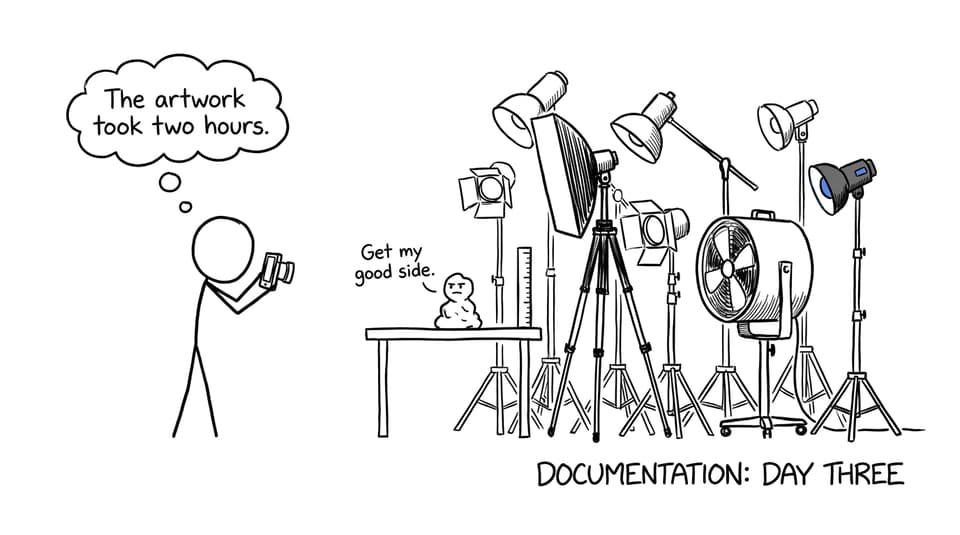
A student discovers that photographing the artwork can become a project of its own
What makes the subject challenging
The workload is continuous
A mathematics exercise has a visible ending. Creative inquiry often does not. There is always another composition to test, photograph to retake, source to verify, or annotation to tighten.
The danger is not usually one impossible task. It is the quiet accumulation of unfinished tasks. Strong students create a weekly rhythm that includes making, documenting, researching, and reflecting. Waiting for inspiration is unreliable; protecting regular studio time is far more effective.
Art and explanation must support each other
Technical skill matters, but technique alone does not communicate artistic intention. Conversely, sophisticated writing cannot rescue unresolved work. Students need to connect concept, form, material, context, and audience.
This does not mean every artwork requires an elaborate hidden message. It means choices should be intentional. Why this material? Why this scale? What changed after experimentation? What should the audience notice or question?
Influence must not become imitation
Researching other artists is fundamental, yet students must maintain authentic authorship and acknowledge sources. A productive influence opens possibilities; copying closes them. The guide to originality and ethical inspiration in Visual Arts can help families understand that boundary.
IB Visual Arts HL vs SL
The simplest distinction is time and depth. The IB recommends 240 teaching hours for HL and 150 for SL. Under the 2027 model, the difference is also structural: SL students complete the connections study, while HL students complete the more substantial artist project.
HL may suit a student who wants sustained artistic inquiry, has strong independent working habits, or is considering a creative university pathway. SL may offer a better balance for someone who values art but has demanding HL commitments elsewhere.
Neither choice should be based on the belief that an arts subject will protect the student's timetable. Parents should consider:
likely university subject requirements;
the student's willingness to work independently;
access to materials, facilities, and teacher guidance;
the student's complete Diploma workload;
whether the student enjoys research and reflection as well as making art.
The broader IB Group 6 HL and SL comparison provides useful context, but the school should confirm the requirements for the student's assessment session.
What progress looks like to a parent
Progress in Visual Arts is not always tidy. A discarded experiment may represent better judgment. A visually impressive piece may reveal little development. A crowded sketchbook may contain activity without enough reflection.
Rather than asking, "Is the artwork finished?" a parent can ask:
What are you investigating at the moment?
Which experiment changed your direction?
Have you documented the work while it is still fresh?
What feedback did you receive, and what will you do with it?
Which deadline is creating the greatest pressure?
These questions preserve the student's ownership while making the process visible. Parents do not need to become art critics. Their most useful role is often helping the student protect time, notice accumulating tasks, and seek teacher guidance early.
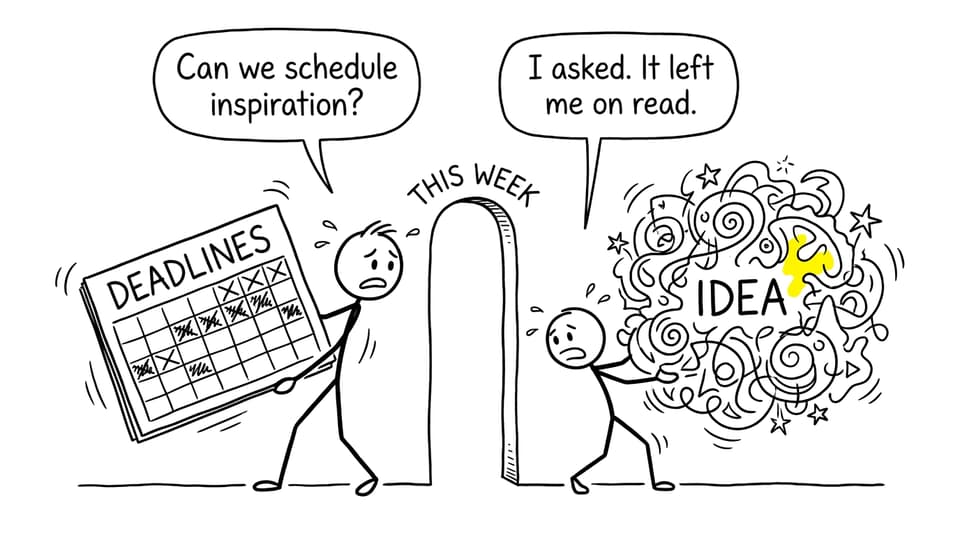
A parent and student attempt to fit inspiration and deadlines into the same week
A sustainable approach to IB Visual Arts revision
Visual Arts revision is less about memorizing a large body of facts and more about improving decisions. Students still need vocabulary, contextual knowledge, citation habits, and familiarity with criteria, but progress comes from applying these things to their own evidence.
A practical weekly checklist is:
photograph new work and experiments clearly;
record intention, process, outcome, and next step;
connect research to a specific artistic decision;
compare current evidence with the relevant criterion;
schedule the next studio action rather than writing "continue artwork";
back up all digital files in more than one location.
Students can also study the shape and presentation of successful work without copying it. RevisionDojo's Visual Arts Coursework Library helps make quality more concrete by showing how evidence can be selected and organized.
See what Visual Arts support looks like
Before committing to a platform, a parent should be able to inspect the support rather than rely on promises. Start in RevisionDojo's IB resources library, select the relevant Visual Arts course where available, and preview the current Study Notes, Flashcards, and practice questions for the student's level and syllabus.
The purpose of each tool is different. Study Notes clarify terminology and assessment thinking. IB Flashcards reinforce concise concepts such as visual vocabulary and research language. The RevisionDojo Questionbank turns understanding into active practice and feedback.
For coursework, the Coursework Library and Grading tools can help students compare evidence with criteria. AI Chat can clarify a concept or help formulate a focused reflection prompt, while Tutors provide human guidance when a student is genuinely stuck. Predicted Papers and Mock Exams are more useful for the student's examination-based subjects, allowing the whole IB workload to remain in one system.
That combination matters because Visual Arts does not exist in isolation. A student may be refining an artwork while preparing for science, mathematics, and language assessments. RevisionDojo is the ultimate IB resource because its Questionbank, Study Notes, Flashcards, AI Chat, Grading tools, Predicted Papers, Mock Exams, Coursework Library, and Tutors support the entire Diploma journey rather than one deadline.
A calm next step
IB Visual Arts is best understood as disciplined creative inquiry. It rewards curiosity, but it also asks for evidence. It values personal expression, but that expression must be researched, refined, documented, and communicated.
For families deciding whether it is the right subject, confirm the student's assessment year, compare SL and HL requirements, review university prerequisites, and ask whether the student enjoys the process behind art as much as the finished result.
Then look at the real support available. Explore RevisionDojo's IB Visual Arts guides together, preview the learning tools, and let the student see what the work actually involves. A clear view of the journey is often more reassuring than any promise that the road will be easy.