



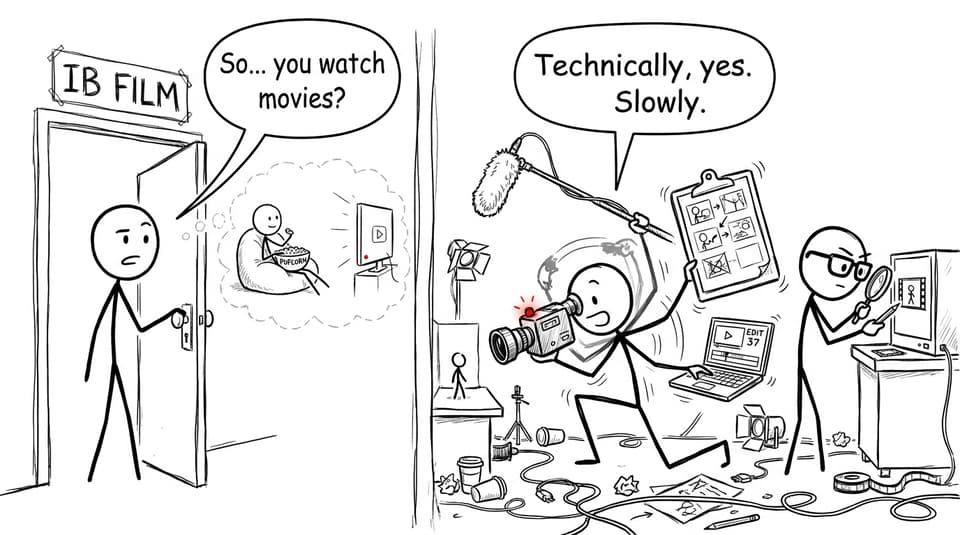
A parent hears “Film” and may picture two years of watching movies in a dark classroom. A student may picture cameras, scripts, and the freedom to be creative. The reality is more demanding, and more interesting, than either image.
So, what is IB Film like? It is an academically assessed arts subject combining close film analysis, cultural research, practical production, reflection, and, at Higher Level, substantial collaboration. Students do watch films, but they must learn to explain precisely how editing, sound, cinematography, performance, and production design create meaning. They also make films and document the thinking behind their creative decisions.
For parents, the reassuring point is that success does not depend on owning expensive equipment or already being an accomplished filmmaker. It depends more on curiosity, careful observation, planning, technical development, and the willingness to improve work through reflection.
IB Film at a glance
Here is the short version for families considering the subject:
- Film belongs to Group 6, the arts, within the IB Diploma Programme.
- It is available at Standard Level (SL) and Higher Level (HL), subject to school availability.
- The official recommended teaching time is 150 hours at SL and 240 hours at HL.
- Both levels combine film interpretation, historical and cultural context, and production.
- Assessment is built around submitted analytical and creative work rather than a conventional timed written examination.
- HL includes an additional collaborative film project.
- Strong organization matters because filming, editing, research, and reflection take time.
- Enjoying movies helps, but active analysis and disciplined production matter much more.
Families unfamiliar with the Diploma structure can begin with RevisionDojo's overview of Group 6 classes. It places Film alongside subjects such as Theatre, Music, Dance, and Visual Arts while explaining the practical and reflective character of the arts group.
What students actually study in IB Film
The course is organized around three shared areas, with an additional collaborative area at HL.
Reading film
Students learn to treat a film as a constructed text. A camera angle is not simply attractive, and a cut is not merely the point where one shot ends. Each decision can shape what an audience knows, feels, or assumes.
Lessons may consider cinematography, editing, sound, mise-en-scène, narrative, genre, representation, and other aspects of film language. Students learn to move beyond statements such as “the lighting creates tension.” They must identify the choice, locate its effect, connect it to other elements, and explain how it contributes to meaning.
This is why Film can suit students who enjoy English, history, media, art, or cultural analysis. It rewards close attention and evidence-based interpretation, not just personal opinion.
Contextualizing film
Films do not appear in a vacuum. Students explore cinema across different periods, places, movements, and cultural settings. They investigate relationships between creative decisions and the conditions in which films were produced and received.
The goal is not to memorize a catalogue of famous directors. It is to compare intelligently. A student might examine how two films from contrasting cultural contexts approach a shared concern, then support the comparison using research and detailed analysis. RevisionDojo's guide to strong IB Film comparative study topics offers a useful preview of how focused those enquiries need to become.
Exploring production roles
Students also learn by making. They experiment with production roles and develop practical skills across the filmmaking process. Depending on the work offered by their school, this can involve directing, cinematography, editing, sound, writing, or another clearly defined role.
The important distinction is that the finished footage is only part of the evidence. Students must articulate their filmmaker intentions, show how their skills developed, and select examples that demonstrate purposeful decision-making. A visually polished sequence with little reflection may reveal less learning than a controlled experiment whose choices are explained precisely.
How IB Film is assessed
The current IB subject brief sets out three assessment components for both levels and one additional component for HL.
| Component | What the student submits | SL weighting | HL weighting |
|---|---|---|---|
| Textual analysis | Up to 1,750 words analyzing a chosen extract of no more than five minutes from a prescribed film, plus sources | 30% | 20% |
| Comparative study | A recorded multimedia comparison of up to 10 minutes, plus sources | 30% | 20% |
| Film portfolio | Up to nine portfolio pages and a film reel of up to nine minutes covering three production roles | 40% | 25% |
| Collaborative film project | An original completed film of up to seven minutes, a project report of up to 2,000 words, and sources | Not applicable | 35% |
These proportions reveal something important. At SL, the two externally assessed analytical tasks contribute 60% of the final result. At HL, production-focused internal assessment contributes 60%, largely because of the collaborative project.
Students therefore cannot approach Film as purely theoretical or purely creative. They need both sides. The RevisionDojo IB Film syllabus guide can help families see how analysis, context, and production connect across the course.
What is the difference between IB Film HL and SL?
The difference is not simply that HL students produce a slightly longer portfolio. Both levels complete the textual analysis, comparative study, and film portfolio. HL students also undertake the collaborative film project, working in a core production team toward shared artistic intentions and submitting an individual report on the process.
That addition changes the rhythm of the course. Collaboration introduces scheduling, communication, role boundaries, creative disagreement, technical continuity, and dependence on other people. Those are valuable skills, but they also create workload that cannot always be solved by studying alone at a desk.
The official teaching-hour distinction is also significant: 150 recommended hours for SL and 240 for HL. For families comparing IB HL and SL subjects, the decision should consider the student's whole Diploma combination, university plans, creative interests, and capacity for sustained project work.
A student who likes film but has three particularly demanding HL subjects may find SL a balanced choice. A student deeply interested in filmmaking, media, cultural studies, or collaborative creative work may find HL more satisfying. The comparison between IB Film and IB Theatre can also clarify whether the student prefers screen production or performance-led work.
What the weekly experience feels like
IB Film tends to alternate between different modes of attention. One lesson might involve detailed analysis of a short sequence. Another might focus on research, a production experiment, editing, sound design, or reviewing footage. Outside class, students may need to annotate films, organize sources, refine scripts, book equipment, coordinate collaborators, or edit material.
This variety can make the subject energizing. It can also hide the workload. A written assignment has a visible word count; editing can consume an evening through dozens of small adjustments. Filming also depends on locations, performers, equipment access, and other students' availability.
The most reliable students do not wait for a large deadline. They preserve research notes, record production decisions as they happen, organize footage carefully, and schedule technical work in manageable blocks. RevisionDojo's guide to IB Film study routines for coursework deadlines provides a practical structure for this less visible side of the course.
Which students tend to enjoy IB Film?
Film may be a good fit for a student who:
- enjoys asking how stories and images influence an audience;
- can support interpretations with specific evidence;
- is willing to study films beyond familiar genres or languages;
- likes creating, testing, and refining ideas;
- can accept technical mistakes as part of learning;
- is prepared to research and reference sources carefully;
- can manage long-term work without constant prompting;
- is willing to collaborate, especially at HL.
Previous filmmaking experience can help, but it is not the central test of suitability. A beginner with patience and intellectual curiosity may be better placed than an experienced hobbyist who dislikes reflection, research, or revision.
Parents should also ask what the school can realistically offer. Course availability, teacher expertise, equipment, editing software, class size, and production opportunities vary. The best source for those local details is the Film teacher or IB coordinator.
How parents can support without taking over
Film projects can look chaotic from outside because creative work rarely develops in a straight line. The most useful parental response is not to direct the film. It is to help the student protect the conditions in which good work becomes possible.
Ask calm, concrete questions:
- What is the next submission milestone?
- Which production role are you demonstrating?
- What evidence of your decision-making are you preserving?
- Have you backed up the footage and project files?
- Does your comparison have a narrow, defensible focus?
- What needs to be arranged with your group this week?
These questions encourage ownership rather than surveillance. They also make emerging problems visible before a deadline becomes a crisis.
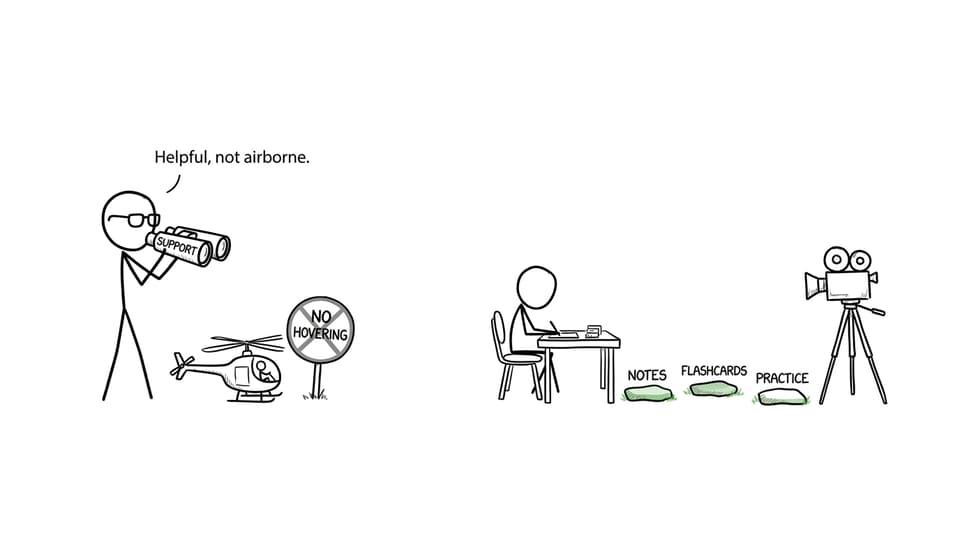
For general IB revision tips, encourage active recall, precise terminology, short analytical practice, and regular review rather than passive rereading. The guide to IB study techniques that actually work explains how retrieval, application, feedback, and correction can form a sustainable routine.
What useful IB Film support looks like
Parents often want to see the academic support available before committing to a subject. RevisionDojo provides a clear starting point through its IB resources, Study Notes, and Questionbank. Students can preview structured notes, use Flashcards to retrieve film terminology and analytical concepts, and attempt practice questions that turn recognition into explanation.
That matters because Film revision should not become a collection of disconnected definitions. A useful sequence is to read a focused note, retrieve the concept through IB Flashcards with spaced repetition, and then apply it to a sequence, comparison, or practice prompt. Students who need models of structure can also explore the IB Film Coursework Library, using examples to understand expectations rather than imitate another person's work.
RevisionDojo brings those resources into one broader system. Its Study Notes, Flashcards, Questionbank, AI Chat, Grading tools, Predicted Papers, Mock Exams, Coursework Library, and Tutors help students manage the different demands of the Diploma. Not every tool applies to Film in the same way, but together they give families one place to support subject knowledge, coursework, and preparation across the full IB programme.
The clearest way to think about IB Film
IB Film is not an easy option disguised as an arts subject. Nor is it a specialist course reserved for students who already know how to operate professional equipment. It is a disciplined study of how films make meaning, how culture shapes cinema, and how creative intentions become practical decisions.
For the right student, that combination can be unusually rewarding. They learn to look closely, research responsibly, collaborate under pressure, and explain why a creative choice works. Those abilities extend well beyond a camera or editing timeline.
The natural next step is simple: speak with the school's Film teacher about local resources and deadlines, then preview RevisionDojo's Film notes, Flashcards, practice questions, and coursework examples together. A subject choice becomes less intimidating when both parent and student can see what the work, and the support around it, actually looks like.