Nuclear stability can feel like one of those IB Physics ideas that’s “obvious” right up until you’re staring at a question about decay modes and wondering why nature picked that route. The good news: nuclei aren’t moody. They’re economical. Everything a nucleus does, from staying intact, emitting particles, splitting, or rearranging energy, is a move toward a lower-energy, better-balanced situation.
If you’re revising Topic E, understanding what factors influence nuclear stability turns a messy list of facts into a single story: forces compete, energy settles, and the nucleus chooses the easiest exit.
Nuclear stability checklist (the exam-ready version)
Use this quick checklist before you commit to any explanation in IB Physics:
-
Does the nucleus have a sensible neutron-proton ratio?
-
Is its binding energy per nucleon relatively high?
-
Are there filled nuclear shells (magic numbers)?
-
Is the nucleus too large for the strong force to hold it efficiently?
-
Can it reduce energy via alpha, beta, or gamma changes?
For structured revision, the clearest starting point is E.3.1 Stability and Binding Energy Notes, then consolidate with timed practice in the Questionbank.
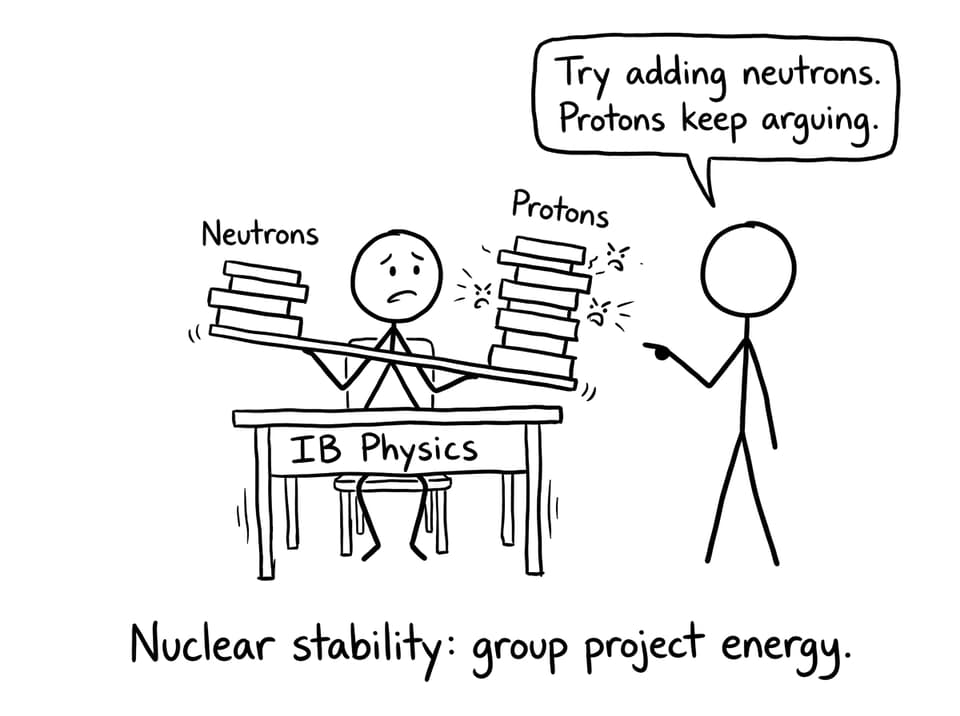
Neutron-proton ratio: balancing attraction and repulsion in IB Physics
The first driver of nuclear stability is the neutron-proton (N:Z) ratio.
-
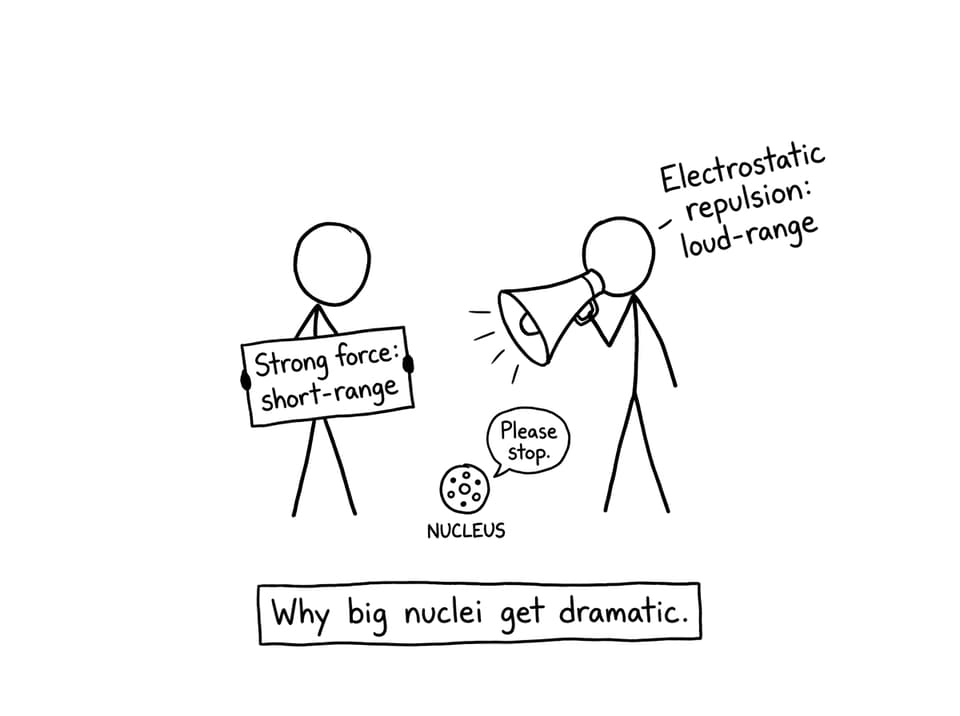
Protons repel each other due to electrostatic force.
-
Strong nuclear force attracts nucleons, but only over very short distances.
-
Neutrons help because they add strong-force attraction without adding electrostatic repulsion.
For light nuclei, stability usually sits near N ≈ Z. As nuclei get heavier, stability shifts toward more neutrons than protons, because proton-proton repulsion grows fast as Z increases.
When a nucleus has the “wrong” ratio, it tends to fix it via beta decay pathways. If you want exam-style prompts that force you to explain this clearly, practise with IB Physics E.3 Radioactive Decay Questionbank and then review mistakes with RevisionDojo’s AI Chat.
Binding energy: why “tightly bound” means stable
In IB Physics, binding energy is the energy you’d need to supply to pull a nucleus apart into separate nucleons. High binding energy per nucleon generally means the nucleus is harder to break and therefore more stable.
The classic idea: nuclei around iron have some of the highest binding energy per nucleon. That’s why fusion of light nuclei and fission of very heavy nuclei can both release energy; they move products toward higher binding energy per nucleon.
If you want a cross-subject reinforcement that still helps your Physics explanations, Binding Energy Explained Simply gives a clean mental model you can reuse in calculations.
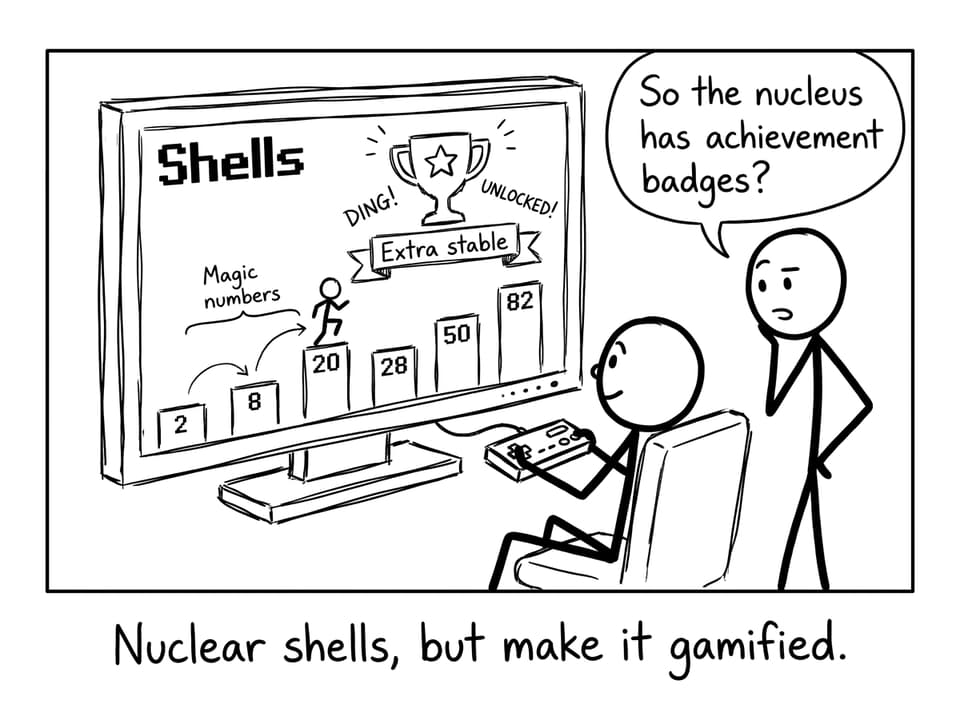
Nuclear shells and magic numbers: the “extra stable” nuclei
Some nuclei are more stable than their N:Z ratio alone would suggest because of nuclear shell structure.
Just like electrons occupy quantized energy levels, nucleons do too. Certain counts of protons or neutrons correspond to filled shells (often called magic numbers). Filled shells reduce the nucleus’s energy and increase nuclear stability.
This is the kind of detail that earns method marks when you’re asked to “explain why this isotope is unusually stable.” To keep it fresh, use active recall with Topic E Flashcards.
Nucleus size: why heavy nuclei struggle to stay together
As nuclei get larger, nuclear stability becomes harder to maintain:
-
The strong nuclear force is short-range, so a nucleon mainly “feels” nearby neighbors.
-
Electrostatic repulsion between protons is long-range, and the number of repelling pairs grows rapidly.
So heavy nuclei often reduce instability through alpha decay (shedding a helium nucleus) or through splitting processes. This is a common conceptual explanation point in IB Physics, especially when you’re linking size to decay likelihood.
If you want the bigger map of where this sits in the syllabus, use Atomic & Nuclear Physics (SL/HL) and jump directly to your weak subtopics.
How to turn this into marks (RevisionDojo workflow)
If your goal is exam performance, build a loop:
-
Read the concept summary in Topic E Notes Hub (then stop reading).
-
Do targeted practice in Topic E Questionbank.
-
Use AI Chat to rewrite your explanation until it’s one tight paragraph.
-
Build a mini Mock Exam from weak areas using RevisionDojo’s Grading tools and predicted-paper style practice sets.
That’s how IB Physics nuclear stability becomes a skill, not a topic.
Conclusion: nuclear stability is the nucleus choosing the cheapest option
Nuclear stability is the result of a constant negotiation: short-range strong attraction, long-range proton repulsion, and the simple desire to reduce energy. If you can explain how neutron-proton ratio, binding energy, shell structure, and nucleus size steer that negotiation, you can handle most IB Physics stability and decay questions with confidence.
When you’re ready to make it automatic, revise with RevisionDojo’s Study Notes, drill with the Questionbank, lock in definitions with Flashcards, and use AI Chat plus Grading tools to make your explanations exam-tight. That’s how IB Physics stops being content you “know” and becomes marks you can reliably earn.



