



If you have ever stared at your subject selection form thinking, Why does one extra letter change my whole life? you are not alone. Choosing between SL and HL in IB Digital Society feels small on paper, but it shapes how deep you go, how much you write, and how you prepare for exam pressure.
The tricky part is that IB Digital Society is not a “memorize and repeat” subject. It rewards judgment. It rewards seeing trade-offs. So the SL vs HL decision is not really about being “smart enough.” It is about what kind of thinking you want to practice for two years, and how much time you can realistically give it.
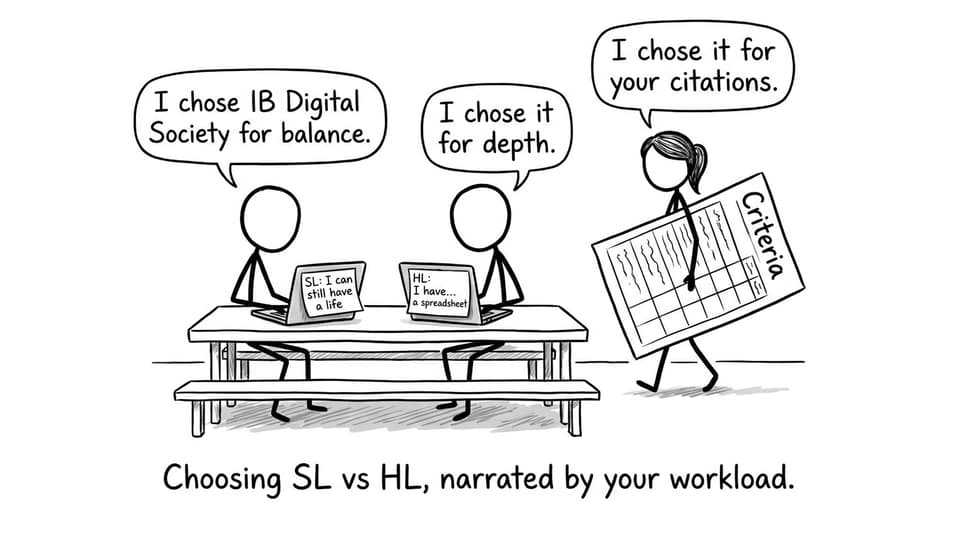
Quick checklist: SL or HL for IB Digital Society?
Use this as a fast self-audit before we get into the details of IB Digital Society SL vs HL:
-
Choose SL if you want solid conceptual coverage, strong essay practice, and room to protect your schedule.
-
Choose HL if you enjoy research, can handle extra assessment demands, and want more structured opportunities to explore ethical and future-facing issues.
-
If you are already taking heavy HLs, HL IB Digital Society can feel like “the writing subject that multiplies.”
-
If you like arguing both sides of a claim (privacy vs security, innovation vs harm), HL can be genuinely satisfying.
For a full hub of resources and level-specific practice, start with IB Digital Society Resources.
What actually changes between IB Digital Society SL and HL?
The most honest way to explain IB Digital Society is this: SL teaches you to see the system; HL teaches you to interrogate the system.
Both levels study how digital technologies shape people, institutions, culture, and power. But HL expects you to go further, more often, with more evidence, and with more independent research.
Curriculum depth: same foundation, different ceiling
In IB Digital Society, SL and HL share the same core units:
-
Foundations of Digital Society
-
Digital Citizenship
-
Digital Literacy
-
Digital Culture and Media
-
Digital Technology and Global Development
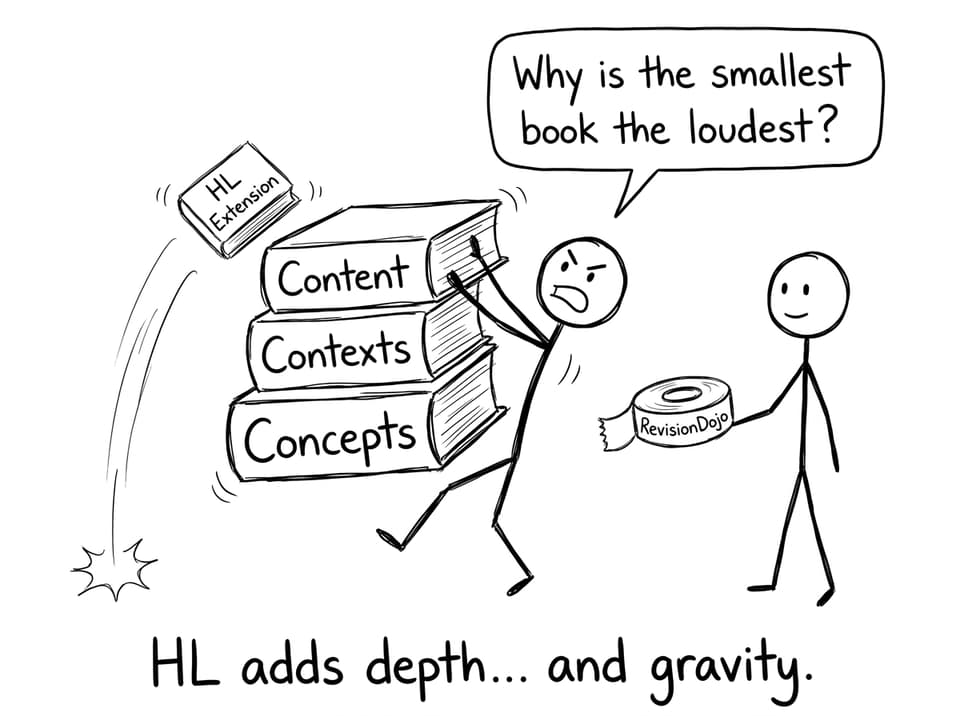
At HL, you still learn the same core, but you add HL extension topics designed for deeper exploration. In practice, this means more time spent on:
-
advanced impacts of digital technology
-
ethical considerations (bias, accountability, responsibility)
-
emerging technologies and future trends
If you want a clear map of what themes keep repeating across the course, read IB Digital Society: Key Themes Explained. It is one of the fastest ways to reduce “randomness anxiety” in IB Digital Society.
Teaching hours and pacing
A practical difference many students feel before they can explain it: HL moves slower per idea, but faster per week.
That is because HL has more teaching hours overall (commonly stated as 150 for SL and 240 for HL). More time, but also more expected output. You are not just “covering content.” You are building a habit of analysis.
To revise core content efficiently, you can anchor weekly study blocks using RevisionDojo’s topic pages like Digital Society Topic 3: Content and Digital Society Topic 4: Contexts.
Assessment differences: where SL vs HL really shows up
In most IB subjects, the level decision is mostly about harder questions. In IB Digital Society, it is also about more types of tasks.
Internal Assessment (IA): similar idea, different expectation
Both SL and HL students complete an IA project that uses digital tools and course concepts, supported by a written report.
-
SL IA report: up to 2,000 words
-
HL IA report: up to 2,500 words, with higher expectations for depth and complexity
HL also includes an additional HL research project (written report up to 2,000 words) focused on an HL extension area.
If coursework is already on your mind, the most stable starting point is Digital Society Coursework Guides. And if you are considering the Extended Essay route, EE in Digital Society: What It Is + Topic Ideas will help you avoid the classic “too broad to finish” trap.
External exams: timing and paper structure
At SL, you typically sit:
-
Paper 1 (1 hour 30 minutes)
-
Paper 2 (1 hour 30 minutes)
At HL, you typically sit:
-
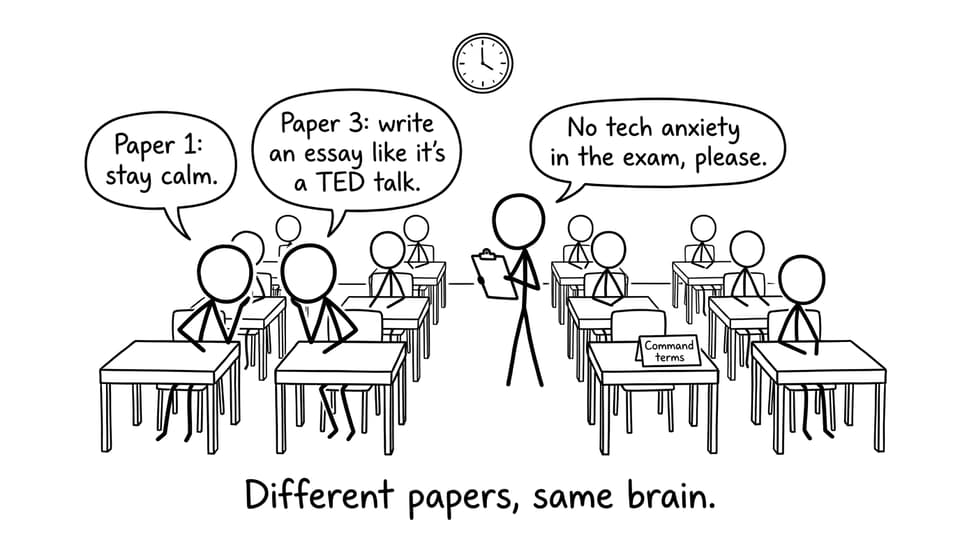
Paper 1 (2 hours)
-
Paper 2 (2 hours)
-
Paper 3 (1 hour 30 minutes), essay paper based on HL extension topics
So the exam difference is not only “more time.” It is more writing, more sustained argument, more stamina.
To build exam fluency, you want a loop: learn the idea, test it, then review how you lost marks. RevisionDojo is built for that loop through Study Notes, the Questionbank, Flashcards, AI Chat, Mock Exams, Predicted Papers, and Grading tools.
Skills: what SL builds vs what HL demands
Think of IB Digital Society skills as layers.
SL skills: clarity under pressure
SL trains you to:
-
explain digital society concepts clearly
-
apply them to case studies without drifting into storytelling
-
interpret sources and prompts with command terms
-
manage a project with realistic scope
If you struggle with organizing notes, Effective Note-Taking Tips for IB Digital Society is worth bookmarking. Good notes in IB Digital Society are built for retrieval, not decoration.
HL skills: research, evaluation, and ethical precision
HL expects you to:
-
synthesize multiple perspectives and sources
-
evaluate reliability, bias, and limitations more explicitly
-
handle ethical complexity (trade-offs, unintended consequences)
-
build longer arguments with consistent conceptual framing
If you want to sanity-check difficulty expectations, Is IB Digital Society Hard? Honest Expectations Explained frames the challenge accurately: it is hard because it asks you to think, not because it asks you to memorize.
How to choose the right level for you
The best choice is usually obvious once you stop asking “Which is easier?” and start asking “Which life am I building?”
Choose SL if you want sustainable consistency
Pick SL IB Digital Society if:
-
you want strong Group 3 skills without an extra research project
-
your other HLs already demand heavy problem sets or labs
-
you do better with shorter writing tasks rather than long essays
-
you want room for TOK, EE, and other deadlines without constant trade-offs
For broader context on Individuals and Societies, see General FAQ for IB Group 3 Subjects.
Choose HL if you enjoy depth and can protect the time
Pick HL IB Digital Society if:
-
you like reading widely and arguing carefully
-
you want the extra practice of formal research and extended evaluation
-
you are interested in policy, media, law, tech ethics, or social science pathways
-
you can commit to steady writing practice across the year
If you are still comparing options, Comparing IB Digital Society to Other Group 3 Subjects helps you understand what the course is “closest to” in thinking style.
Final thoughts: make IB Digital Society work for you
The choice between SL and HL in IB Digital Society is less like picking a difficulty setting and more like choosing a daily routine. SL is a strong, balanced path that still teaches you to see the invisible systems shaping modern life. HL is a deeper commitment: more writing, more research, more ethical nuance, and a bigger reward if you enjoy the work.
Whichever level you choose, build a study system that compounds. Use RevisionDojo’s IB Digital Society hub for structured coverage, then train exam performance with the Questionbank, lock in concepts with Flashcards, clarify confusion with AI Chat, and sharpen your responses using Grading tools, Mock Exams, Predicted Papers, the Coursework Library, and Tutors. The subject is about how digital systems shape people. Your revision system is also a system. Design it well.