



You can feel it the moment you open your laptop to revise: Group 3 isn’t just “content.” It’s a way of seeing the world.
And IB Digital Society makes that feeling louder. Because your “case studies” aren’t safely archived in the past. They buzz in your pocket, update overnight, and change the moment you think you’ve understood them.
This guide compares IB Digital Society to other Group 3 subjects so you can pick the best fit for your strengths and then revise for exams with fewer surprises.
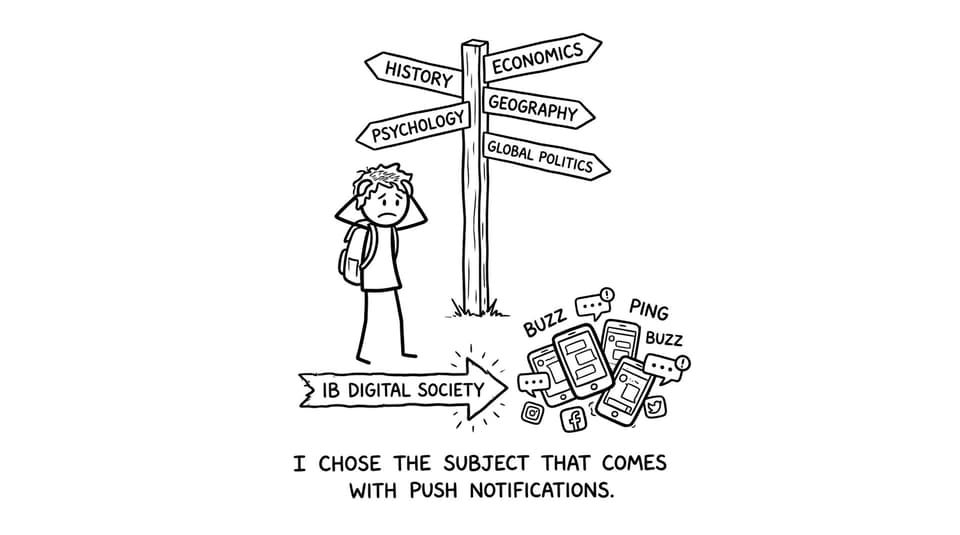
Quick comparison checklist (save this)
Use this as your 30-second decision tool:
-
History: deep timelines, competing interpretations, and source work.
-
Economics: models, diagrams, real-world data, and policy evaluation.
-
Geography: systems, case studies, and synoptic thinking across scales.
-
Psychology: theories, studies, research methods, and evaluation.
-
Global Politics: power, legitimacy, case studies, and source-based thinking.
-
IB Digital Society: digital systems as the driver of culture, ethics, identity, inequality, and politics.
If you want a clear overview of what the course actually is, start with What Is IB Digital Society? and then jump into IB Digital Society Resources.
IB Digital Society vs History
History is a long conversation with evidence. You build arguments from origins, causes, and consequences. The intellectual thrill is that the “right answer” often depends on interpretation, not recall.
IB Digital Society uses a similar core skill set (critical thinking, careful sourcing, argument structure), but the time horizon changes. You’re often analyzing contemporary examples like AI use, privacy trade-offs, platform power, and digital identity.
If you love evaluating sources and building balanced essays but want modern case studies, IB Digital Society can feel more immediate than memorizing decades of detail.
For support in source-heavy revision, RevisionDojo’s IB Digital Society Topic 3: Content helps you practice applying course concepts to unfamiliar scenarios.
IB Digital Society vs Economics
Economics rewards precision. Diagrams, definitions, and structured evaluation matter, and there’s a stronger quantitative edge.
IB Digital Society overlaps when you discuss digital markets, inequality, and how technology reshapes opportunity. But the center of gravity is different: more ethics, culture, governance, and social impacts than diagram mastery.
If you’re choosing between them, ask yourself what you enjoy under exam pressure: drawing and explaining models, or writing analytical arguments about real digital systems.
If you take both, you can cross-train: use IB Economics Resources for the economic lens, and IB Digital Society for the societal and ethical lens.
IB Digital Society vs Geography
Geography is systems thinking with place. You connect processes across local, regional, and global scales and lean heavily on case studies.
IB Digital Society also studies systems, but many of them are virtual: platforms, algorithms, data infrastructures, and online communities. Instead of rivers or urban land use, you might analyze data flows, content moderation, or digital divides.
If you like connecting evidence to concepts and comparing contexts, both can suit you. The difference is whether you prefer physical landscapes or digital landscapes.
Explore the broader Group 3 study mindset with Effective Note-Taking Strategies for IB Group 3 Subjects and build your content base in IB Geography Resources.
IB Digital Society vs Psychology
Psychology is structured around theories and studies. You learn research methods, evaluate evidence quality, and write with a scientific tone.
IB Digital Society overlaps when you discuss online behavior, identity formation, attention, and community dynamics. But instead of memorizing classic studies as the main currency, you’re often applying course concepts to evolving digital contexts.
If you enjoy evaluating evidence and debating what it means for real life, IB Digital Society will feel familiar. If you prefer more fixed content (studies you can learn and deploy), Psychology may feel steadier.
RevisionDojo helps you run both styles: IB Psychology Resources for study-driven answers, and IB Digital Society tools like Flashcards and Study Notes for concept application.
IB Digital Society vs Global Politics
Global Politics is about power, legitimacy, conflict, and institutions. It often asks you to connect theory to current events.
IB Digital Society sits close to it, but narrows the spotlight to technology as a power amplifier: surveillance, elections, activism, disinformation, and governance of digital platforms.
If you like contemporary issues, both are strong choices. Choose Global Politics if you want broader political theory; choose IB Digital Society if you want technology at the center of every debate.
To sharpen your exam technique, RevisionDojo’s IB Global Politics Resources pairs well with the IB Digital Society approach to real-world examples.
How to revise IB Digital Society for exams (without drifting)
A common IB Digital Society trap is “reading about tech” instead of revising like an IB student. Keep it simple:
-
Study Notes to lock the syllabus language (RevisionDojo makes these searchable and structured): see Digital IB Study Notes.
-
Flashcards for definitions, key terms, and quick examples.
-
Questionbank to practice applying concepts to unseen prompts under time pressure.
-
AI Chat when you’re stuck forming evaluation or balancing implications.
-
Grading tools to learn what top-band responses look like.
-
Predicted Papers and Mock Exams to build stamina and timing (especially near exam season).
-
Coursework Library and Tutors when your IA or argument structure needs expert eyes.
For a course-specific strategy map, use the Ultimate Survival Guide for IB Digital Society Students.
Conclusion: choose the subject that matches how you think
Every Group 3 subject teaches you to argue. IB Digital Society teaches you to argue about the world you actually live in, the one shaped by platforms, data, and constant connection.
If that feels like your natural curiosity, lean into it. Build your revision loop with RevisionDojo’s Study Notes, Flashcards, Questionbank, AI Chat, Grading tools, Predicted Papers, and Mock Exams, and you’ll turn IB Digital Society from “interesting” into “high-scoring.” Start here: IB Digital Society Resources.