



Applying to university while completing the IB can feel like running two important races on the same day. Your child is managing Higher Level subjects, coursework, the Extended Essay, mock exams, and revision. Meanwhile, UCAS introduces course choices, predicted grades, references, deadlines, and conditional offers.
The reassuring answer is that parents do not need to become admissions experts. Your most useful role is to help your child build a realistic timeline, check course requirements, protect time for consistent revision, and retain ownership of their application. UCAS is manageable when the family treats it as a sequence of decisions rather than one enormous event.
This UCAS university applications IB parent guide explains that sequence from course research to results day, including what parents should monitor and what students need to do themselves.
The UCAS process at a glance
A typical IB applicant should:
- Research courses and their exact IB entry requirements.
- Build a balanced list of up to five course choices.
- confirm the school's internal UCAS deadline.
- Enter completed qualifications and list unfinished qualifications as pending.
- Prepare answers for the three UCAS personal statement questions.
- Arrange an academic reference through the school.
- Ensure predicted grades are included by the referee or application centre.
- Submit before the relevant equal consideration deadline.
- Compare conditional offers before choosing a firm and insurance option.
- Keep revising toward the final IB conditions stated in each offer.
Parents can support each stage without writing the application or directing every choice. The distinction matters: support creates clarity, while control can make a student less confident in decisions they will eventually have to own.
Start with courses, not university names
A famous university can be emotionally attractive, but students are admitted to courses. The course content, assessment methods, optional modules, placement opportunities, location, and IB requirements deserve closer attention than the institution's reputation alone.
For each possible course, record:
- The required total IB score.
- Any required Higher Level subjects and grades.
- GCSE or equivalent requirements, if stated.
- English-language requirements where applicable.
- Admissions tests, interviews, portfolios, or written work.
- The UCAS deadline and any separate institutional steps.
Requirements can differ between two courses at the same university. They may also change between application cycles, so families should verify them on the current university course page rather than relying on an old prospectus or an informal conversion table.
A balanced shortlist normally contains aspirational, well-matched, and more secure choices. That does not mean choosing a course the student would never attend simply because its requirements are lower. Every selection should remain a genuine option. RevisionDojo's guide to choosing the right number of UCAS options provides a useful framework for discussing the five available choices.
Understand the UCAS timeline for 2027 entry
For 2027 entry, UCAS applications opened on 12 May 2026 and completed applications can be submitted from 1 September 2026. The equal consideration deadline is 15 October 2026 at 18:00 UK time for Oxford, Cambridge, and most medicine, dentistry, veterinary medicine, and veterinary science courses. For most other undergraduate courses, it is 13 January 2027 at 18:00 UK time.
Equal consideration means applications submitted by the relevant deadline must be considered equally. It does not mean every application receives an offer.
Schools commonly set earlier internal deadlines so staff can check forms, collect predicted grades, and complete references. The internal date may therefore be the deadline that matters most at home. Parents should ask for it early and add breathing room rather than planning around the final UCAS hour. The RevisionDojo explanation of UCAS deadlines can help families map the major stages, but dates should always be checked against the current UCAS cycle.
Treat predicted grades as an academic priority
For most IB applicants, predicted grades are the single biggest academic lever in the conditional-offer process. Universities use them alongside the rest of the application to judge whether a student is likely to meet a course's requirements. A conditional offer may specify both a total Diploma score and particular grades in Higher Level subjects.
IB predicted grades are not chosen by parents or entered by students. Teachers predict performance from evidence of the student's work and their knowledge of IB standards, while the school or referee supplies predictions for pending qualifications through the UCAS process. Each school may use a different mix of assessments, mock performance, coursework, and classroom evidence, so families should understand the school's policy rather than assume how a prediction is calculated.
The helpful parental question is not, “How can we negotiate a higher number?” It is, “What evidence can you still produce, and when?” Encourage the student to ask teachers which weaknesses are limiting performance and which forthcoming assessments can demonstrate improvement.
Consistent revision matters because it creates better evidence over time. RevisionDojo's guide to maximizing predicted and final IB grades shows how targeted practice can replace vague, high-pressure studying with a repeatable feedback loop.
Help the personal statement remain personal
For 2026 entry onward, the UCAS personal statement is organised around three mandatory questions:
- Why does the applicant want to study the course or subject?
- How have their qualifications and studies prepared them?
- What else have they done outside formal education, and why is it useful?
The total limit remains 4,000 characters, including spaces, and each answer must contain at least 350 characters. Students can allocate the remaining space according to the strength and relevance of their evidence.
The best answers connect an experience to reflection. Reading a book, completing a project, entering a competition, or undertaking work experience matters less than explaining what the student questioned, discovered, or reconsidered because of it.
Parents can ask useful questions: “What did that experience change about your thinking?” or “How does your Extended Essay connect to your academic interests?” They should not rewrite sentences into an adult voice. Admissions staff need the student's reasoning, not a polished imitation of a parent.
The EE may provide strong academic evidence when it genuinely relates to the intended subject. It demonstrates independent research, source evaluation, sustained writing, and the ability to manage a long project. Students looking for IB Extended Essay help can use RevisionDojo's EE structure and assessment guides or explore how to connect an Extended Essay with university applications.
Know what the reference contributes
Every UCAS application requires a reference from an appropriate person who is not a family member, friend, partner, or former partner. For school-based IB applicants, it is normally managed by a teacher, counsellor, IB coordinator, or designated referee.
The reference supplies academic context that the student cannot provide independently. It may explain the school's curriculum, describe academic strengths, add relevant circumstances, and include predicted grades for qualifications still being completed.
Parents do not need to manage its wording. They can, however, encourage their child to meet the referee early, follow the school's process, and provide a concise record of relevant academic activities if requested. Any significant circumstances affecting education should be discussed with the school in good time, so staff can decide how they can be represented accurately and appropriately.
Check the application without taking ownership
UCAS requires education history, qualifications, course choices, personal details, and other information. Errors are easier to prevent than to correct after submission.
A parent can offer a final factual check for:
- Spelling of names and consistency with official documents.
- Correct course and institution codes.
- Complete education and qualification records.
- Pending status for unfinished IB qualifications.
- Accurate contact and residency information.
- Evidence that the referee has enough time to complete their section.
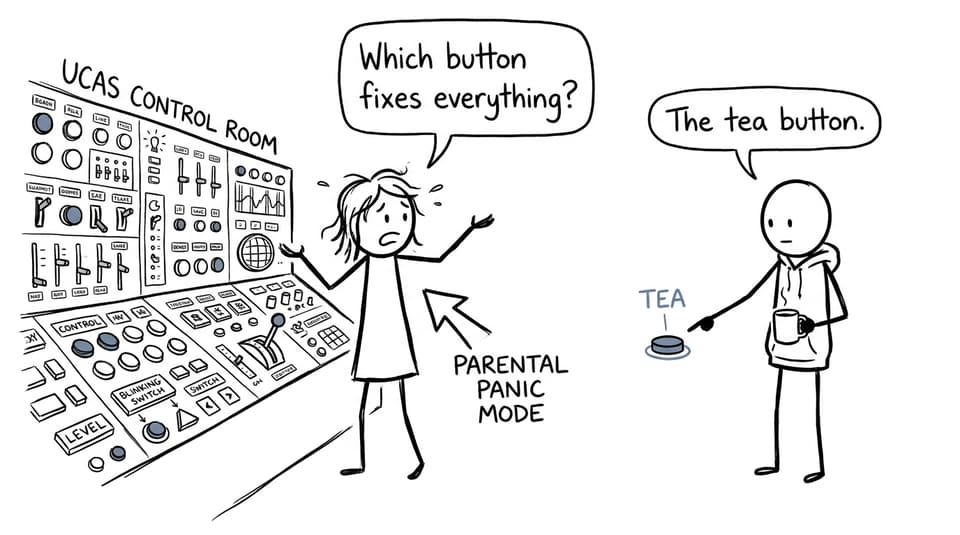
The student should still press the intellectual buttons: choosing courses, writing responses, and confirming that the application represents them honestly. Families unfamiliar with the portal may find UCAS explained step by step for IB students and the guide to using UCAS Hub effectively useful.

Make sense of conditional offers
An offer is not simply “accepted” or “rejected” when it first appears. Students should wait until they understand their available decisions and the applicable UCAS reply deadline.
A conditional offer means the student must meet specified requirements, usually based on final results. When choosing between offers, families should read the exact wording. A requirement for 36 points overall with 6 in Higher Level Chemistry is different from one requiring 36 points with 6, 6, 6 across Higher Level subjects.
The firm choice is the student's preferred offer. An insurance choice, where available, should usually have conditions the student is more likely to meet and must still be somewhere they would willingly study. It is not useful insurance if its conditions are effectively as demanding as the firm offer or if the student would refuse to attend.
Once choices are made, attention should return to the IB. The application may have opened the door, but final results determine whether many conditional places are confirmed. Students should also work with their IB coordinator to understand how official results will be sent to the relevant institutions.
Give support that reduces pressure
IB diploma parents often feel responsible for keeping every plate in the air. Yet the most valuable support is frequently quiet and practical: maintaining routines, protecting sleep, helping compare written requirements, and holding one calm weekly check-in instead of asking for updates every day.
Near predicted-grade decisions and final exams, RevisionDojo can make that routine more concrete. Its all-in-one IB exam preparation platform brings together Study Notes, Flashcards, a Questionbank, AI Chat, Grading tools, Predicted Papers, Mock Exams, a Coursework Library, and Tutors. A student can review a weak topic, practise targeted questions, diagnose mistakes, and rehearse under time pressure without building a new system from scattered resources.
That matters because predicted grades are strengthened by sustained evidence, not a last-minute burst of anxiety. Later, the same habits help students work toward the actual conditions in their offers.
A calm next step
This week, ask your child to create a one-page application map containing course requirements, the school's internal deadline, predicted-grade priorities, personal statement evidence, and unfinished tasks. Then agree on which parts they own and where they would like help.
UCAS becomes less frightening when every concern has a place on the map. RevisionDojo can support the academic side of that journey, but the deeper goal is independence: an IB student who can choose thoughtfully, prepare consistently, and arrive at university knowing that the application was genuinely theirs.