
If you have ever promised yourself you would “deal with UCAS after mocks,” you are in good company. The problem is that UCAS does not care about your good intentions. It cares about dates, times, and whether you clicked submit before 18:00 UK time.
For IB students, that timing matters even more. You are balancing internal assessments, TOK, the Extended Essay, and exam prep. UCAS sits on top of all that like another syllabus. The goal of this guide is simple: make UCAS deadlines feel boring and predictable, so you can spend your energy where it actually earns marks.
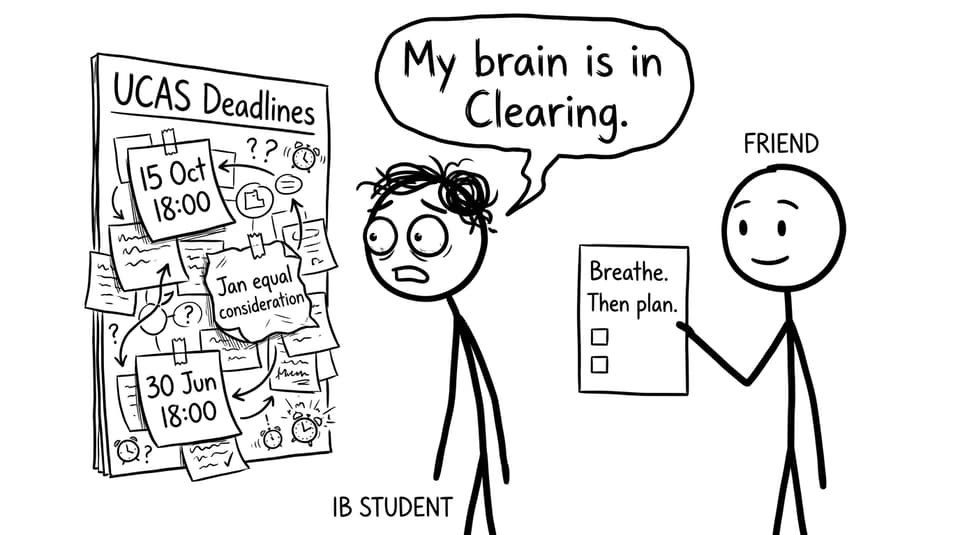
UCAS deadlines at a glance (save this)
Keep this short list somewhere you will actually see it:
-
Spring (April-May): the new UCAS cycle opens and course search goes live.
-
Summer: you can start building your UCAS application in the Hub.
-
2 September: applications can be submitted (not just drafted).
-
15 October (18:00 UK time): early deadline for Oxford, Cambridge, medicine, dentistry, and veterinary medicine/science.
-
January (18:00 UK time): the equal consideration deadline for most undergraduate courses (date changes by cycle).
-
26 February: UCAS Extra opens.
-
30 June (18:00 UK time): final deadline for on-time processing; later routes you into Clearing.
-
Early July: Extra closes and Clearing opens.
If you are also choosing courses right now, pair this with How to Choose the Right UCAS Courses (IB Students).
The UCAS timeline (and how IB students should think about it)
The “start early, submit later” trap
UCAS lets you begin your application in the summer, but submission only opens from 2 September. This is where students lose time: they confuse “I started” with “I progressed.”
A better approach is to use summer for quiet, high-leverage work:
-
draft and redraft your personal statement
-
confirm course prerequisites (especially IB HL requirements)
-
line up your reference process with your school
If you want a clean breakdown of what universities actually see, read UCAS Application Structure Explained and How Universities Assess UCAS Applications.
15 October: the early UCAS deadline that changes your autumn
The 15 October (18:00 UK time) UCAS deadline is for Oxford, Cambridge, and most medicine-related pathways. For IB students, this often collides with the most intense term of Year 13: coursework deadlines, predicted grade pressure, and the start of serious exam revision.
If you are anywhere near this route, you need the personal statement and evidence (reading, shadowing, reflections) moving early. RevisionDojo helps because you can keep exam prep steady while you build the application: use Flashcards for daily recall, Study Notes for quick clarity, and the Questionbank to stay exam-shaped even when your brain is occupied.
For statement support, see How to Write a Standout Personal Statement for UCAS and Common Personal Statement Mistakes to Avoid.
January: “equal consideration” is not a vibe
Most courses have a January UCAS deadline for equal consideration. That phrase sounds polite, but it is practical: apply by that deadline and universities must consider your application fairly alongside others submitted on time. Apply after, and they can still read you, but they do not have to.
This is why the safest strategy is boring:
-
aim to submit well before January
-
treat December as your buffer (not your launch)
-
use your school’s internal deadline as the real one
If you want to keep your revision structured while you handle UCAS admin, steal a planning method from Balanced IB Study Schedule That Actually Works.
Extra, Clearing, and the late-phase UCAS reality
If you use all five choices and have no offers, UCAS Extra opens on 26 February. It lets you apply to one extra course at a time.
The final deadline for “on-time processing” is 30 June at 18:00 UK time. After that, UCAS applications automatically move into Clearing.
If you ever end up in Clearing, preparation beats panic. Keep a calm checklist ready using UCAS Clearing Checklist 2025, and if you need to tighten your statement fast, use Writing a Personal Statement in a Hurry (Clearing Guide).
A simple UCAS + IB planning checklist
Use this when your week feels crowded:
-
Put every UCAS deadline in two places (calendar + notes app).
-
Decide your “submit week” (at least 2 weeks before the official UCAS deadline).
-
Draft your statement in rounds, not marathons.
-
Keep IB revision consistent: 20 minutes of Flashcards daily plus two Questionbank sessions per week.
-
Do one timed session weekly using Mock Exams or Predicted Papers to protect your exam stamina.
RevisionDojo is built for that kind of dual-track life: Questionbank, Study Notes, Flashcards, AI Chat, Grading tools, Predicted Papers, Mock Exams, a Coursework Library, and Tutors when you need a human to look at your blind spots.
Closing: make UCAS boring, so your future stays wide
UCAS deadlines feel stressful when they are fuzzy. They feel manageable when they are specific, visible, and planned backwards. Put the UCAS dates in your calendar, choose a personal “submit week,” and keep your IB revision steady enough that your confidence does not collapse every time you open the Hub.
If you want one place to keep both worlds under control, build your routine in RevisionDojo: drill marks with the Questionbank, learn faster with Study Notes, keep recall alive with Flashcards, get unstuck with AI Chat, sharpen work with Grading tools, rehearse with Predicted Papers and Mock Exams, reduce coursework stress with the Coursework Library, and bring in Tutors when you need a decisive push. UCAS is just a timeline. Your preparation is the advantage.