

When you watch someone do a bicep curl, it looks simple: weight up, weight down. But in IB SEHS, that single rep is a tiny story about control, force, and what the muscle is doing while the joint moves (or doesn’t). If you can name the contraction and describe the muscle length change clearly, you turn a fuzzy biomechanics answer into easy marks.
This guide breaks down the three contraction types you must know for IB SEHS and shows you how to explain them in an exam-friendly way.
Quick checklist for IB SEHS answers
Before you write anything, run this quick mental script:
-
Identify the movement phase (lifting, lowering, holding/stabilising).
-
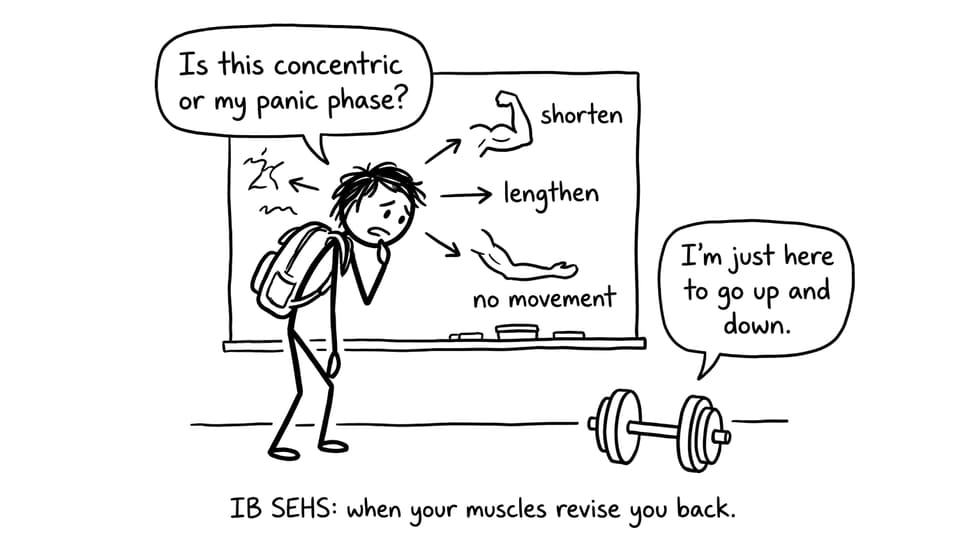
State muscle action + muscle length change.
-
Add a sport or gym example.
-
Use precise language: “shortens,” “lengthens under tension,” “no change in length.”
If you want extra practice applying definitions to scenarios, pair this article with RevisionDojo’s 4.2.2 Outline the Types of Muscle Contraction and then drill exam-style prompts in the Questionbank.
Concentric contraction (muscle shortens)
A concentric contraction happens when a muscle produces force while shortening. In plain terms: the muscle “wins” against the resistance and the body segment moves in the direction of the muscle’s action.
Think of the upward phase of a bicep curl: the biceps shorten to lift the load. In sport, concentric actions show up when you accelerate--sprinting out of the blocks, driving up for a rebound, or pushing the ground away in a jump.