

Travel and IB sounds like a contradiction until you meet the student who makes it work.
Not the mythical "I study six hours on a plane" person. The real one: they miss a week of school for a family wedding, or bounce between countries for sports, or take a long-awaited trip right before revision season. And somehow, when they get back, they are not drowning.
The difference is not discipline. It is design.
In the IB, time is rarely the problem. Friction is. If studying while traveling requires a laptop, six tabs, a folder of PDFs, and "just getting into the mood," you will do none of it. But if your plan is small, portable, and specific, you can keep the IB moving forward even when your location changes.
This guide is a practical system for traveling without abandoning your IB progress. It is built for exam preparation, not guilt. And it leans on the kind of tools that travel well: short bursts of active recall, targeted practice questions, and timed mini-simulations you can run anywhere.
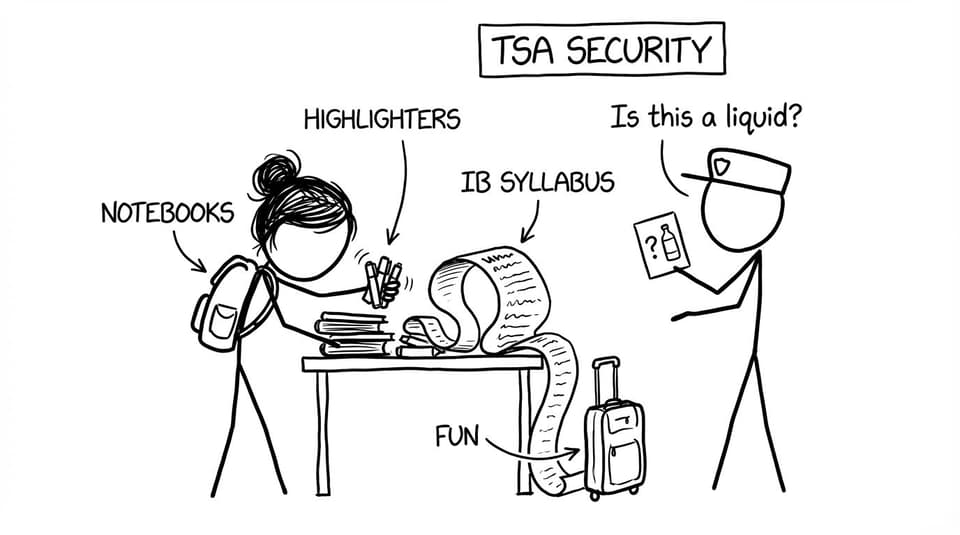
The Travel-and-IB checklist (save this)
If you only take one thing from this post, take this travel checklist. It keeps IB revision realistic.
- Choose two IB subjects to maintain (not all six).
- Pack one "core loop": Study Notes -> Flashcards -> Questionbank.
- Define your daily minimum: 10 minutes (yes, ten).
- Define your "hotel desk session": 30-45 minutes, 3 times per week.
- Run one timed block per week (mini Mock Exam or Exam Mode section).
- Use AI Chat to unblock confusion fast instead of postponing it.
- Keep a mistake list: 5 bullets per session, max.
RevisionDojo is built around this exact loop: Study Notes, Flashcards, Questionbank, AI Chat, Grading tools, Predicted Papers, Mock Exams, Coursework Library, and Tutors all in one place, so you do not have to rebuild your study setup every time you change time zones.
Useful starting points:
Travel and IB: what actually breaks first
Travel does not ruin the IB because you lose hours. It ruins the IB because you lose rhythm.
The IB rewards continuity. Concepts stack. Skills compound. If you disappear from practice for ten days, you do not just pause progress; you quietly increase the cost of restarting. The first session back feels harder, so you avoid it, and the gap grows.
That is why the goal of traveling during the IB is not "keep up perfectly." The goal is simpler: prevent restart pain.
You do that by maintaining three things:
Recall (memory stays warm)
Flashcards are travel-proof because they are small, fast, and honest. They expose forgetting early.
If you want a structured flashcard approach that fits short sessions, use IB Flashcard System: Active Recall for Better Memory.
Feedback (you still know what's weak)
A few practice questions tell you more than an hour of rereading. During travel, you need fast feedback loops.
The easiest way is a focused set from a question bank, like Comprehensive IB Question Bank: Thousands of Practice Questions.
Timing (exam stamina does not vanish)
Even one timed block each week keeps pacing familiar. You do not need full-length sessions to preserve exam instincts.
If you want a simple workflow, follow How to Run Timed IB Mock Exams in RevisionDojo (Exam Mode + Test Builder).
The "carry-on" IB system: a simple routine that travels
Think of your IB prep like packing.
A suitcase full of "maybe" items becomes heavy and useless. A carry-on with essentials stays light and gets used.
Here is a carry-on system you can run from an airport lounge, a train seat, or a quiet corner of a relative's house.
The 10-minute daily minimum (your non-negotiable)
Do this every day you travel, even on chaotic days:
- 10 minutes of Flashcards (spaced repetition)
- End by starring 3 cards that felt shaky
This is not about heroics. In the IB, consistency beats intensity because it keeps retrieval pathways alive.
RevisionDojo makes this frictionless because Flashcards are integrated with your notes and can be generated quickly from what you are learning.
The 30-45 minute "hotel desk session" (3 times per week)
This is your real progress block.
- 10 minutes: skim one slice of Study Notes (one subtopic only)
- 20 minutes: do a targeted set in the Questionbank
- 10 minutes: write a mistake list and ask AI Chat 1-2 questions
If you want a step-by-step structure for exam prep blocks, borrow the framework from How to Study for IB Exams: Step-by-Step Guide.
The weekly timed block (protect pacing)
Once per week, run a timed section:
- A mini Mock Exam, or
- A Predicted Papers section (if your subject has them)
Then review errors for patterns: command terms, missed definitions, time traps.
Examples you can explore:
Travel and IB planning: choose what to pause on purpose
One of the hardest IB lessons is that you cannot do everything at once. Travel forces that lesson early.
So decide deliberately:
Keep these running
- Flashcards (daily)
- Question practice (3 times/week)
- One timed block (weekly)
Pause these without guilt
- Perfect note rewriting
- A full reorganization of your binder
- New resources that require setup time
Travel is not the time to build a new system. It is the time to keep your existing IB system small enough to survive.
How RevisionDojo makes IB travel-friendly (without the chaos)
When you travel, your biggest enemy is not content. It is switching costs.
RevisionDojo reduces switching costs by keeping the whole IB loop connected:
Questionbank for "I have 15 minutes" studying
Instead of asking "what should I revise," you filter by topic and practice. That is especially powerful while traveling because it removes decision fatigue.
Start here: All IB revision needs in one place.
Study Notes for fast clarity
Travel sessions are not ideal for deep, slow reading. Notes that are syllabus-aligned and exam-focused help you regain traction quickly.
If you want to understand why digital notes fit travel so well, see Digital IB Study Notes: Access Anywhere, Anytime.
Flashcards for compounding memory
Spaced repetition is the closest thing students get to "free points" in the IB because it makes knowledge available under pressure.
Use: IB Flashcard System: Active Recall for Better Memory.
AI Chat for instant unblocking
Travel creates tiny gaps: you forget a definition, you half-remember a method, you misread a command term. AI Chat keeps those gaps from becoming delays.
Mock Exams, Predicted Papers, and grading tools for realism
When you are away from your usual study environment, it is easy to drift into comfortable revision. Timed simulations bring you back to what the IB actually requires: performance.
Coursework Library and Tutors when travel overlaps with deadlines
If your travel collides with IA, EE, or TOK work, you need clarity fast. The Coursework Library gives exemplars and structure, and Tutors provide a human check-in when your brain is tired.
Travel and IB: routines for planes, trains, and family houses
Your travel environment matters. Here are small adjustments that keep IB revision realistic.
Planes
- Do flashcards during boarding and taxiing (easy wins)
- Use Study Notes offline if possible
- Avoid long writing tasks unless you have space and energy
Trains and buses
- Do question sets that are MCQ-heavy or short response
- Use AI Chat to clarify one concept at a time
- Keep sessions short: 15-20 minutes
Family trips
- Claim a predictable window: right after breakfast or before dinner
- Announce it once: "I study 30 minutes daily for IB, then I'm present."
- Use a timer and stop when it ends
Common travel traps (and how to avoid them)
The "I'll catch up later" trap
Later becomes a larger pile, and the IB pile has a way of becoming emotional. Protect your daily minimum instead.
The "I must use the trip productively" trap
If you turn travel into a productivity contest, you will resent both travel and IB. Keep the plan small and repeatable.
The "I revised, so I'm fine" trap
Revision without feedback is comforting but unreliable. Keep a question bank session in the loop.
A helpful reminder about exam-style practice: IB Questions: Official Exam Practice.
Closing: make travel a feature, not a fracture
Travel can either break your IB rhythm or teach you what good revision actually is.
Good IB revision is portable. It is specific. It is built on short loops that create feedback: notes to understand, flashcards to remember, questions to apply, timed blocks to perform.
If you want that system in one place, build your travel routine around RevisionDojo: the Questionbank for targeted practice, Study Notes for fast clarity, Flashcards for daily recall, AI Chat for quick explanations, Grading tools for coursework feedback, Predicted Papers and Mock Exams for realism, the Coursework Library for exemplars, and Tutors when you need a human guide.
Start here and keep your IB moving, wherever you are: International Baccalaureate (IB)