In the last 10 minutes before a test, most students don’t panic because they forgot a fact. They panic because they don’t know what the fact means.
That’s the quiet gift of IB SEHS. It trains you to treat knowledge like a tool, not a trophy. You’re constantly asked to weigh evidence, interpret messy results, and defend a conclusion that could be challenged. And in IB exams, that mindset is worth marks.
If you’re revising IB SEHS right now, you’re not just learning about performance and health. You’re building a repeatable way of thinking: observe, question, test, evaluate.
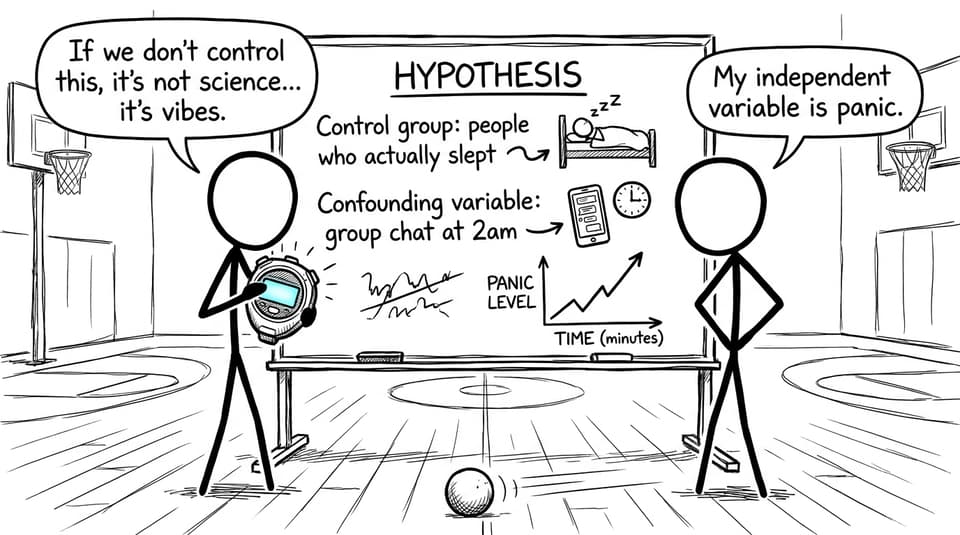
IB students controlling variables
Quick checklist: how IB SEHS builds critical thinking
Use this as a quick pre-exam reminder. Strong IB SEHS answers usually show these moves:
Question the claim before you accept it
Identify variables and limitations (then use them)
Interpret data trends, not just describe them
Link theory to a real performance or health context
Evaluate: “So what?” and “Compared to what?”
Reflect on improvements like a scientist, not a critic
IB SEHS teaches you to distrust neat stories (and love evidence)
Sports science is full of confident one-liners: “Ice baths are essential,” “Carbs are bad,” “This training plan guarantees results.” quietly asks you to slow down and do something harder: .
RevisionDojo was developed independently of the IBO and as such is not endorsed by it in any way.
IB SEHS
evaluate the evidence
That evaluation habit looks like:
Checking whether a claim is based on an appropriate method (lab test vs field test)
Spotting bias, sample issues, and uncontrolled variables
Comparing studies rather than treating one result as truth
A good way to rehearse this is to revise one narrow area, then challenge it with questions. For example, when reviewing hydration, don’t just memorize definitions. Ask what changes in different environments, sports, or athlete profiles. The Hydration and Nutrition topic hub makes this kind of revision easier because you can move between notes and practice.
Data analysis: where critical thinking becomes visible
In IB SEHS, data is rarely polite. Heart rate varies. Timing slips. Participants don’t behave consistently. And that’s the point: you’re learning how to reason under uncertainty.
Critical thinking shows up when you can:
Identify a meaningful pattern (not just list numbers)
Use statistics or graphs to support a claim
Explain anomalies with plausible reasoning
Decide whether your hypothesis is supported, partly supported, or rejected
If you’re rusty on the physiology behind typical graphs and responses, revise a single slice, then immediately practise. For example, energy systems are perfect for this because exam questions demand application and comparison. Start with Energy Systems (A.2.3) and follow with questions until your explanations stop sounding like guesses.
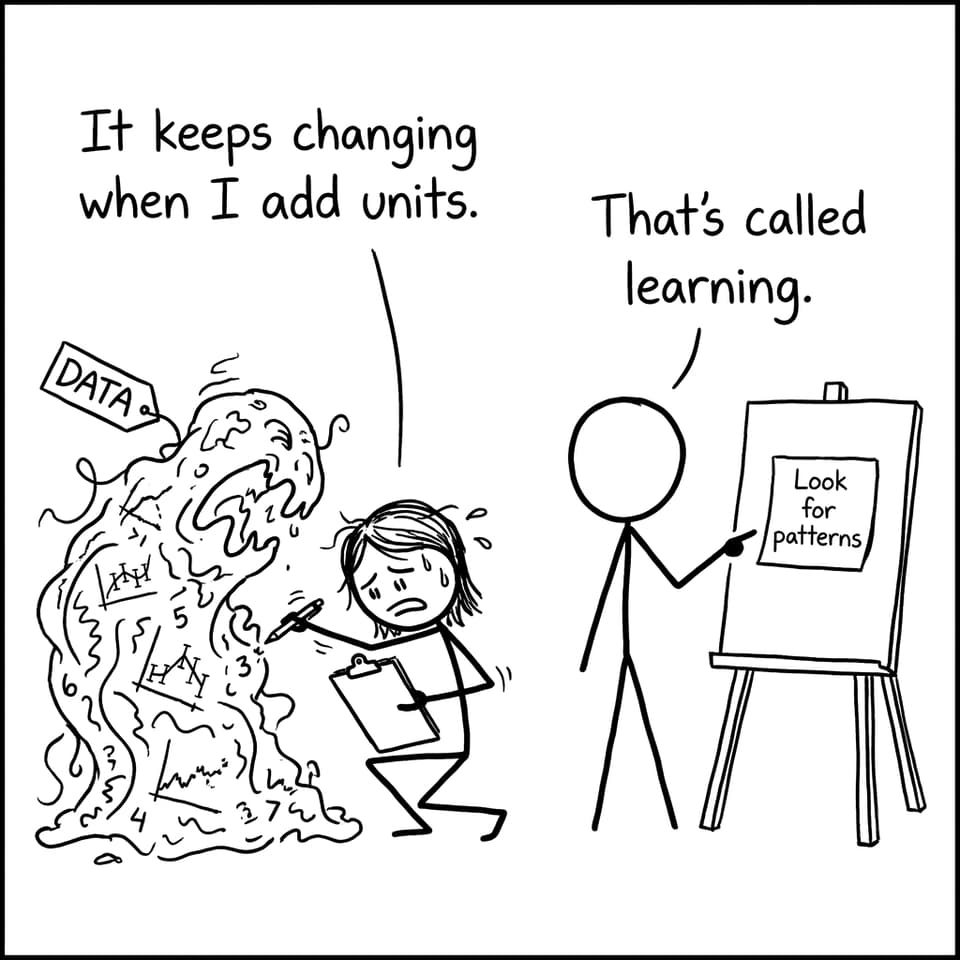
Data monster comic
Problem-solving when experiments go wrong (the underrated skill)
Here’s a small truth that feels unfair: the experiment you planned is rarely the experiment you actually get.
A strap slips. A participant doesn’t follow instructions. The warm-up wasn’t consistent. Results scatter.
IB SEHS turns that frustration into training. You learn to:
Adjust a method without destroying validity
Separate measurement error from real variation
Suggest realistic improvements (not fantasy upgrades)
This is exactly what examiners want in evaluation paragraphs: specific limitations tied to specific consequences. If you want a structured way to practise that thinking for coursework too, the IB SEHS IA (2026 syllabus) Grader is useful because it forces you to justify your reasoning against the rubric language.
Applying theory to real life (where IB SEHS feels different)
The strongest IB SEHS students don’t just “know the content.” They can transfer it.
Applying psychological theory to team performance under pressure (build context from Psychology of Sport)
Connecting a physiological concept to an athlete’s fatigue profile (for depth, review a focused note like Lactate inflection point notes)
This is also where RevisionDojo’s ecosystem helps: Study Notes for clarity, Flashcards for retention, and the Questionbank to make application automatic under time pressure.
A simple IB SEHS revision loop for critical thinking
When you’re tired, you need a process you can repeat.
Clarify (10--15 min): one subtopic using the SEHS hub or SEHS cheatsheets
Pressure-test (weekly): a timed rehearsal using IB Predicted Papers or built Mock Exams
Review (10 min): write one mistake rule: “Next time I will…”
If you need the broader exam strategy frame, the Step-by-step guide to study for IB exams pairs well with IB SEHS because it turns critical thinking into a schedule.
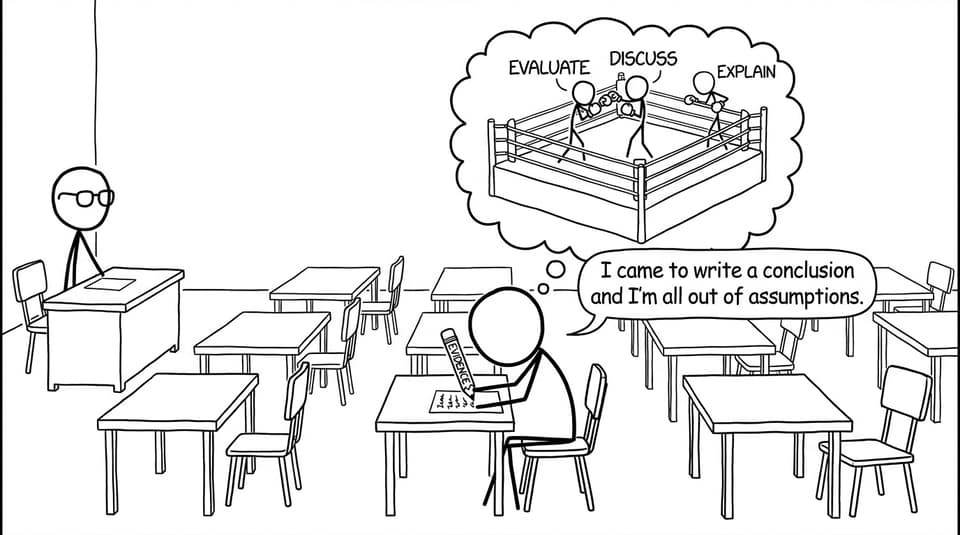
Exam hall command terms comic
Conclusion: IB SEHS is a thinking subject disguised as content
At some point in revision, you’ll notice a change. You’ll read a claim and immediately ask, “Based on what?” You’ll see a graph and think, “What else could cause this?” You’ll write a conclusion and naturally include limitations.
That’s IB SEHS doing its real job.
If you want to turn that mindset into marks, build your practice around RevisionDojo: use Study Notes for speed, Flashcards for recall, the Questionbank for exam-style application, AI Chat for quick unblocking, Predicted Papers and Mock Exams for realism, and Grading tools (plus the Coursework Library and Tutors) to tighten your evaluation. In the end, critical thinking isn’t a personality trait. In IB SEHS, it’s a skill you can train.
IB SEHS goal setting in sport made simple: goal types, SMART targets, common mistakes, and exam-ready tips using RevisionDojo practice tools.