A few months before exams, a lot of IB students have the same quiet fear: What if I can recite the theory but I can’t use it? You can know every definition in IB SEHS and still freeze when a question asks you to apply it to a new situation.
But here’s the comforting truth: the real world works the same way the best IB SEHS answers do. Health innovation rarely begins with a perfect plan. It starts with a problem (injury, fatigue, chronic disease), a messy set of data, and someone who can connect ideas across physiology, biomechanics, psychology, and research methods.
That “someone” can be you.
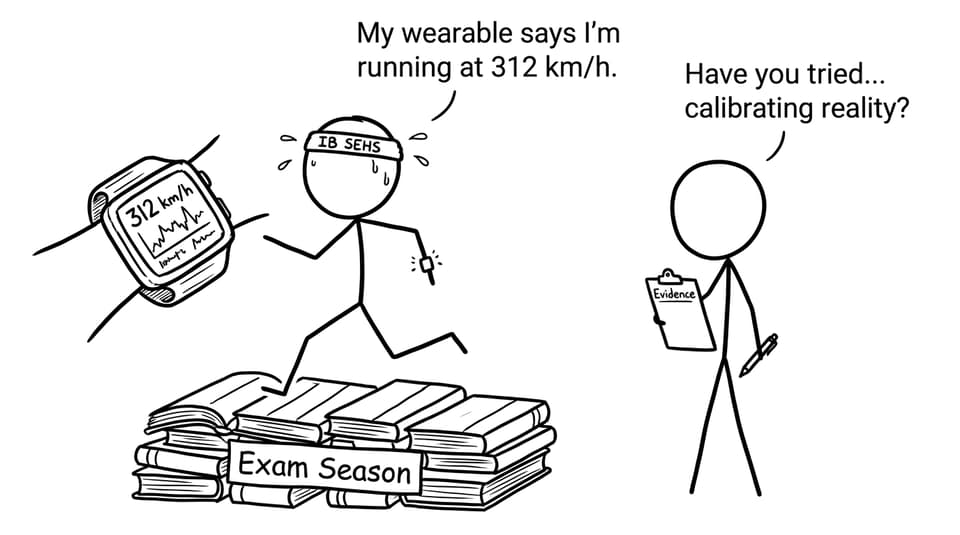
A stressed IB student and a reality-check friend
Quick checklist: how IB SEHS turns into innovation
Use this as a revision lens. If you can link a topic to one item below, you’re practicing the kind of thinking examiners reward in IB SEHS.
Biomechanics that informs medical devices and injury prevention
Physiology that guides monitoring, rehabilitation, and clinical decisions
Sport psychology that improves adherence, motivation, and recovery
Nutrition that shapes energy availability and population health
Data and research design that separates evidence from hype
Technology (wearables, sensors, apps) that converts signals into action
Biomechanics: where IB SEHS quietly meets medical tech
A prosthetic limb, an exoskeleton, or even a rehab brace is basically a question of forces and movement. That’s biomechanics. In IB SEHS, you learn how the body creates motion and how joints and tissues respond to load. In health innovation, those same principles decide whether a device reduces pain or causes a new injury.
A strong exam move is to take a biomechanics concept and ask: What would happen if we changed the load, the lever, or the technique? That’s also what designers do.
If you’re revising movement content, anchor your understanding with the syllabus-aligned topic page on Generating movement in the body. Then pressure-test it with exam-style practice in RevisionDojo’s Questionbank and check your explanations with AI Chat when your reasoning gets fuzzy.
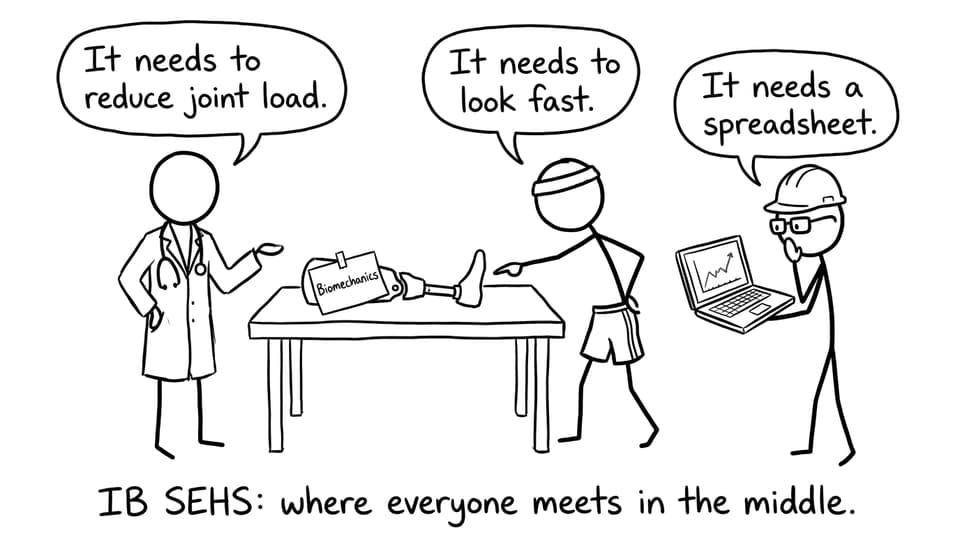
Doctor, athlete, and engineer arguing over a prosthetic
Physiology and monitoring: turning body signals into decisions
A big chunk of modern health innovation is measurement: heart rate, oxygen delivery, fatigue signals, recovery markers. In IB SEHS, physiology gives you the meaning behind the numbers. Without that, data is just decoration.
For example, if a wearable reports a rising heart rate during a constant workload, you should immediately think about cardiovascular drift, hydration status, temperature, and intensity relative to thresholds. In exam terms, that’s “apply” and “evaluate,” not “state.”
A practical way to revise this is to pair concepts with one core mechanism and one real-world implication.
Mechanism: transport and delivery of oxygen and nutrients
Implication: when monitoring tools should trigger rest, rehydration, or medical attention
Use RevisionDojo’s notes to tighten your language, especially around definitions and relationships. A good starting point is Transport (A.1.3) notes. Then drill weak areas using Mock Exams to build timing, not just knowledge.
Rehabilitation science: innovation that looks like patience
Rehab innovation often sounds futuristic: electrical stimulation, hydrotherapy protocols, gait retraining, even robotic support. But the best innovations aren’t flashy. They are repeatable, measurable, and personalized.
That’s exactly the mindset of a high-scoring IB SEHS response: clear variables, controlled conditions, and a conclusion that matches the evidence.
If your weakness is “I can’t link muscle theory to outcomes,” revise the molecular basis of contraction until you can explain it in plain language, then in exam language. RevisionDojo’s Sliding filament theory notes are ideal for that kind of two-step clarity.
And if coursework stress is stealing revision time, use the Grading tools for faster feedback loops. The IB SEHS IA Grader helps you see what the rubric is actually rewarding, which makes your writing more “innovation-minded”: specific, justified, and reflective.
Public health: when IB SEHS becomes policy (and persuasion)
A lot of health innovation isn’t a device. It’s a decision system: how schools schedule activity, how cities design walkable spaces, how campaigns target sedentary behavior, how interventions scale.
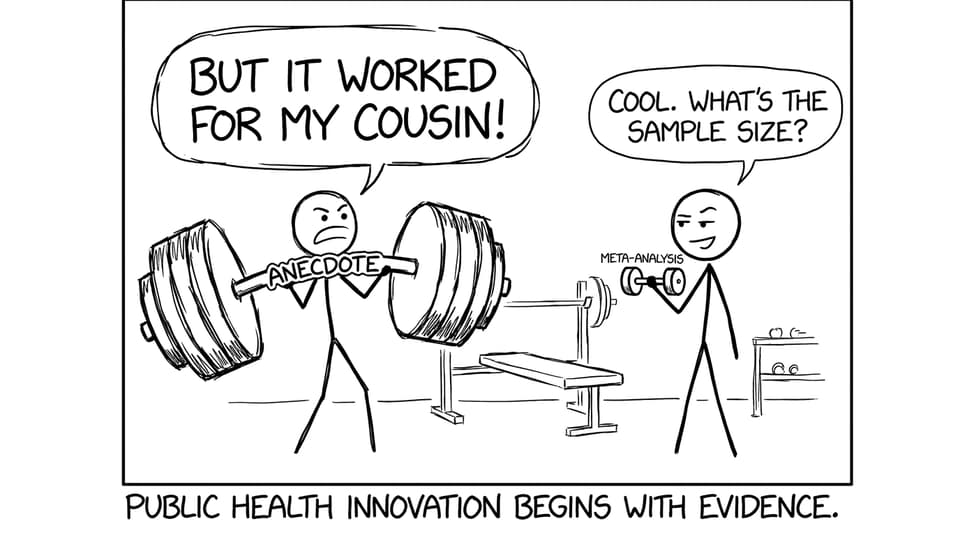
IB SEHS prepares you for this because it trains you to argue with evidence. You learn to question sample sizes, bias, confounding variables, and whether a claim matches the data.
When you revise, try this public-health twist: pick one global health issue (obesity, cardiovascular disease risk, mental health) and build a mini-argument that includes:
one physiological explanation
one behavioral or psychological factor
one intervention and its limitations
This is also where RevisionDojo’s Study Notes and examiner-written SEHS cheatsheets shine: they compress the “what” so you can spend your energy practicing the “so what.”
Two lifters: Anecdote vs Meta-analysis
Wearables and data: the modern IB SEHS case study generator
Wearables make great exam examples because they combine content areas: energy systems, fatigue, training principles, recovery, and data validity. The trick is not to praise technology blindly. In IB SEHS, you get marks for balance.
Try this structure in longer answers:
What the device measures (HR, GPS load, movement patterns)
What that measurement can indicate (intensity, recovery, risk)
Why it might mislead (calibration, context, individual differences)
What better evidence would look like (controlled testing, triangulation)
To revise the physiology behind training and fueling, link your wearable examples to topic content like Hydration and nutrition (A.2) and Energy systems (A.2.3). Then use RevisionDojo’s Flashcards for spaced recall and the Questionbank for the hard part: applying it under time pressure.
A simple RevisionDojo workflow for IB SEHS exam prep
If you want health-innovation thinking and exam readiness, use a loop you can repeat:
Fix: ask AI Chat to diagnose why a response missed marks
Rehearse: one timed block using Mock Exams and, when available, Predicted Papers (RevisionDojo builds these with examiner logic)
If you want extra strategy ideas, the IB SEHS blog tag page is a good place to browse targeted posts.
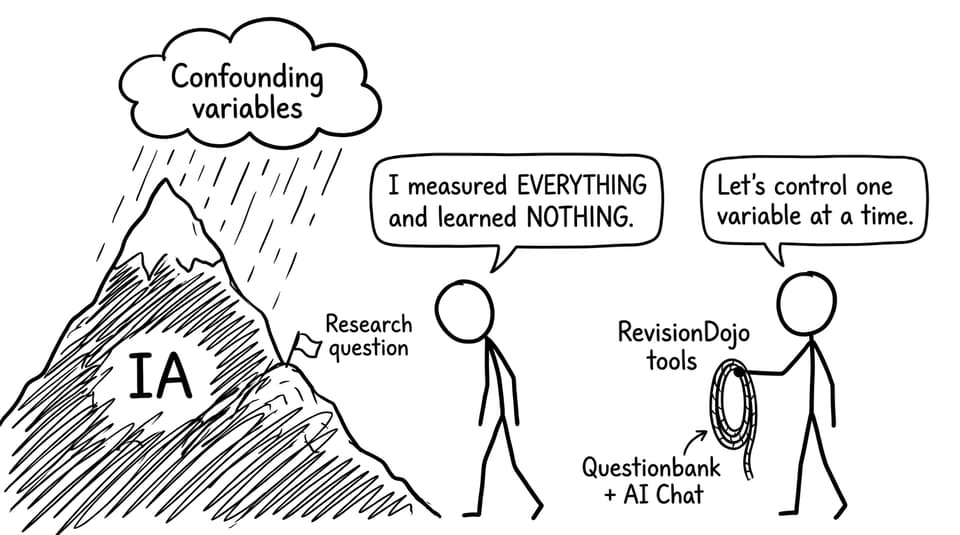
A student climbing the IA mountain
Closing: why IB SEHS is bigger than the syllabus
The link between IB SEHS and real-world health innovation is not a motivational poster. It’s a practical pipeline: understand how the body works, measure it carefully, and make decisions that are honest about evidence.
If you want to turn your IB SEHS revision into exam performance, build your routine around RevisionDojo’s Questionbank, Study Notes, Flashcards, AI Chat, Grading tools, Predicted Papers, Mock Exams, Coursework Library, and Tutors. You’re not just preparing for an exam. You’re training a way of thinking that the real world actually needs.
IB SEHS goal setting in sport made simple: goal types, SMART targets, common mistakes, and exam-ready tips using RevisionDojo practice tools.