


Ethics shows up in the IB when you least expect it.
Not as a tidy “ethics unit” you can revise the night before, but as a quiet question hiding inside everything else: Who is affected by this knowledge? And then the harder one: What do we owe them?
The strange part is that most IB students already feel the ethical weight of topics (AI, climate policy, medical trials, censorship, data privacy). They just don’t always have a method for turning that feeling into marks. Ethical reasoning is a skill you can train. And once you can do it in one subject, you can do it across your whole IB timetable.
If you want a TOK-friendly way to practice this, bookmark TOK Ethics: A Practical Lens for Real-World Dilemmas and treat it like a gym plan for your brain.
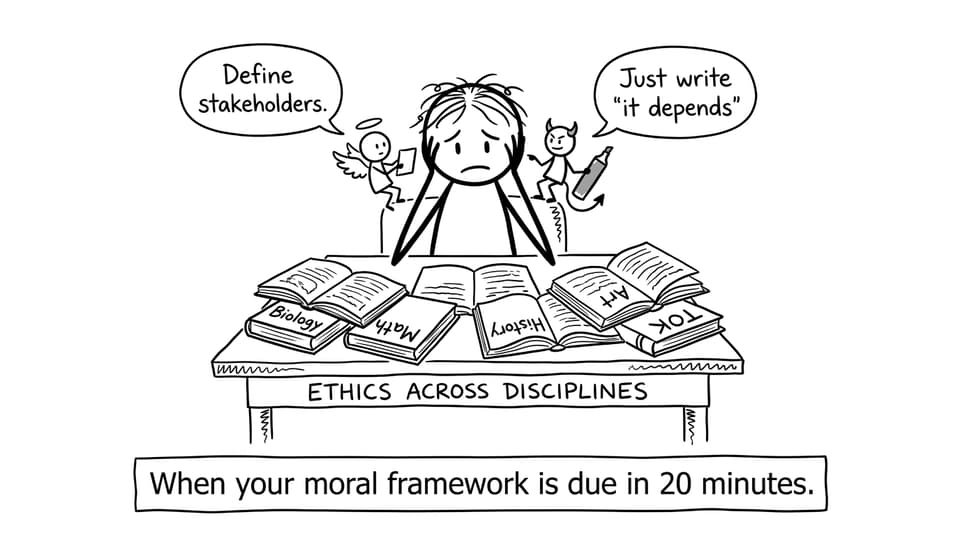
A quick IB checklist for ethical reasoning (save this)
Use this mini-checklist whenever an IB prompt smells even slightly ethical:
-
Name the decision (or knowledge claim) clearly.
-
Identify stakeholders (who benefits, who is harmed, who is ignored).
-
State the value conflict (e.g., progress vs safety, freedom vs harm, privacy vs utility).
-
Apply one ethical framework (as a lens, not a slogan).
-
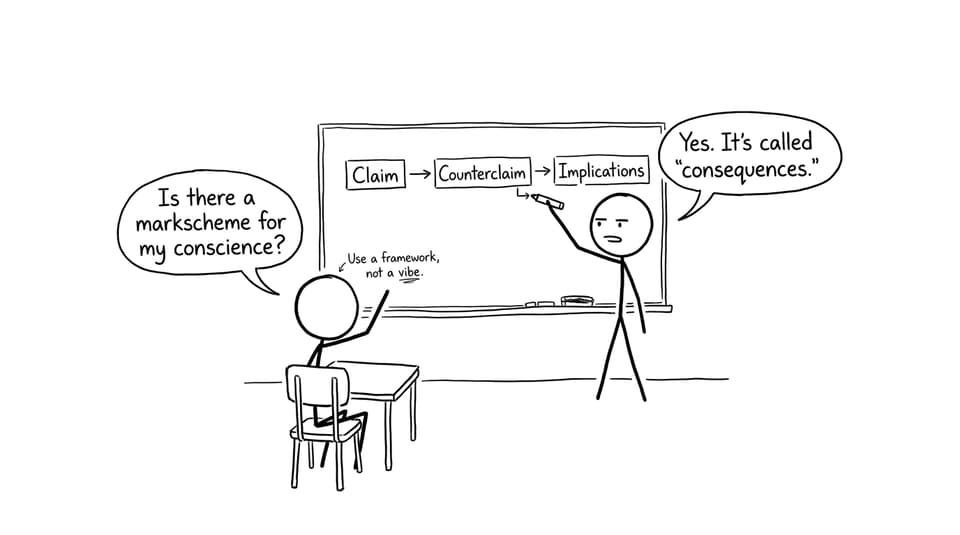
Offer a counterclaim (what a reasonable person could argue back).
-
Finish with implications (what changes if we accept your view).
That last step matters more than students think. If you want to get better at it quickly, use How to Consider Implications in TOK Arguments and Conclusions as your template.
Why ethical reasoning matters in the IB (and in exams)
In the IB, ethical reasoning is not about sounding like a philosopher. It’s about proving you can handle complexity without collapsing into “it’s complicated.” Examiners reward answers that:
-
show perspective without losing clarity,
-
use evidence and concepts rather than moral panic,
-
distinguish between what we can do and what we should do,
-
and explain consequences rather than just opinions.
Ethical reasoning also makes revision more efficient. When you revise by themes (harm, responsibility, fairness, consent), you can reuse the same thinking patterns across Biology, Economics, English, Design, and TOK. That’s a quiet IB advantage: one skill, many papers.
For broader exam efficiency, pair this article with How to Study for IB Exams: Step-by-Step Guide.
Finding ethics in every discipline (without forcing it)
Ethics is easiest when you stop treating it as “extra.” Instead, treat it as a shadow cast by content.
Sciences: the ethics of methods, risk, and publication
In IB sciences, ethical reasoning often lives in what counts as acceptable evidence and what risks are permitted. Think: clinical trials, animal testing, genetic engineering, dual-use research.
A strong ethical paragraph in an IB science response usually does three things: identifies harm, weighs benefit, and specifies constraints (consent, oversight, uncertainty).
If you also take TOK, connect this to how ethics can limit what can be studied at all. See When Ethics Limits What We Can Know (TOK Notes).
Mathematics and data: the ethics of models and invisibility
Math feels neutral until it leaves the classroom.
In the IB, ethical reasoning appears when mathematics is used to classify people, predict outcomes, or allocate resources. Data privacy, algorithmic bias, and misleading graphs aren’t side topics. They’re real examples of how a “correct” model can still produce unfair outcomes.
A useful IB move is to ask: What did the model optimize for? Because whatever it optimized for became more important than whatever it ignored.
Individuals and Societies: the ethics of power and trade-offs
History, Global Politics, Economics, and Business Management are full of ethical reasoning because they are full of trade-offs under pressure.
Ethical reasoning here is about more than moral language. It’s about:
-
competing responsibilities (state vs individual, short-term vs long-term),
-
unintended consequences,
-
and how incentives shape what leaders claim is “necessary.”
TOK can sharpen your writing by pushing you to ask not only “Is this right?” but “How do we justify it as knowledge?” Use TOK Thinking and Skills: How to Succeed in IB TOK to build that habit.
The Arts and Languages: the ethics of representation
In English, Film, Visual Arts, Theatre, or Music, ethical reasoning often becomes a question of representation: who speaks, who is spoken for, and what harm can come from stereotypes, appropriation, or exploitation.
A high-scoring IB response usually avoids the trap of “censorship vs freedom” as the only binary. Instead, it discusses artistic intent, audience impact, and responsibility, while admitting that impact can be unpredictable.
If you want a direct TOK bridge, read TOK Prompt #4 (Nov 2026): Ethics in Art vs Science. Even if you’re not writing that exact prompt, the comparison logic transfers.
The IB method: use frameworks as lenses, not answers
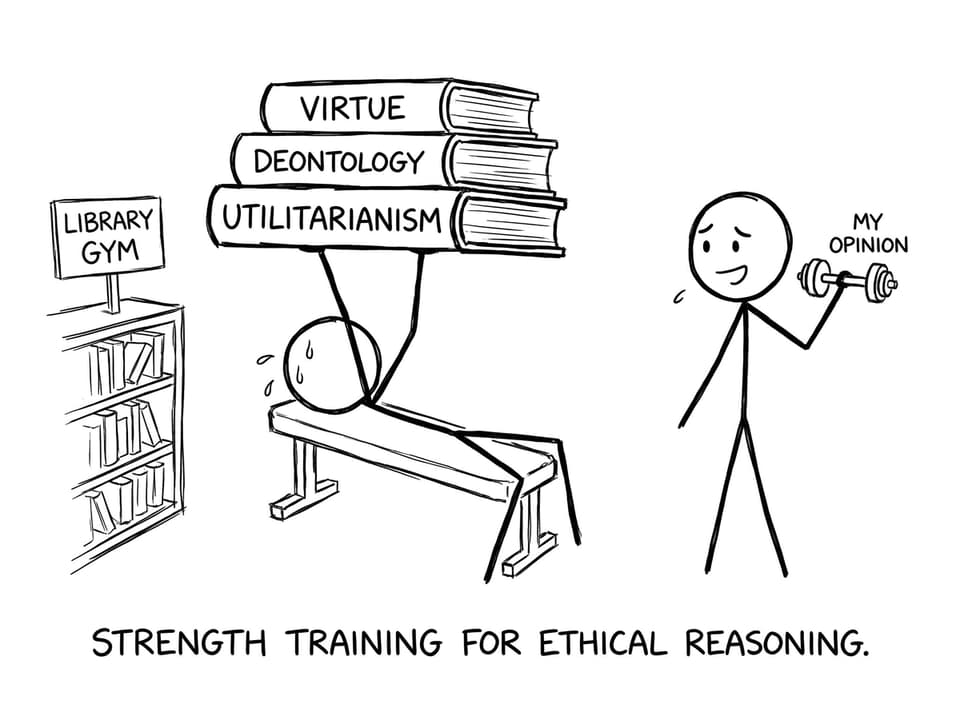
Frameworks are not there to make you sound clever. They are there to stop you from drifting.
Utilitarianism (outcomes)
Ask: Which option produces the greatest overall good? In IB answers, name what “good” means (health, safety, freedom, wellbeing) and admit measurement problems.
Deontology (duties and rules)
Ask: What principles must not be violated, even for good results? Useful for consent, rights, fairness, and academic honesty.
Virtue ethics (character)
Ask: What would a responsible, honest, compassionate person or institution do? Good for leadership decisions, professional responsibility, and long-term trust.
Rights-based reasoning (protections)
Ask: Whose rights are at stake, and which rights conflict? This is especially effective in Individuals and Societies and in data ethics.
If you want a single sentence to keep you honest in the IB, use this: “A framework is a flashlight, not a verdict.”
Turn ethical reasoning into exam points (the RevisionDojo loop)
Ethical reasoning improves fastest with repetition. Not repetition of content, but repetition of structure.
Here’s the simple IB training loop using RevisionDojo:
-
Start with Study Notes to learn the concept cleanly and spot ethical pressure points.
-
Convert ethical vocabulary into daily Flashcards (stakeholder, consent, bias, trade-off, responsibility).
-
Practice applying the idea in the Questionbank so ethics becomes a reflex, not a speech.
-
Use AI Chat to challenge your claim: “What is the strongest counterclaim to my argument?”
-
For writing tasks (TOK, EE, IA drafts), use Grading tools to see whether your reasoning is actually justified.
-
Build realism with Predicted Papers and Mock Exams so you can reason ethically under time pressure.
-
When you need examples fast, the Coursework Library shows what strong thinking looks like.
-
If the skill still feels unstable, book Tutors to pressure-test your argument and fix blind spots.
For an overview of this system, see RevisionDojo App: The Smarter Way to Prep for IB Exams and RevisionDojo for IB.
Common traps IB students fall into (and how to avoid them)
Trap: “My opinion” paragraphs
Fix: anchor your view in stakeholders, concepts, and a framework. You can still be personal, but your reasoning must be public and testable.
Trap: forgetting the counterclaim
Fix: write one sentence that begins, “A reasonable objection is…” Your IB score improves when you show you can argue against yourself.
Trap: ethics without implications
Fix: after every claim, add 2-3 lines on consequences. If you need a guide, How TOK Encourages Questioning and Critical Inquiry pairs well with implication writing.
Closing: the IB payoff of ethical reasoning across disciplines
The IB isn’t only testing what you know. It’s testing whether you can carry knowledge responsibly.
When you train ethical reasoning across disciplines, you stop revising as if every subject is an island. You begin to see repeating patterns: stakeholders, trade-offs, evidence limits, consequences, responsibility. That recognition is what makes you faster in exams and calmer under pressure.
If you want to turn ethical reasoning into a repeatable advantage, build your routine inside RevisionDojo: Study Notes for clarity, Flashcards for daily recall, Questionbank practice for application, AI Chat for counterclaims, and Mock Exams plus Predicted Papers for realism. That’s how IB thinking becomes something you can do on purpose, not something you hope shows up on a good day.