


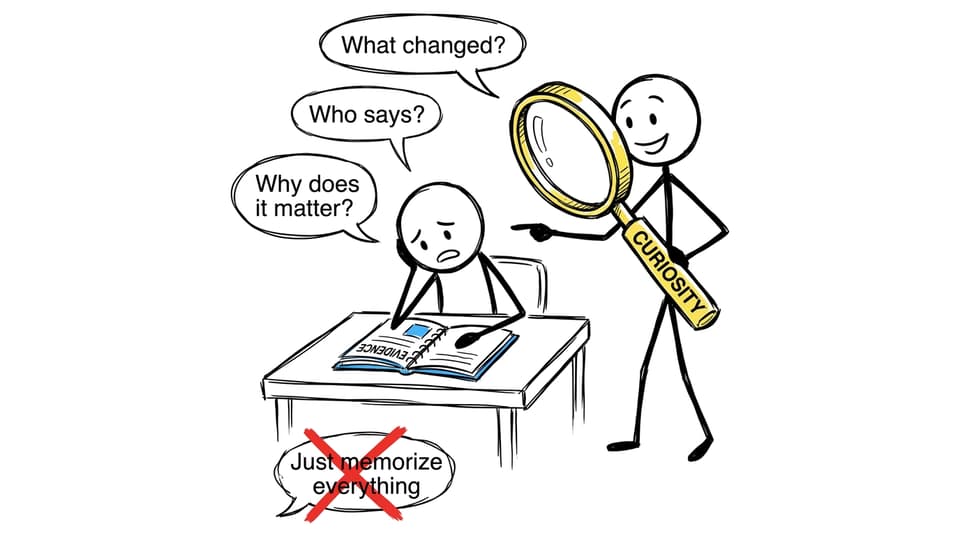
A parent watching a child study history can feel an odd pull: help more, but do not take over. The useful middle ground is not testing every date or correcting every sentence. It is helping your child ask better questions, find trustworthy evidence, and explain why the past matters.
That is the heart of supporting a child studying MYP History. MYP Individuals and Societies is inquiry-led and criterion-related. Students investigate, interpret, communicate, and think critically rather than simply memorising events. Your role is to make those habits easier to practise while keeping the work theirs.
A simple parent checklist
- Ask what question the unit explores, not only what happened.
- Help your child separate evidence from interpretation.
- Encourage short, regular study sessions.
- Discuss the reliability and perspective of sources.
- Ask what the teacher's feedback means before suggesting a solution.
- Praise clearer thinking, revision, and persistence rather than marks alone.
The aim is a calm environment in which your child can think aloud, make mistakes, and improve.
Understand what MYP History asks students to do
MYP History may sit within Individuals and Societies, while exact units and assignments vary by school. Students commonly investigate historical questions through concepts such as change, causality, perspective, significance, identity, and power. The IB describes four broad assessment areas in Individuals and Societies: knowing and understanding, investigating, communicating, and thinking critically.
This changes the kind of support that helps. A child may remember many facts but struggle to select evidence or explain a source's perspective. Another may have a promising argument but organise it poorly. Before helping, ask which skill the task measures and which criterion the student needs to demonstrate.
A useful question is, "Which criterion are you trying to show here?" It turns the vague concern "Is this good?" into a manageable next step. RevisionDojo's MYP History resources offer Study Notes, lessons, Flashcards, and Questionbank practice, giving families a shared reference point without requiring parents to become subject experts.
Ask questions that make history come alive
Parents do not need to deliver a second lesson. Often, the best support is a thoughtful question:
- What changed, and what stayed the same?
- Who benefited from this decision?
- Which groups might interpret this event differently?
- What evidence supports that explanation?
- Is this a cause, consequence, or turning point?
- Why is this event historically significant?
These prompts move students from recalling information to constructing historical understanding. They also work during museum visits, documentaries, or conversations about current events. Keep the tone curious rather than prosecutorial. "Tell me how you worked that out" is usually more productive than "Why don't you know this yet?"
Help with evidence, not answers
Evidence does not speak for itself. Every source has an origin, purpose, audience, and context. It may reveal something valuable while remaining limited in other respects.
Ask your child to complete three sentences:
- "This source shows..."
- "It is useful for understanding..."
- "It is limited because..."
Calling a source "biased" is only a starting point. Strong analysis explains how the creator's purpose or position affects what the source includes, excludes, exaggerates, or ignores. RevisionDojo's guide to primary sources and historical source analysis introduces useful vocabulary. Parents can then ask whether the analysis addresses the question and uses evidence for a clear reason.
Build a low-pressure study rhythm
A repeatable routine usually serves students better than a dramatic weekend revision session. Try two or three short sessions each week, with each session covering three stages.
Learn
Review a small section of content and write a three-sentence summary identifying the central development, one example, and one remaining question.
Retrieve
Close the notes and recall important terms, people, causes, and consequences. Flashcards can help, but attempting an answer before checking it is essential.
Apply
Answer one question, interpret a source, or plan a paragraph. This is where knowledge becomes usable. RevisionDojo's resources on Urbanisation and Demographic Change, War, Conflict and Peacemaking, and Social and Cultural Movements show how broad topics can be divided into manageable steps.
Parents can protect the time and reduce distractions without supervising every minute. Independence is part of the outcome.
Support writing without rewriting it
A red pen may produce a cleaner paragraph, but it does not necessarily teach the student to improve the next one. Instead, ask your child to identify the claim, specific evidence, explanation connecting that evidence to the claim, and link back to the question.
When something is missing, ask rather than supply. "What does this example prove?" teaches more than writing the connecting sentence for them. RevisionDojo's IB History essay guidance provides a useful model for claims, evidence, explanation, and judgement. The same reasoning supports shorter MYP assignments, even when their format differs.
Use technology as a coach
Digital tools work best when students remain responsible for the thinking. A Questionbank tests understanding, Flashcards expose gaps in recall, AI Chat can clarify unfamiliar ideas, and Grading tools can identify recurring weaknesses in structure or evidence. Ask, "What did the tool help you notice?" rather than focusing only on the result.
RevisionDojo brings together Study Notes, Questionbank practice, Flashcards, AI Chat, Grading tools, Mock Exams, Predicted Papers, Coursework Library resources, and Tutors. A useful sequence is simple: understand the topic, retrieve the essentials, answer a question, and review feedback. For relevant units, the Supranational Institutions topic also helps students connect factual knowledge with power, cooperation, and change.
Know when to step back
Support becomes pressure when every conversation feels like an assessment. Some evenings should contain no history questions. Sleep, movement, or time away from schoolwork may be more useful than another reminder.
Watch for patterns rather than isolated bad days. If your child repeatedly misunderstands tasks, criteria, or workload expectations, contact the teacher early and ask which single skill should be prioritised. Encourage your child to bring one work example and one specific question. That develops self-advocacy as well as historical understanding.
The quiet advantage of steady support
Supporting a child in MYP History is less about knowing every answer than creating conditions in which good thinking develops. Ask about questions, notice evidence, protect a manageable routine, and let your child own the final words.
History requires patience with incomplete information and competing perspectives. With RevisionDojo providing structured notes, practice, feedback, and expert help, parents can offer something more valuable than extra pressure: a steady system that helps students become independent historians.