


A week before finals, a student will sometimes treat the Personal Project like a fire alarm: loud, urgent, and suddenly everyone is involved.
In the MYP, that moment is a gift in disguise. It reveals what the project is really testing: not genius, but judgment. Not perfection, but proof. And for students preparing for exams, it quietly trains the same skills they need under timed pressure: planning, clarity, evidence, and reflection.
For supervisors, the challenge is subtle. You must help without steering. You must ask for evidence without turning the project into paperwork. You must keep the student moving while protecting their ownership. This guide shares practical, calm best practices for MYP Personal Project supervision that also supports exam readiness.
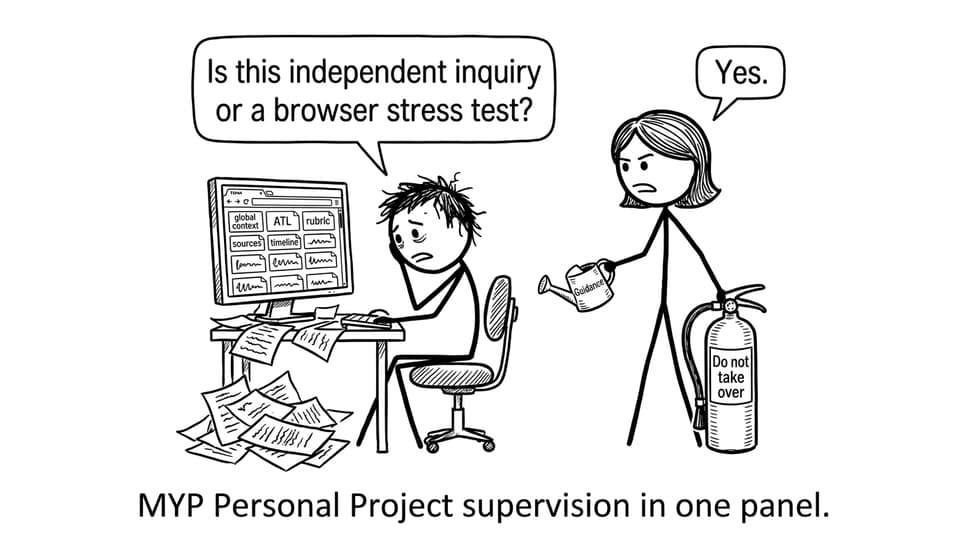
The one-page MYP supervision checklist
If you only keep one system, keep this:
-
Confirm a measurable goal and realistic scope (Week 1).
-
Lock one Global Context and keep returning to it.
-
Build success criteria early so evaluation is possible.
-
Schedule short checkpoints every 2-3 weeks.
-
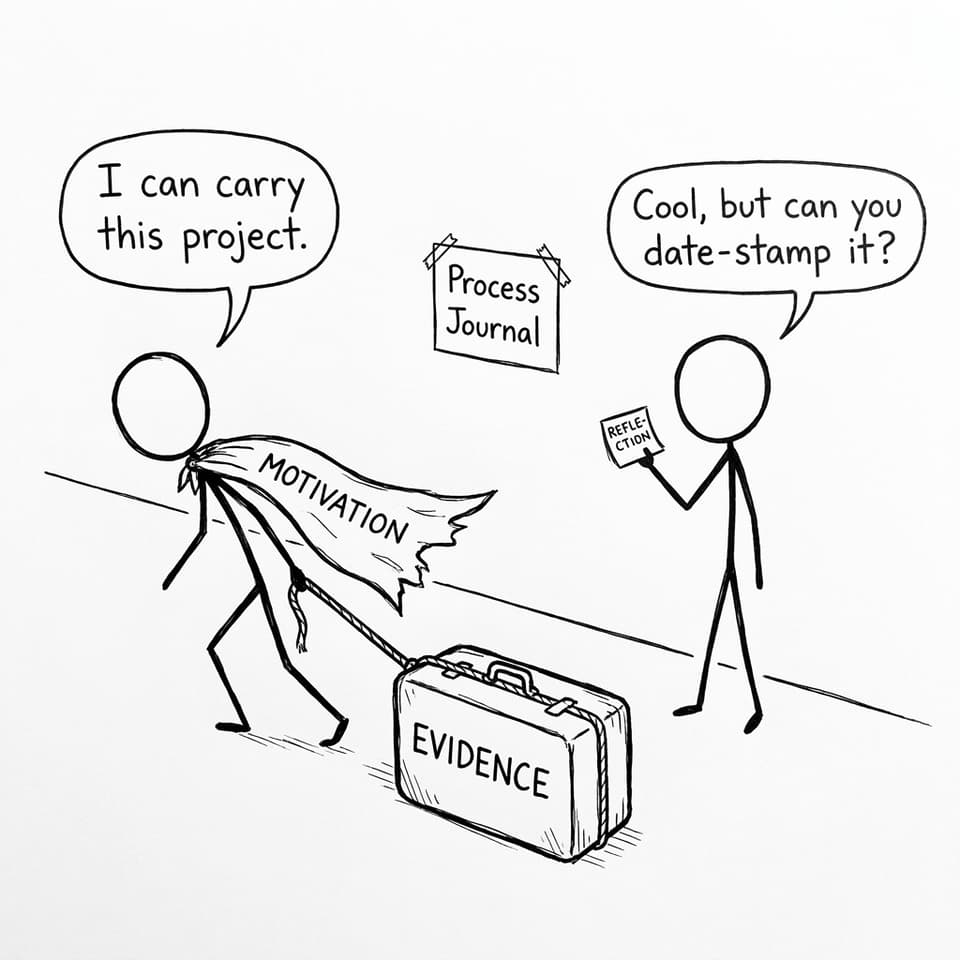
Require a dated process journal entry at every checkpoint.
-
Give formative feedback using Criteria A-D language.
-
Audit academic honesty before the final report is submitted.
-
End with evidence-based reflection, not feelings-only reflection.
When students want examples of what “good” looks like, point them to the IB Personal Project (MYP) Examples and the broader IB Personal Project Examples library. Those models reduce panic and sharpen expectations.
Your real job in the MYP Personal Project
A supervisor is not a project manager and not an editor. In MYP terms, your role is closer to a coach who keeps the athlete honest about training.
Mentor the student’s motivation, not your own preferences
Students choose ambitious topics because ambition feels safe at first. “Big” goals delay the moment they must act. Help them shrink the goal until action is unavoidable.
If a student says, “I want to raise awareness,” ask: awareness for whom, measured how, by when? In the MYP, specificity is kindness.
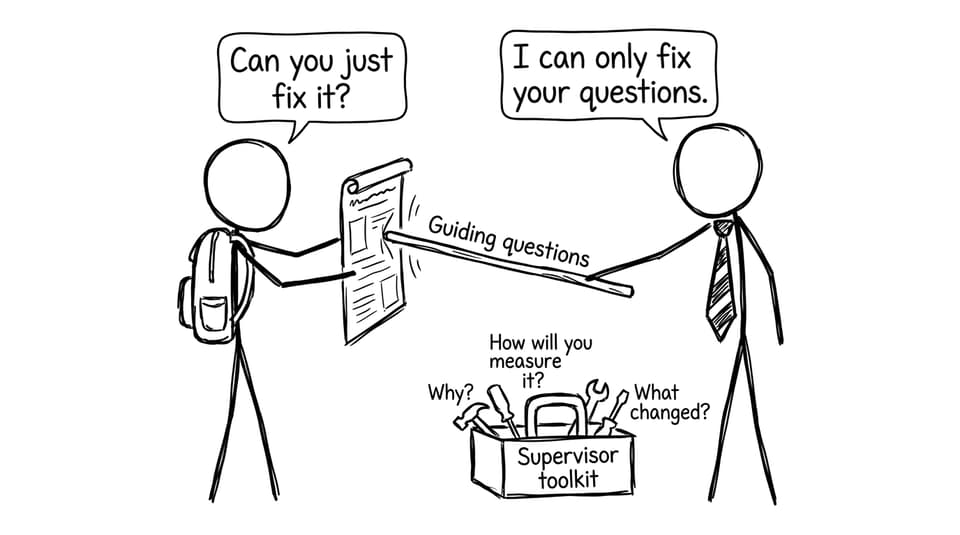
Guide the process with questions, not fixes
A good supervision meeting ends with the student having two clear next actions and one reflection prompt. It does not end with you redesigning their product.
A practical script:
-
“What did you decide since last time, and what evidence shows it?”
-
“What changed, and why?”
-
“Which Criterion are you currently strongest in, and which is weakest?”
When students get stuck, the MYP Personal Project: The Ultimate Student Guide is a strong shared reference point. It keeps your feedback aligned to the same cycle and vocabulary.
The MYP project cycle, supervised the smart way
Students will often treat the Personal Project like four separate tasks. In the MYP, it’s one loop: investigate, plan, act, reflect. Your supervision should make that loop visible.
Investigating: help them choose a goal they can prove
Strong supervision starts by preventing the two classic mistakes: a goal that is too broad, or a goal that cannot be evaluated.
Ask for:
-
A goal statement with a clear product/outcome.
-
2-4 success criteria that can be tested.
-
A short paragraph connecting the goal to a Global Context.
If they need inspiration, send them to Real Ideas of IB MYP Personal Projects for Inspiration. It gives variety without encouraging copying.
Planning: insist on milestones, then reward adaptation
Students think planning is predicting the future. You know it’s preparing for reality.
Require a timeline with:
-
milestones (mini-deadlines)
-
buffers (extra time)
-
risks (“If X happens, I will do Y.”)
Then, in every meeting, ask what changed. In MYP assessment thinking, adaptation plus documentation is often stronger than a perfect plan that was never real.
Taking action: require evidence, not just progress
A student may say, “I worked a lot.” Your response should be gentle and firm: “Show me.”
Evidence can be:
-
prototypes, drafts, screenshots
-
photos with dates
-
feedback forms
-
test results
-
short decision notes (what you chose and why)
If students are unsure what to capture, the Common MYP Personal Project Mistakes (and Fixes) article is a useful diagnostic. It turns vague effort into observable proof.
Reflecting: teach them to write like an examiner is reading
Students often confuse reflection with memory. In the MYP, reflection is evaluation using evidence.
A repeatable prompt set:
-
What was my success criteria, and what proof shows the result?
-
What was the biggest setback, and what decision did it force?
-
Which ATL skill improved, and what strategy demonstrates that improvement?
-
If I repeated the project, what would I change first?
Academic honesty: the quiet supervision superpower
Personal Projects can drift into messy territory: unattributed images, copied explanations, overly helpful relatives, and now AI-generated writing. A calm supervisor reduces risk by building habits early.
Use student-friendly guidance like IB MYP Academic Honesty Policy: What Students Should Know to define expectations, and reinforce that honesty is a process, not a last-minute checklist.
Practical supervision moves:
-
Ask students to keep a running sources log from day one.
-
Separate notes (quotes/paraphrases) from draft wording.
-
Require citations for images, data, and specific claims.
-
If AI is used, require transparency and student-owned rewriting.
If students want a simple referencing system, How to Cite Sources Correctly in Your IA offers a clean approach that transfers well to MYP project writing.
How RevisionDojo supports MYP students while you supervise
Supervision works best when students have a stable toolset between meetings. RevisionDojo is built for that.
-
The MYP Personal Project Grader helps students pressure-test drafts against rubric language before you see them.
-
The Coursework Library gives annotated models, so feedback becomes concrete.
-
AI Chat can help students refine research questions, clarify explanations, and test whether their reflection is evidence-based.
-
Study Notes and Flashcards support the exam side of life, so the project doesn’t swallow revision time. Start with Study Notes | RevisionDojo.
-
When exam pressure rises, Questionbank, Mock Exams, and Predicted Papers keep the student’s exam rhythm intact, while you keep the MYP project moving.
-
If a student needs extra accountability or specialized feedback, Tutors provide targeted support without turning you into a 24/7 helpline.
Closing: supervision that builds more than a product
The best MYP Personal Project supervision doesn’t create a “perfect” outcome. It creates a student who can plan, adapt, prove, and reflect. Those are exam skills hiding in plain sight.
If you want students to feel calm and capable, build a simple loop: milestones, evidence, criteria-based feedback, and honest reflection. Then let RevisionDojo carry the weight between meetings with its Questionbank, Study Notes, Flashcards, AI Chat, Grading tools, Predicted Papers, Mock Exams, Coursework Library, and Tutors.
Supervise lightly, document heavily, reflect honestly. That’s the MYP way, and it’s a strong way to prepare for whatever comes next.


