
The best study prompts AI can respond to do not ask it to finish your work. They ask it to make you retrieve, explain, compare, apply, and improve what you know.
That distinction matters in DP1. AI can produce a polished paragraph in seconds, but polished is not the same as understood. If the tool performs all the thinking, you may leave with an answer and no stronger ability to produce one under exam conditions.
Used well, AI for studying resembles a patient tutor. It can ask one question at a time, adjust an explanation, challenge weak reasoning, and give feedback on your attempt. Used poorly, it becomes a copying machine that quietly removes the struggle through which learning happens.
This guide gives you reusable prompts, a practical workflow, and clear boundaries based on current IB academic integrity guidance.
The quick checklist for better AI study prompts
Before sending a prompt, check whether it does these five things:
- Names the subject and level, such as IB Biology HL or Economics SL.
- Identifies the exact concept, rather than requesting help with an entire topic.
- Makes you respond first, before revealing an explanation or model.
- Requests feedback instead of replacement, especially for written work.
- Sets an integrity boundary, such as not writing assessed material for you.
A useful test is simple: after the conversation, could you explain or apply the idea without AI open beside you? If not, the exchange probably created dependence rather than learning.
What good study prompts AI to make you do
Strong prompts introduce productive friction. They make remembering slightly difficult, expose gaps, and require decisions.
A weak prompt says:
Write an analysis of how the author creates tension in this passage.
A stronger version says:
I am a DP1 English A student. Ask me to identify one choice that creates tension in this passage. Do not suggest an answer until I respond. Then challenge me to explain the effect and connect it to the wider purpose of the passage.
The second prompt leaves authorship with the student. It also separates a complex skill into observable steps: identify, explain, connect, and refine.
That principle works across subjects.
| Learning goal | Prompt pattern |
|---|---|
| Recall knowledge | Quiz me one question at a time. Do not show the answer until I commit to a response. Revisit anything I miss later. |
| Understand a concept | Ask me to explain the concept in my own words. Identify the first gap or misconception, then ask a follow-up question. |
| Apply knowledge | Give me a new, syllabus-relevant situation where I must use this concept. Do not tell me which method to choose. |
| Improve reasoning | Read my attempt and identify the weakest step. Ask a question that helps me repair it myself. |
| Reflect on mistakes | Help me classify this error as knowledge, interpretation, method, calculation, or communication. Then suggest one targeted practice task. |
The common feature is not clever wording. It is that the student remains intellectually active.
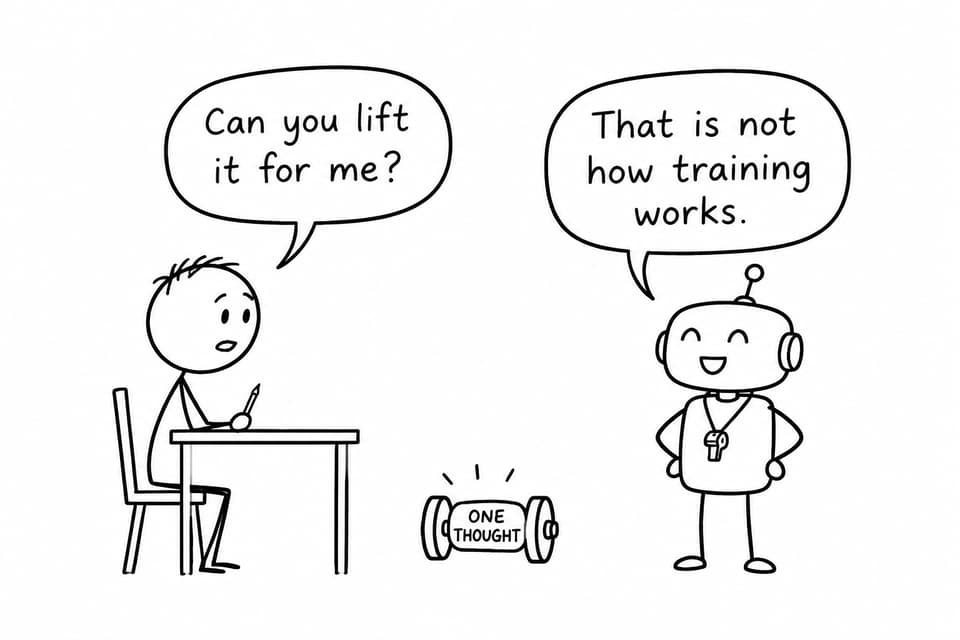
The fastest way around the effort is often the fastest way around the learning.
Reusable prompts for DP1 students
You do not need a complicated formula. Give the AI context, define its role, specify the learning process, and state what it must not do.
Prompts for active recall
I am studying [topic] in IB [subject and level]. Quiz me with eight questions, one at a time. Mix definitions, explanations, and applications. Wait for each answer, give brief feedback, and return to missed ideas after two other questions.
Ask me to recall the steps in [process] without hints. Once I answer, compare my sequence with an accurate version and identify only the missing or misplaced steps.
These work well after reviewing RevisionDojo Study Notes. Close the notes before answering. Retrieval is the point.
Prompts for explanations
Explain [concept] at three levels: a one-sentence overview, a DP1 explanation, and one unfamiliar example. Then ask me to explain why the example fits.
I understand [part A] but not [part B]. Ask me two diagnostic questions before explaining anything. Use my answers to locate the exact misunderstanding.
Diagnostic questions matter because “I do not understand” can describe several different problems. You may lack a definition, confuse two ideas, or understand the concept but not its application.
Prompts for calculation and problem-solving
Give me an IB-style practice problem on [topic]. Do not include the solution. If I get stuck, provide one small hint at a time. After I finish, check each step and ask me to correct the first error myself.
Here is my working: [insert working]. Do not replace it with a complete solution. Identify the earliest incorrect step, explain what principle I should reconsider, and give me time to revise it.
For deeper practice, combine this approach with the RevisionDojo Questionbank, Predicted Papers, and Mock Exams. Let Jojo support the reasoning process, then attempt fresh questions without assistance. That second attempt shows whether the method has become yours.
Prompts for essays and analysis
Ask me questions that help me develop a defensible answer to this practice question. Do not propose a thesis or write sentences for me. Test whether my claims are specific, supported, and relevant.
Review my paragraph as a coach. Identify one unclear claim, one unsupported inference, and one place where analysis becomes description. Do not rewrite the paragraph. Ask me to revise each issue.
Challenge my interpretation from a reasonable opposing perspective. Ask me to defend it with evidence, then tell me which part of my defence remains weakest.
RevisionDojo's guide to AI tools and academic honesty offers a broader framework for keeping assistance separate from authorship.
IB academic integrity and AI: what is allowed?
The IB does not impose a blanket ban on AI software. However, it does not regard material produced by an AI tool, even in part, as the student's own work. If AI-generated text, images, or graphs are included in assessed work, that use must be clearly acknowledged in the body of the work and appropriately referenced in the bibliography.
This does not mean that attribution automatically makes every use acceptable. Your school, teacher, or assignment may set stricter boundaries. A task might permit brainstorming but prohibit generated wording, for example. Always follow the instructions attached to the specific assessment and ask your teacher when the boundary is unclear.
A practical DP1 guide looks like this:
| Generally appropriate for learning | Requires caution or explicit permission | Not academically honest |
|---|---|---|
| Asking for a quiz on a studied topic | Brainstorming ideas for assessed work | Submitting generated work as your own |
| Requesting another explanation | Using AI feedback during coursework drafting | Hiding AI-generated text, images, or analysis |
| Practising with new examples | Including any generated material in a submission | Asking AI to fabricate data, evidence, or references |
| Receiving feedback on a practice answer | Uploading school or copyrighted material | Using AI where the teacher has prohibited it |
You remain responsible for accuracy. AI can invent references, simplify a disputed point, or confidently apply the wrong method. Verify important claims using your course materials and original sources. RevisionDojo explains the policy distinction further in its IB AI policy overview and guide to why academic integrity matters.
A four-step workflow that prevents copying
A good workflow creates distance between assistance and final performance.
Attempt before asking
Write an answer, sketch a plan, or solve as much as you can first. Even an incomplete attempt gives the AI something meaningful to diagnose. Starting with “do this for me” removes the evidence of what you actually understand.
Request narrow feedback
Ask for the first misconception, the weakest inference, or one missing step. Narrow feedback is easier to process than a complete replacement answer.
Revise in your own words
Close the AI response and make the change yourself. If you cannot revise without copying its sentence, ask for a question or hint instead of wording.
Test the learning elsewhere
Use a fresh Flashcard, Questionbank problem, or Mock Exam task. You can also compare your work with Study Notes and use RevisionDojo's Grading tools to identify recurring weaknesses. For longer-term support, the Coursework Library and Tutors can help you understand expectations without taking ownership away from you.
RevisionDojo's introduction to Jojo as a syllabus-grounded IB tutor explains how subject context and assessment logic can make this feedback more focused.
Keep a prompt record for assessed work
For consequential assignments, record how you used AI. Save the prompt, relevant output, date, tool name, and what you changed as a result. This does not replace any acknowledgement required by your school or the IB. It simply makes your process easier to explain honestly.
Also avoid entering personal data, confidential feedback, unpublished school materials, or copyrighted resources unless you have permission and understand how the platform handles them. Integrity includes responsible handling of other people's work, not just the wording in your final document.
When uncertain, ask your teacher before using the tool. A two-minute clarification is safer than trying to reconstruct an unclear process near submission.
Build a learner, not just an answer
DP1 is when habits quietly compound. A shortcut used once can feel harmless. Repeated every week, it can leave you with polished homework and fragile knowledge.
The better use of AI is less dramatic. Ask it to quiz you. Make it wait for your attempt. Request a hint, defend your reasoning, revise the weakness, and then try again alone. RevisionDojo brings that process together through Questionbank practice, Study Notes, Flashcards, AI Chat, Grading tools, Predicted Papers, Mock Exams, the Coursework Library, and Tutors.
When you have written your own answer, create a free RevisionDojo account and ask Jojo to check it. Tell Jojo not to rewrite the work. Ask for the first gap in your reasoning and one question that will help you fix it yourself. That small instruction keeps the tool useful while ensuring the learning still belongs to you.