
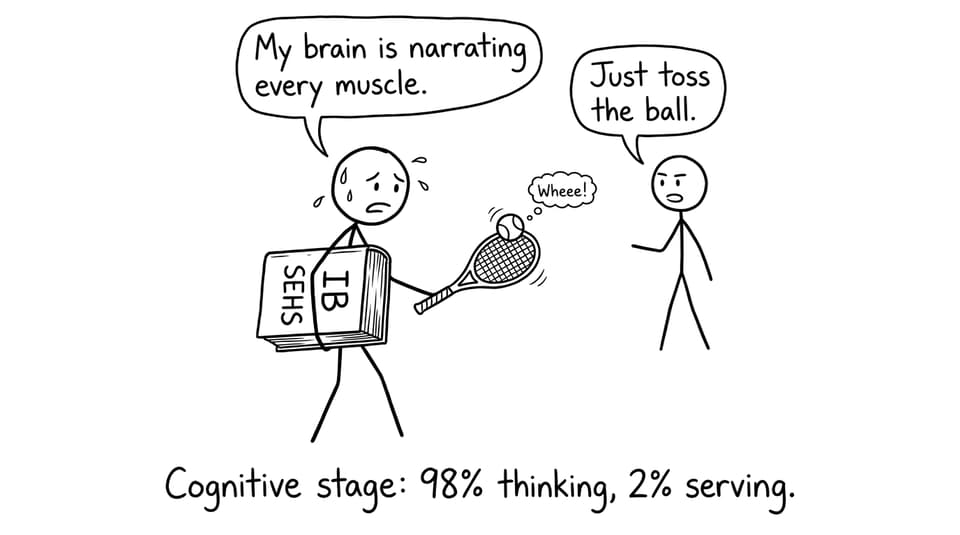
A skill looks effortless only after it has been awkward.
Think about the first time you tried a new movement in sport: the brain narrating every step, the body disagreeing, and the ball going anywhere except where you intended. That messy beginning is exactly what IB SEHS calls the early stage of motor learning. And if you can describe that journey clearly, you can pick up easy marks on skill acquisition questions.
Stages of skill acquisition (IB SEHS) at a glance
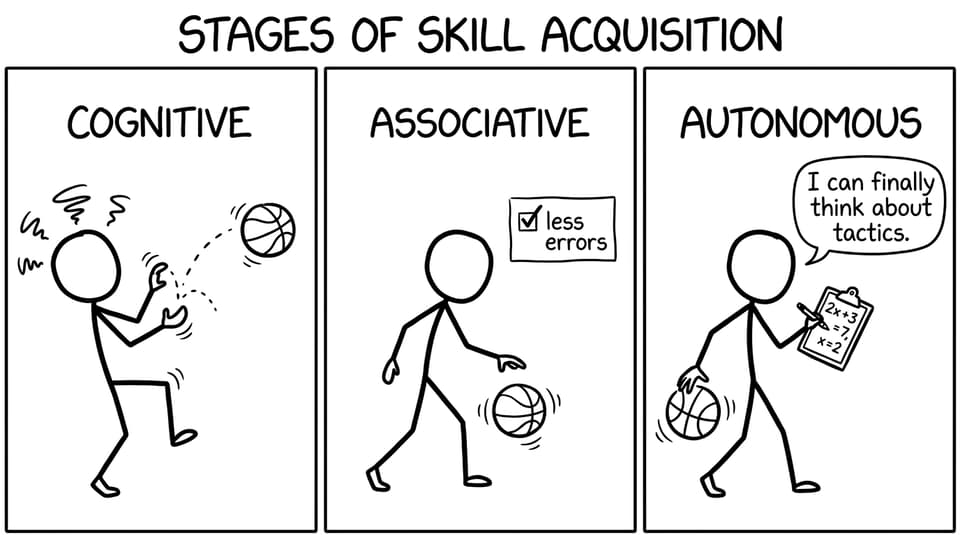
In IB SEHS, the stages of skill acquisition explain how performers move from beginner to automatic performance:
-
Cognitive stage: understanding the task, lots of errors
-
Associative stage: refining technique, fewer errors
-
Autonomous stage: automatic performance, attention freed for tactics
If you want extra practice applying these in exam-style prompts, the IB SEHS tag archive is a useful jumping-off point for connected topics.
Cognitive stage (beginner learning in IB SEHS)
The cognitive stage is where learning feels like thinking out loud. In IB SEHS, this stage is defined by the performer trying to understand what the skill is and how to do it.
What examiners are usually looking for:
-
Large, frequent errors and poor consistency
-
High attention demands (the performer must concentrate hard)
-
Heavy reliance on instructions and demonstrations
-
Movements often appear uncoordinated
A strong exam application might sound like: “A beginner basketball player dribbling will watch the ball and make frequent errors because attention is focused on the movement pattern, which is typical of the cognitive stage in IB SEHS.”
To build detail around how learning is taught, connect this stage to pedagogy and feedback. RevisionDojo’s Pedagogy for Skill Acquisition HL notes help you add that extra layer of explanation.
Associative stage (the ‘practice stage’ in IB SEHS)
The associative stage is the middle stretch: less dramatic improvement, more quiet polishing. In IB SEHS, performers here start detecting their own mistakes and need less constant feedback.
Key characteristics:
-
Fewer, smaller errors
-
More consistent performance
-
Improved coordination and timing
-
Better ability to recognise and correct errors
This is a great place to mention practice structure. You can reinforce your answer by linking associative learning to practice methods like variable vs fixed or massed vs distributed. See Practice Methods and Skill Learning for clear exam language you can reuse.
Autonomous stage (automatic performance in IB SEHS)
The autonomous stage is when the skill runs in the background. In IB SEHS, this stage is marked by automaticity: the performer can execute with minimal conscious thought and instead focus on strategy, opponents, or the environment.
What to include:
-
Highly consistent and accurate execution
-
Minimal attention required for the basic movement
-
Better focus on tactics and decision-making
-
Often more resilient under pressure and fatigue
This is where your examples can shine: an elite footballer can control and pass while scanning for runs. In exam terms, the “attention freed” point is often the mark earner.
How to write stage-of-learning answers (quick checklist)
For top marks in IB SEHS, avoid listing stages without applying them. Use this mini structure:
-
Name the stage
-
Give two characteristics (errors, attention, consistency)
-
Apply to the scenario (sport-specific example)
-
Link to feedback or practice (if asked)
For targeted exam questions, use RevisionDojo’s Motor learning processes Questionbank and the broader Skill in Sport topic hub.
A final way to remember it (and revise it)
The stages of skill acquisition are really a story about attention: in IB SEHS, beginners spend attention on “how to move,” intermediates spend it on “how to move better,” and experts spend it on “what to do next.”
If you want to turn that story into exam marks, RevisionDojo is built for it: use the Study Notes to lock definitions, the Flashcards to drill characteristics, the Questionbank and Mock Exams to practise application, and AI Chat plus Grading tools to tighten your phrasing. When you revise like that, IB SEHS stops feeling like memorising lists and starts feeling like explaining real performance.