



You do not notice how personal a Group 3 choice is until you are a month into revision.
One subject makes you argue with the internet itself: who gets watched, who gets paid, who gets silenced. The other makes you argue with decisions: pricing, strategy, operations, people. If you are stuck between IB Digital Society and IB Business Management, you are not choosing “the easier one.” You are choosing the kind of thinking you want to practise every week until exam day.
IB Digital Society is for students who like messy questions with real consequences. Business Management is for students who like structured decisions with clear frameworks. Both can score well. Both can feel hard. The trick is matching the course to your strengths before your timetable locks in the wrong kind of difficulty.
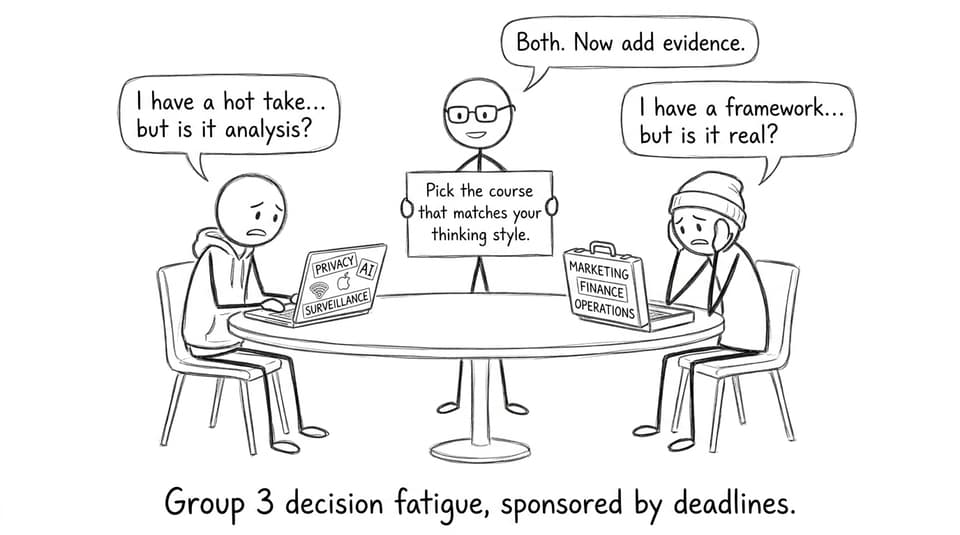
Quick decision checklist (save this)
Use this as a fast filter. If you tick more boxes in one column, that is your signal.
Choose IB Digital Society if you...
-
Enjoy debating ethics, power, and culture through technology
-
Like connecting concepts to current examples (platforms, policies, AI systems)
-
Write best when questions are open-ended and you can argue a position
-
Want a Group 3 that feels interdisciplinary (politics, media, law, sociology)
Start with the course overview and tools hub: IB Digital Society Resources.
Choose Business Management if you...
-
Like frameworks, definitions, and decision-making under constraints
-
Prefer structured responses where marks reward clear application
-
Enjoy case study details and using business tools to justify choices
-
Are interested in business degrees, management, entrepreneurship, or marketing
Get the full map of the subject and revision tools here: IB Business Management Resources.
What IB Digital Society actually feels like
In IB Digital Society, the content is not “learning how tech works.” It is learning how tech changes people, systems, and incentives. The syllabus pushes you to think in trade-offs: privacy vs security, convenience vs autonomy, innovation vs harm. You are rewarded for being precise about mechanisms (how a system produces an outcome) and honest about uncertainty.
That is why IB Digital Society often feels like you are revising the news. A strong answer sounds calm, not dramatic: you define a concept, choose a focused example, explain the chain of cause and effect, then evaluate impacts for different stakeholders.
If you want a clearer expectation of the course, keep these handy:
And when you revise, the fastest loop is: Study Notes for clarity, Questionbank for exam phrasing, and AI Chat for rapid feedback when your argument feels fuzzy.
What Business Management actually feels like
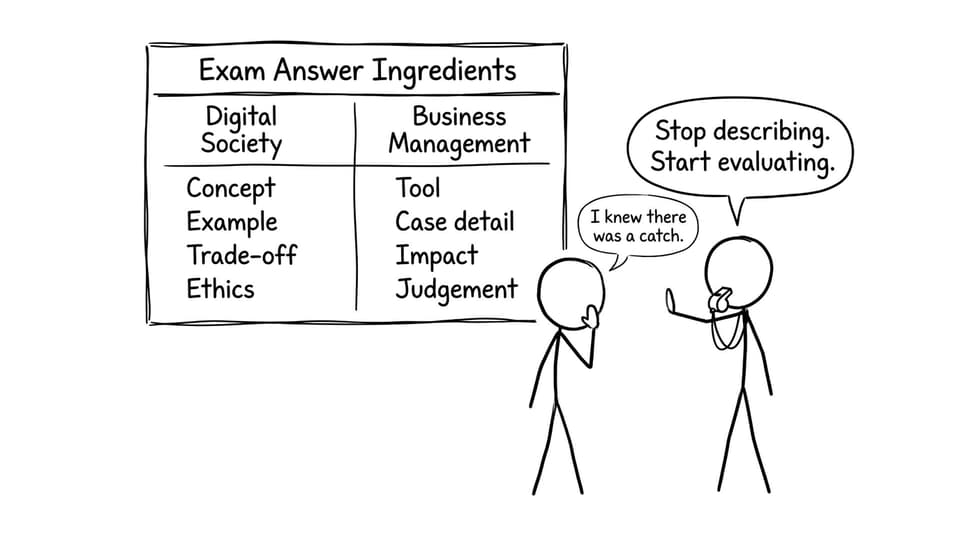
Business Management is less “opinion” and more “decision.” You still evaluate, but your evaluation is anchored in tools and context. You learn how organisations work: marketing, finance, HR, operations, strategy, ethics. In exams, the marks often go to students who can move from definition to application quickly, without retelling the case.
Business Management has a reassuring rhythm:
-
Define the tool or concept
-
Apply it to the case detail
-
Analyse the implications
-
Evaluate with a justified judgement
If you want to see how examiners reward structure, these guides are worth revisiting before mocks:
RevisionDojo helps here because you can drill frameworks with Flashcards, practise timing with Mock Exams, and use Grading tools to tighten paragraphs that are “correct” but not yet mark-efficient.

Where they overlap (and where they don’t)
The overlap is real: both subjects reward analysis, evidence, and evaluation. Both punish description.
But the shape of a good answer differs.
In IB Digital Society, your strength is interpretation
A top IB Digital Society response often reads like a careful essay: concept-driven, example-rich, ethically aware. You show you can hold multiple perspectives at once.
In Business Management, your strength is decision logic
A top Business response reads like a confident recommendation: tool-driven, case-specific, constraint-aware. You show you can choose and justify.
A quick way to test yourself: which sentence feels more natural to write?
-
“This policy shifts power by changing incentives for users and platforms.” (IB Digital Society)
-
“Given the cash flow constraint, this option is feasible short term but risky long term.” (Business)
What universities tend to value
Universities rarely “prefer” one Group 3 subject in isolation. They prefer evidence that you can handle the thinking style of your intended degree.
-
Business and management routes: Business Management signals direct relevance.
-
Law, politics, media, humanities: IB Digital Society signals ethical reasoning and contemporary global awareness.
If you are aiming for politics or policy-related degrees, this is a useful comparison point: IB Global Politics: Best IB Subjects for a Politics Degree.
Predicted grades and exam performance: what changes with your choice
Your predicted grade is not just “how smart you are.” It is how consistently you meet the markscheme under timed conditions. That is why choosing between IB Digital Society and Business Management should include one practical question: which rubric style will you execute better when stressed?
For the admissions side of the story, keep this bookmarked: Do IB Predicted Grades Matter for Conditional Offers?.
On RevisionDojo, you can turn this into a plan: build targeted Predicted Papers, practise timed sets in the Questionbank, and use Tutors if you need a faster correction loop.
Conclusion: choose the subject that matches your thinking
The best choice between IB Digital Society and Business Management is the one that fits how you naturally reason under exam pressure. If you want to argue carefully about ethics, culture, and power through technology, IB Digital Society will feel meaningful and scoreable. If you want to make structured decisions using clear frameworks and case details, Business Management will feel cleaner and more direct.
Whichever you choose, RevisionDojo can be your home base: Study Notes to learn, Flashcards to retain, Questionbank to practise, AI Chat to test understanding, Grading tools to refine writing, Predicted Papers and Mock Exams to simulate the real thing, a Coursework Library for exemplars, and Tutors when you want human feedback.
Pick your path, then practise it like it matters. Because it does.