
Samsara, karma and moksha describe a central pattern in many Hindu traditions: beings undergo repeated birth and death, actions have consequences that shape this condition, and liberation ends bondage to the cycle. For IB World Religions SL, however, knowing those three definitions is only the beginning. The stronger question is how they fit together.
Think of them as a diagnosis, an explanation and a goal. Samsara names the condition from which liberation is sought. Karma helps explain why that condition continues. Moksha names release from it. Yet Hinduism contains diverse schools, devotional communities and philosophical interpretations, so neither the nature of bondage nor the meaning of liberation has one universally accepted explanation.
This guide connects these Hinduism key concepts to primary texts, contrasting interpretations, the three fundamental questions and the five IB themes. For a broader foundation, begin with RevisionDojo’s notes on atman, samsara, karma and maya.
The essential checklist
| Concept | Original-language term | Exam-ready meaning |
|---|---|---|
| Samsara | Saṃsāra (संसार) | The continuing cycle of birth, death and rebirth, commonly understood as a condition of bondage or dissatisfaction |
| Karma | Karman (कर्मन्), commonly karma | Action and the consequences associated with action, intention and moral responsibility |
| Moksha | Mokṣa (मोक्ष) | Liberation or release from samsara, interpreted differently across Hindu traditions |
| Atman | Ātman (आत्मन्) | The enduring self or deepest self in many Hindu schools |
| Brahman | Brahman (ब्रह्मन्) | Ultimate reality, understood impersonally, personally or in qualified ways across traditions |
| Dharma | Dharma (धर्म) | Duty, right conduct, moral order and the way of life appropriate to a person and context |
For a developed answer, remember five moves:
- Define each term accurately.
- Explain the relationship among the concepts.
- Support the explanation with primary texts.
- compare at least two Hindu interpretations.
- connect belief to ritual, ethics and lived experience.
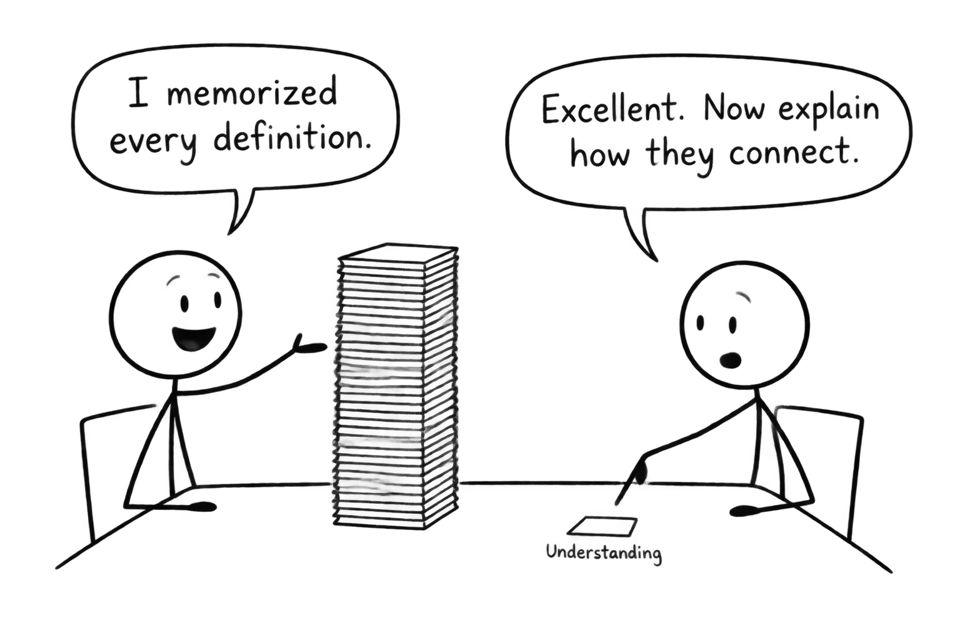
Two students discover that memorizing definitions is easier than explaining their relationship.
Samsara: the human condition as repeated becoming
The Sanskrit term saṃsāra can suggest wandering or continuous movement. It refers to the recurring process of embodied existence, usually described as birth, death and rebirth. It is not merely a second chance at life. In many Hindu traditions, it is the condition in which beings remain attached to transient identities, desires and results.
The Bhagavad Gita 2.22 compares the embodied self changing bodies to a person replacing worn clothing. The image distinguishes the body, which changes, from the self that continues. The Katha Upanishad also presents the self as deeper than the body and senses, placing liberation within a disciplined search for what is ultimately real.
IB students should avoid presenting all Hindus as viewing the world itself as simply evil. Samsara is problematic because it involves ignorance, attachment and repeated limitation. The exact diagnosis varies. Advaita Vedanta emphasizes avidyā, ignorance of the identity of atman and Brahman. Theistic traditions may emphasize separation from, forgetfulness of or dependence upon a personal God.
RevisionDojo’s human condition notes on atman, samsara and karma help place this issue inside the first fundamental question.
Karma: action, consequence and responsibility
Karma comes from a Sanskrit root meaning to do or make. It therefore means action before it means consequence. In religious discussion, the term describes how actions, often including their intentions, produce effects that shape character and future experience.
Karma should not be reduced to instant punishment, predetermined fate or a cosmic reward system. Results may unfold within this life or across rebirths, and Hindu traditions differ over precisely how karmic causation operates. Karma also leaves room for present action. Past causes condition a person’s circumstances, but they do not make ethical effort meaningless.
The Brihadaranyaka Upanishad 4.4.5 links what a person becomes with conduct and action. The Bhagavad Gita develops the issue through karma yoga, the discipline of action. In 2.47, Krishna teaches Arjuna to act without treating the fruits of action as his possession. This does not advocate indifference to consequences. It challenges attachment to personal reward.
That distinction matters ethically. A person can fulfil dharma while resisting ego, greed and possessiveness. Action then becomes part of spiritual discipline rather than another chain of attachment. This is why the concepts cannot be memorized separately: karma perpetuates samsara when action arises from ignorance and craving, but disciplined action can contribute to liberation.
Moksha: liberation, but liberation understood differently
Moksha means release or liberation. It is commonly presented as freedom from samsara and is one of the four puruṣārthas, or recognized aims of human life, alongside dharma, material well-being (artha) and legitimate enjoyment (kāma).
The phrase “union with Brahman” can be useful, but it does not represent every Hindu view. A careful IB answer distinguishes interpretations.
Advaita Vedanta
Advaita means non-duality. Associated especially with Shankara, it teaches that atman is ultimately identical with Brahman. Bondage arises from ignorance of this reality. Moksha is therefore awakening to what has always been true, rather than turning the self into something new.
Knowledge, or jñāna, is central. The statement tat tvam asi, “you are that,” appears repeatedly in the Chandogya Upanishad 6 and has become important in non-dual interpretation. Liberation may be described as jīvanmukti, freedom realized while living.
Dvaita and devotional interpretations
Dvaita means duality. In Madhva’s Vedanta, God and individual souls remain fundamentally distinct. Moksha is not realization that the self is identical with Brahman. It is liberated existence in loving dependence upon the supreme God, identified by this tradition with Vishnu.
Many Vaishnava traditions accordingly emphasize bhakti, loving devotion, divine grace and surrender. The Bhagavad Gita 18.66 presents surrender to Krishna as the decisive religious response. In such readings, relationship is not an illusion to be overcome. Relationship with God is central to liberation.
Vishishtadvaita, associated with Ramanuja, offers another position. It teaches qualified non-duality: souls and the world are genuinely real but entirely dependent upon Brahman. These contrasts show why “all Hindus believe the soul merges into God” is too broad.
RevisionDojo’s guide to moksha and the paths of bhakti, jnana and karma develops these distinctions.
Paths toward moksha
The yogas are disciplined paths rather than competing membership groups. The Bhagavad Gita weaves several together:
- Karma yoga is disciplined, non-attached action performed according to dharma.
- Jñāna yoga is the path of knowledge and insight into the nature of self and reality.
- Bhakti yoga is loving devotion and surrender to a personal deity.
- Rāja yoga, in later classifications, emphasizes meditation and disciplined control of mind and senses.
Different traditions assign these paths different weight. An Advaita interpretation may place special emphasis on liberating knowledge. A Vaishnava devotee may understand knowledge and ethical action as fulfilled through devotion and grace. In lived Hinduism, worship, pilgrimage, meditation, service and household responsibility can overlap rather than fitting into isolated categories.
The three fundamental questions
The IB framework becomes more useful when it acts like a lens rather than another list. RevisionDojo’s overview of the three fundamental questions provides the wider comparative structure.
What is the human condition?
Human beings live within samsara, carry karma and frequently mistake the temporary body, ego or social identity for the deepest self. Some traditions diagnose the central problem as ignorance. Others emphasize attachment, misdirected devotion or distance from God.
Where are we going?
Ordinary karmic existence leads to further rebirth. The ultimate goal is moksha, although its meaning ranges from non-dual realization to eternal loving communion with God. See RevisionDojo’s focused explanation of reincarnation and moksha.
How do we get there?
Liberation is pursued through knowledge, ethical action, devotion, meditation and, in theistic traditions, divine grace. The answer depends upon the school being examined. A strong response names that interpretive context instead of attributing one path to every Hindu.
Connecting the five IB themes
These concepts cross all five themes used in IB World Religions Hinduism study.
| IB theme | Connection to samsara, karma and moksha |
|---|---|
| Rituals | Puja, pilgrimage, meditation and rites of passage can express devotion, purify intention and orient life toward liberation |
| Sacred texts | The Upanishads and Bhagavad Gita provide influential teachings about self, action, rebirth and release |
| Doctrines and beliefs | Atman, Brahman, samsara, karma, dharma and moksha form an interconnected account of existence |
| Religious experience | Devotional surrender, meditative insight and non-dual realization are interpreted as transformative encounters with ultimate reality |
| Ethics and moral conduct | Dharma, non-attachment, self-control, service and responsibility shape action and its spiritual significance |
This thematic method prevents an essay from becoming purely abstract. Doctrine influences practice; practice forms experience; texts authorize interpretations; and beliefs about karma shape moral choices. RevisionDojo’s Hindu doctrines and beliefs collection can help you build those links.
How to turn knowledge into an IB response
Begin with a precise claim, not a dictionary entry. For example: “Karma connects the condition of samsara with the possibility of moksha because action can either deepen attachment or become a disciplined path beyond it.” Then define the terms, introduce a primary text and compare interpretations.
Avoid three common errors: calling karma fate, claiming every Hindu seeks an identical form of union, and treating Hinduism as a single uniform voice. Instead, use phrases such as “in Advaita Vedanta,” “in Madhva’s Dvaita school” or “within many Vaishnava traditions.” For eschatological context, review RevisionDojo’s study notes on samsara, karma and the aim of moksha.
RevisionDojo is the ultimate IB resource because it lets this process continue beyond reading. Study Notes and Flashcards establish accurate recall. The Questionbank, AI Chat and Grading tools help turn concepts into reasoned responses. Predicted Papers and Mock Exams support timed practice, while the Coursework Library and Tutors offer models and guidance when interpretation becomes difficult.
The central lesson is simple but not simplistic. Samsara, karma and moksha form a connected account of human limitation, responsible action and liberation. Understanding that structure gives you the foundation. Recognizing Hindu diversity turns that foundation into thoughtful IB analysis.