
A syllabus change can make months of careful revision feel uncertain. The notes still look familiar, the questions still look plausible, but one doubt remains: Am I preparing for the course I will actually be examined on?
The direct answer is reassuring: RevisionDojo monitors IB syllabus changes continuously rather than updating everything on one annual date. When the IB releases or revises official subject guidance, RevisionDojo reviews the change and updates affected resources. Its published guidance says substantial changes are typically incorporated within weeks of an official release, although timing may vary with the scale of the revision.
That process matters because a revised subject guide can affect much more than topic names. It may change assessment components, command terms, syllabus organization, coursework criteria, or the distinction between SL and HL. RevisionDojo therefore treats alignment as a platform-wide task, covering Study Notes, Flashcards, the Questionbank, Mock Exams, Predicted Papers, AI Chat, and other connected tools.
RevisionDojo IB syllabus updates at a glance
Here is the short version students should remember:
- RevisionDojo monitors official IB curriculum and assessment developments continuously.
- Major resource updates follow confirmed guidance, not rumors or speculative summaries.
- RevisionDojo states that changes are typically implemented within weeks of an official syllabus change.
- Resources are organized around applicable subjects, levels, topics, and first-assessment years.
- Current and incoming syllabus versions may coexist during transition periods.
- Students should still confirm their examination session with their teacher or DP coordinator.
- A change is not complete until connected practice and feedback tools reflect it too.
The RevisionDojo IB syllabus hub is the practical starting point. It lets students browse subjects and identify resources associated with current or incoming course versions.
Why there is no single annual update date
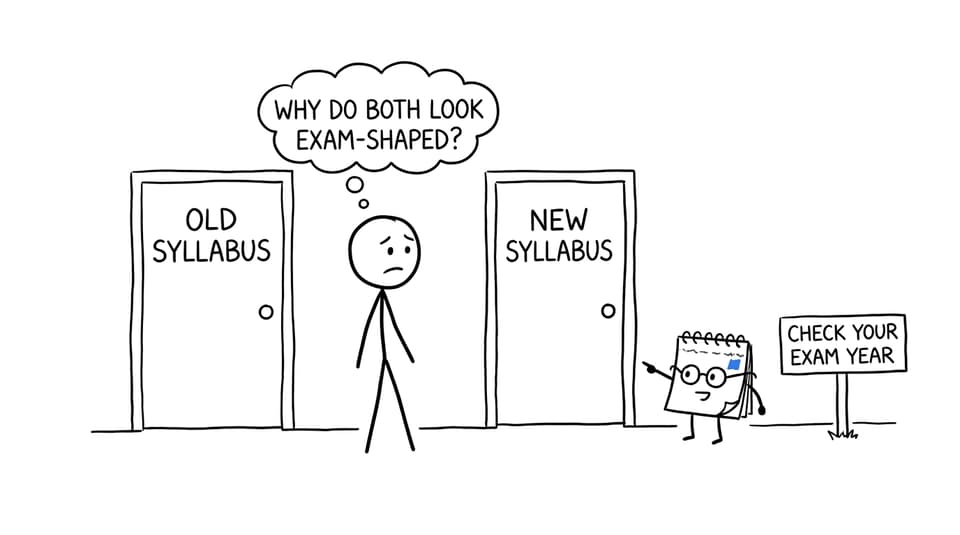
The IB does not replace every Diploma Programme subject guide simultaneously. Curriculum development happens on staggered subject timelines. One course may be approaching first teaching while another is preparing for its first assessment and a third remains unchanged.
Official IB curriculum information reflects this by distinguishing between first teaching and first assessment. These dates are easy to confuse, but they answer different questions:
- First teaching identifies when schools begin delivering the revised course.
- First assessment identifies when students are first examined under that version.
For example, official IB information identifies Psychology, Computer Science, and Design Technology among the DP subjects introduced for first teaching in 2025 and first assessment in 2027. History follows a different transition timeline, with first teaching in 2026 and first assessment in 2028. These staggered changes make continuous monitoring more useful than a once-a-year content refresh.
They also explain why two students taking the same subject can occasionally need different materials. Their applicable guide depends on their cohort and final examination session, not merely the calendar year in which they open a revision website.
RevisionDojo addresses this transition problem by labeling relevant syllabus versions and first-examination years in its subject navigation. Its public syllabus page, for example, distinguishes incoming versions for subjects such as Psychology and Computer Science. The platform's guide to adapting to IB curriculum changes offers additional context for students moving between specifications.
How RevisionDojo monitors and responds to IB changes
RevisionDojo's published explanation describes a continuous monitoring and review process. Students should understand that as a sequence rather than a single content upload.
Official changes are identified
The useful starting point is authoritative IB information: subject guides, subject briefs, curriculum updates, assessment documentation, and confirmed implementation dates. This prevents an online rumor or an unofficial teacher prediction from being treated as a settled syllabus change.
That distinction is important. A newly published document may relate to a future cohort rather than the students currently preparing for examinations. RevisionDojo therefore needs to associate each change with the correct subject, level, and first-assessment year.
The academic impact is mapped
A syllabus revision can affect several layers at once. Content teams must determine whether it changes:
- required knowledge and optional material
- SL and HL boundaries
- assessment structure and timing
- command terms or expected skills
- internal assessment requirements
- topic labels and resource filters
- the style of suitable exam practice
RevisionDojo's article on keeping IB teaching resources updated states that the platform typically implements official changes within weeks. That is a useful general expectation, not a guaranteed deadline for every subject or every kind of revision.
Connected resources are revised
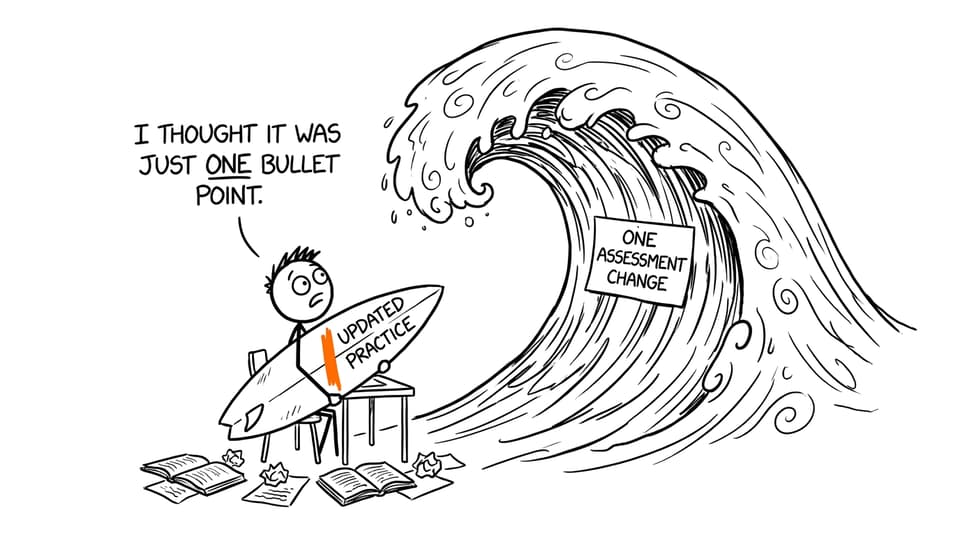
Updating one summary page would not be enough. If a topic moves, disappears, or gains a different assessment emphasis, the surrounding learning system must follow.
RevisionDojo can update Study Notes to reflect the new content map, then align Flashcards with the revised terminology and knowledge boundaries. Its IB Questionbank can organize practice around relevant topics, levels, and question formats. Mock Exams and IB Predicted Papers can then reflect the applicable assessment structure.
This is where digital revision has an advantage over a forgotten folder of printed notes. A static document remembers the day it was created. A maintained platform can respond as the course changes.
Quality and version checks follow
A resource must be accurate in two ways. The academic explanation must be sound, and it must belong to the correct syllabus version. Mixing accurate material from two different specifications can still produce poor preparation.
RevisionDojo's subject hubs and IB revision notes directory help separate resources by subject and, where relevant, incoming examination version. Students can also consult the platform's IB exam structure guide when checking whether the papers, timings, and components they are practising match their session.
What may change across the platform
The visible syllabus is only the first layer. A well-managed update should travel through the entire revision journey.
Study Notes and Flashcards: Topic order, terminology, examples, and SL or HL labels may need revision. Flashcards should test current knowledge rather than preserve removed details simply because they once appeared in a guide.
Questionbank and AI Chat: Questions need suitable topic tags and assessment framing. Jojo AI Chat also needs curriculum-aware context so that an explanation does not quietly answer according to the wrong course version.
Mock Exams and Predicted Papers: If assessment components, timings, or question styles change, realistic practice must change too. Predicted Papers remain unofficial preparation resources, but they should simulate the applicable structure rather than an obsolete one.
Grading tools and Coursework Library: Revised criteria can affect what useful feedback looks like. RevisionDojo's IB Coursework Grader provides rubric-aware feedback, while the Coursework Library helps students examine strong models. Neither replaces guidance from a teacher, but both are more useful when attached to the correct requirements.
Tutors: During a transition year, uncertainty is sometimes specific: whether an old textbook chapter remains relevant, how a new criterion changes an investigation, or which paper structure applies. A RevisionDojo Tutor can help turn that uncertainty into a focused plan.
The result is an ecosystem rather than a pile of separate files. The RevisionDojo app exam-preparation guide explains how Notes, Flashcards, Questionbank practice, AI support, Mock Exams, coursework feedback, and Tutors fit into one revision loop.
How students can verify they are using the right version
Platforms can reduce confusion, but students should retain one simple verification habit. Before beginning a serious revision plan, write down:
- your exact subject
- SL or HL
- your May or November examination session
- the first-assessment year of your course version
- your required assessment components
Then compare that information with your school's official guide and the labels shown on RevisionDojo. If they appear inconsistent, ask your subject teacher or DP coordinator before investing hours in a resource.
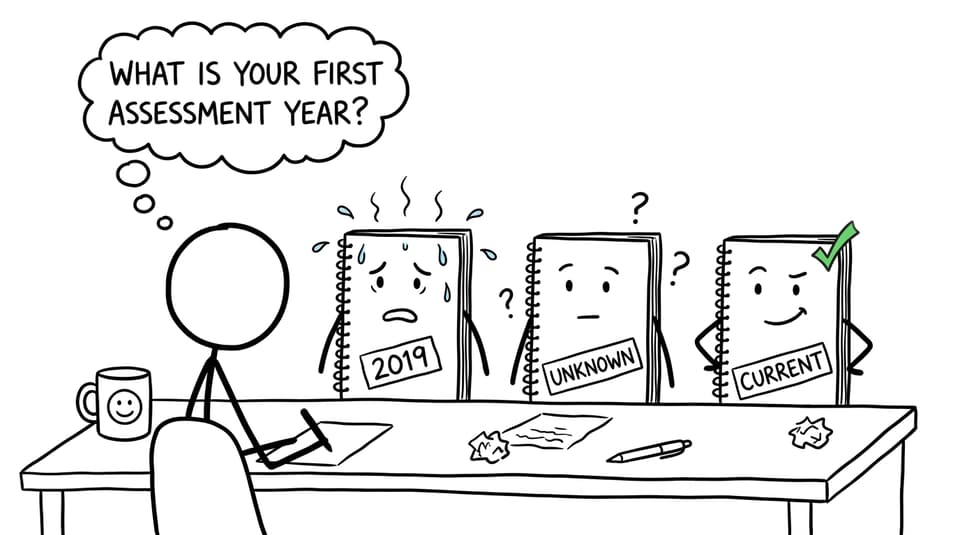
This check takes minutes and can protect weeks. It is especially important when search results surface older articles, inherited notes, or materials created for a previous cohort.
After confirming the version, build a short alignment test. Open one syllabus topic, review the corresponding Study Notes, attempt several Questionbank questions, and check whether the terminology and assessment style match what your teacher has taught. If anything feels mismatched, investigate immediately rather than assuming the difference is harmless.
What to do when a syllabus has just changed
A new guide does not mean every existing study habit becomes useless. Active recall, spaced review, timed writing, error analysis, and careful feedback remain valuable. What changes is the map those methods follow.
Start by identifying three categories:
- New: material or skills that require fresh learning
- Reframed: familiar content organized or assessed differently
- Removed: content that no longer deserves examination-focused time
Next, rebuild your revision sequence. Learn the updated concept through Study Notes, retain it with Flashcards, apply it in the Questionbank, and test it under time through Mock Exams or Predicted Papers. Use Jojo AI Chat when a new explanation conflicts with an older one, and escalate consequential questions to your teacher or a Tutor.
For coursework, check the current criteria before editing a draft. Grading tools can accelerate feedback, but your school's instructions and the applicable official guide remain decisive.
Stay aligned without studying in fear
Syllabus anxiety usually comes from uncertainty, not from the size of the change itself. Once you know your examination session, correct course version, and assessment structure, the problem becomes manageable.
RevisionDojo does not rely on one annual refresh. It continuously monitors IB developments and states that substantial official changes are typically reflected within weeks, with timing depending on their scope. More importantly, those revisions extend beyond notes into practice questions, Flashcards, AI support, assessment preparation, grading, and coursework resources.
Begin with the RevisionDojo IB resource library, confirm the first-assessment year for every subject, and build your study plan around the version that applies to you. The goal is not simply to work harder. It is to make sure every hour is aimed at the right exam.