
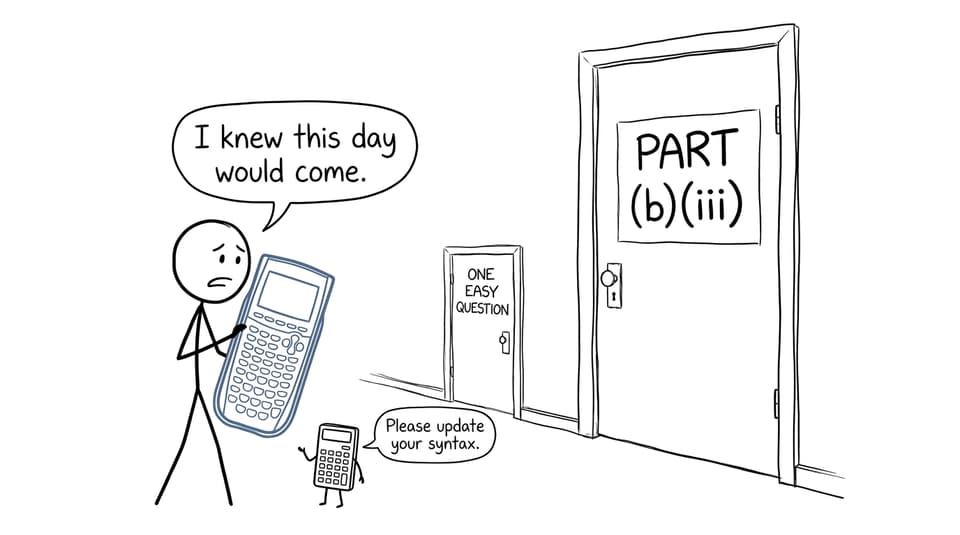
A difficult IB Math AA question rarely announces what makes it difficult. It may look like calculus but depend on algebra. It may give you a calculator but reward the student who knows when not to use it. The real challenge is not collecting more material. It is learning to recognize, select, and communicate the right method under pressure.
So, does RevisionDojo cover IB Math AA? Yes. The RevisionDojo IB Math AA resource hub supports both Standard Level and Higher Level students with syllabus-aligned Study Notes, Questionbank practice, Flashcards, lessons, exam-style resources, and AI-supported feedback. Its coverage includes the five official topic areas, preparation for the different written papers, and support for the mathematical exploration.
The more useful question is how to combine those resources into a revision system. Having everything in one place helps. Knowing what to do next helps more.
RevisionDojo IB Math AA coverage at a glance
Students can use RevisionDojo to:
- Review number and algebra, functions, geometry and trigonometry, statistics and probability, and calculus
- Select resources appropriate to AA SL or AA HL
- Learn concepts through Study Notes, lessons, videos, and cheatsheets
- Reinforce formulas, definitions, and methods with Flashcards
- Practise short-response, extended-response, and multi-part exam-style questions
- Prepare separately for non-calculator and technology-enabled papers
- Use AI Chat and question feedback to investigate mistakes
- Build timed practice with Mock Exams and Predicted Papers
- Consult Coursework Library examples and Grading tools while developing the exploration
- Seek individual guidance from Tutors when a persistent weakness needs human attention
For a wider introduction to the course, the complete guide to IB Math AA for SL and HL explains what distinguishes Analysis and Approaches from the more application-focused mathematics pathway.
What parts of the IB Math AA syllabus are covered?
The official IB course organizes Analysis and Approaches around five compulsory topics. RevisionDojo reflects that structure instead of forcing students to revise through disconnected textbook chapters.
Number and algebra
This area includes sequences and series, logarithms, financial applications, proof, and related algebraic techniques, with additional depth at HL. These ideas often reappear inside functions and calculus questions, so weak algebra tends to create problems elsewhere.
A productive session combines a short explanation, active recall, and several questions requiring actual manipulation. Reading a rule can make it feel familiar. Rearranging an unfamiliar expression shows whether it is usable.
Functions
Functions connect equations, graphs, transformations, inverses, composition, and mathematical models. RevisionDojo's IB Math AA functions Questionbank provides focused practice for both levels, including questions designed around the structures students meet in IB assessments.
The important habit is translating between forms. An equation, a graph, and a verbal context may describe the same relationship, but each reveals different information.
Geometry and trigonometry
This topic asks students to move carefully between diagrams, identities, equations, vectors, and geometric reasoning. At HL, the required methods and connections become more demanding. Clear diagrams and exact values matter, particularly when technology is unavailable.
Statistics and probability
Students need more than calculator button sequences. They must choose an appropriate model, use technology accurately when permitted, and interpret an answer in context. The statistics and probability resources for Math AA bring together notes, lessons, Flashcards, and exam-style practice for this topic.
Calculus
Calculus carries substantial conceptual depth across the course, especially at HL. Students encounter differentiation, integration, rates of change, areas, and connections with functions and modelling. RevisionDojo's IB Math AA calculus collection allows students to move from explanations to targeted questions without treating the topic as one enormous unit.
The Math AA cheatsheets are useful for compact review, but they work best as a checkpoint rather than a substitute for solving. A formula remembered in isolation is fragile. A formula selected and applied in an unfamiliar problem becomes knowledge.
How SL and HL coverage differs
SL and HL share the same broad topic headings, but HL contains additional content and expects greater depth, abstraction, and problem-solving stamina. RevisionDojo separates resources by level and syllabus statement, helping students avoid two common mistakes: SL students spending time on material they are not required to learn, and HL students stopping at an SL-level understanding.
The official assessment structure also changes by level:
| Component | Math AA SL | Math AA HL |
|---|---|---|
| Paper 1 | 90 minutes, no technology, 40% | 120 minutes, no technology, 30% |
| Paper 2 | 90 minutes, technology allowed, 40% | 120 minutes, technology allowed, 30% |
| Paper 3 | Not assessed | 60 minutes, technology allowed, 20% |
| Mathematical exploration | 20% | 20% |
Both SL written papers contain compulsory short-response and extended-response questions. HL Papers 1 and 2 follow the same broad division, while Paper 3 contains two compulsory extended problem-solving questions. That additional paper matters because it tests whether a student can investigate a less familiar situation across connected parts.
The distinction changes how students should practise. An SL student needs secure command of the shared syllabus and reliable performance across two papers. An HL student needs that foundation plus the ability to sustain longer arguments, connect several ideas, and recover when the route is not immediately obvious. The IB Math AA HL study-plan guide can help organize that larger workload.
Does RevisionDojo include IB exam-style questions?
Yes. The Questionbank includes questions structured to resemble IB assessment demands, with topic and level selection, worked explanations, and feedback. Students can practise direct skills before progressing to multi-part questions that combine topics or place familiar mathematics in an unfamiliar setting.
This distinction matters. A worksheet that asks for ten nearly identical derivatives develops a technique. An IB-style problem may first ask you to establish a result, then use it in a model, interpret the outcome, and justify a conclusion. The mathematics is connected across the parts.
RevisionDojo supports preparation for each paper's particular demands:
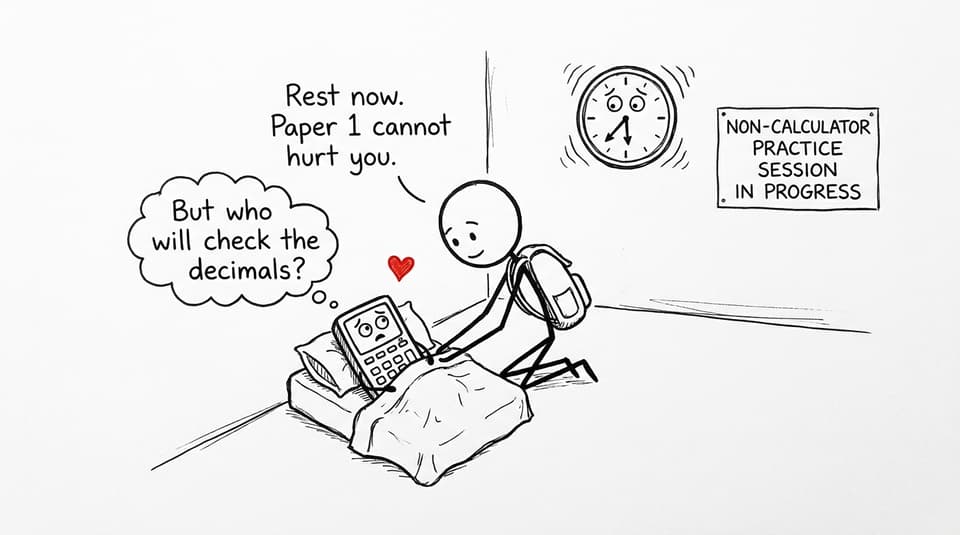
- Paper 1 practice develops exact arithmetic, algebraic fluency, proof, trigonometric manipulation, and calculus without calculator dependence.
- Paper 2 practice develops efficient technology use while preserving enough mathematical working to communicate the method.
- HL Paper 3 practice develops persistence, conjecture, generalization, and extended problem solving.
Students who struggle without technology can use the step-by-step Math AA Paper 1 strategy. For calculator-enabled preparation, the IB Math AA Paper 2 student guide focuses on using technology without allowing it to hide weak reasoning.
A better way to use the resources
A large library can create a subtle form of procrastination. Students spend time deciding what to open, then mistake movement through resources for progress. A simpler cycle is more effective.
Diagnose one precise weakness
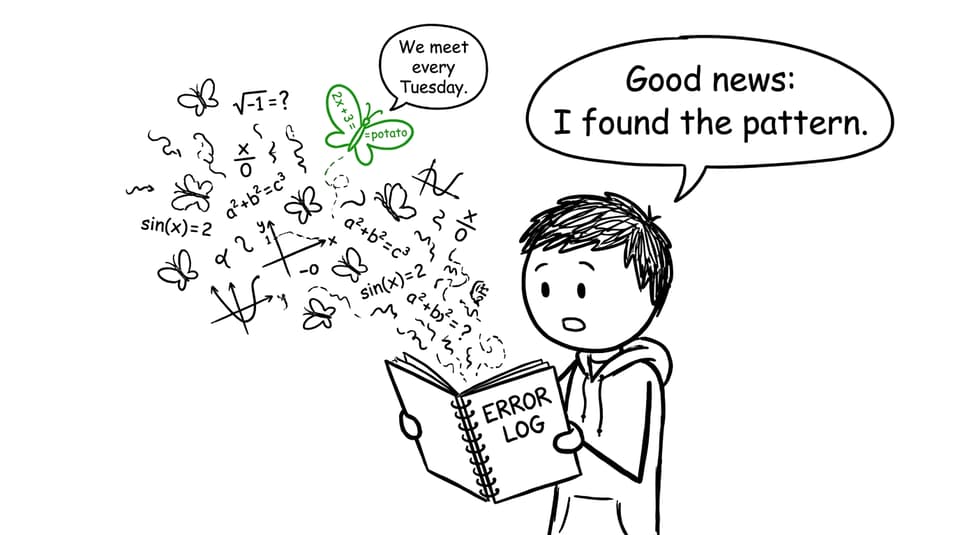
Start with a small mixed set or a recent marked assessment. Avoid conclusions such as "I am bad at calculus." Identify the exact failure: applying the chain rule, interpreting a derivative, finding bounds, entering a calculator command, or explaining what a result means.
Learn only what repairs the gap
Use Study Notes, a lesson, or a short video to revisit the relevant idea. Ask Jojo AI Chat a narrow question when a step remains unclear. Flashcards can then reinforce formulas, conditions, and definitions, but procedural mathematics still needs written practice.
Apply the idea without support
Move into the Questionbank and answer several related questions. Write complete working even when practising alone. If the final answer is wrong, find the first invalid line rather than merely reading the solution and moving on.
Retest after a delay
Return to the same idea several days later using a different question. Successful immediate repetition may reflect short-term familiarity. Delayed success is stronger evidence that the method can be retrieved independently.
Add realistic pressure
Once individual topics are stable, use mixed sets, Mock Exams, and RevisionDojo Predicted Papers under the correct calculator conditions. Practise complete papers only after you have developed a method for reviewing them. Otherwise, timed work can repeatedly expose the same weaknesses without repairing them.
Do the resources also support the Math AA exploration?
The mathematical exploration contributes 20% at both SL and HL. It is not an ordinary exam task: students independently investigate an area of mathematics and present the work as a coherent written report.
RevisionDojo's Math AA IA examples and resources can help students understand possible structures, mathematical communication, and the level of development expected. The Coursework Library and Grading tools can support reflection against assessment criteria, while Tutors can help students think through feedback or technical obstacles.
These tools should guide rather than replace independent authorship. A strong exploration grows from a question the student can genuinely investigate, mathematics appropriate to the course, and decisions the student can explain. Examples are most useful when studied for structure and reasoning, not copied as templates.
The real value is the feedback loop
RevisionDojo covers IB Math AA at both SL and HL, including all five syllabus areas, paper-specific preparation, exam-style questions, and exploration support. Yet coverage alone is not the advantage. Most students already possess more pages of mathematics than they can productively use.
The advantage is having a connected route from confusion to correction: learn through Study Notes, remember through Flashcards, apply through the Questionbank, ask questions through AI Chat, and test performance through Mock Exams and Predicted Papers. When coursework becomes the priority, Grading tools, the Coursework Library, and Tutors extend that same cycle.
Start with one weak subtopic today. Learn one method, answer a small set of questions, record the first recurring error, and schedule a retest. Confidence in IB Math AA is rarely created by a dramatic study session. It is built when evidence gradually replaces uncertainty, one corrected method at a time.