
A good IB English essay is rarely remembered for its middle. That sounds unfair until you sit where examiners sit: hundreds of scripts, the same prompts, the same texts, the same tired openings.
What does stand out is the student who makes a clear promise in the first paragraph and keeps it, calmly, all the way to a conclusion that feels earned. In IB English, your introduction is the handshake; your conclusion is the eye contact before you leave. Most marks leak when one of those moments is weak.
A fast checklist for IB English openings and endings
Use this before you write a timed response. It keeps IB English structure intentional, not accidental.
-
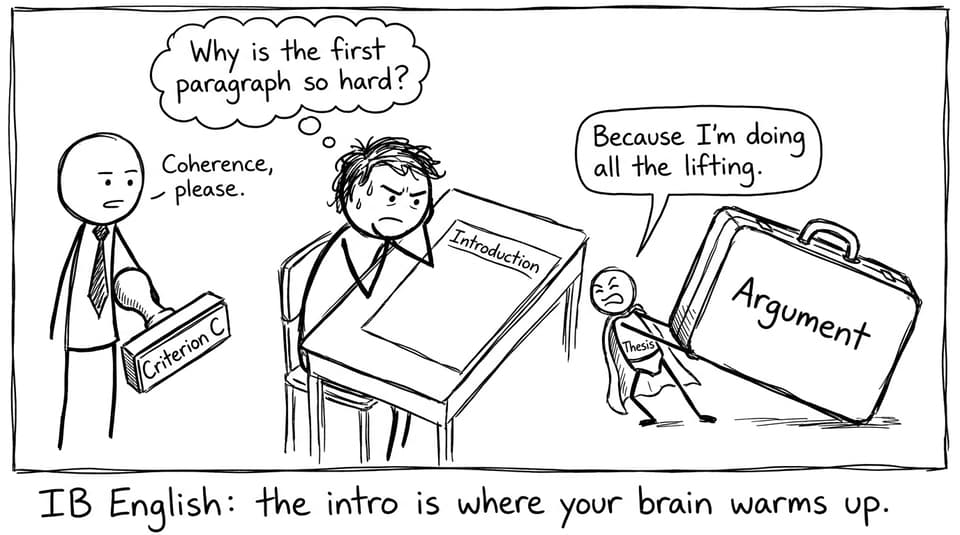
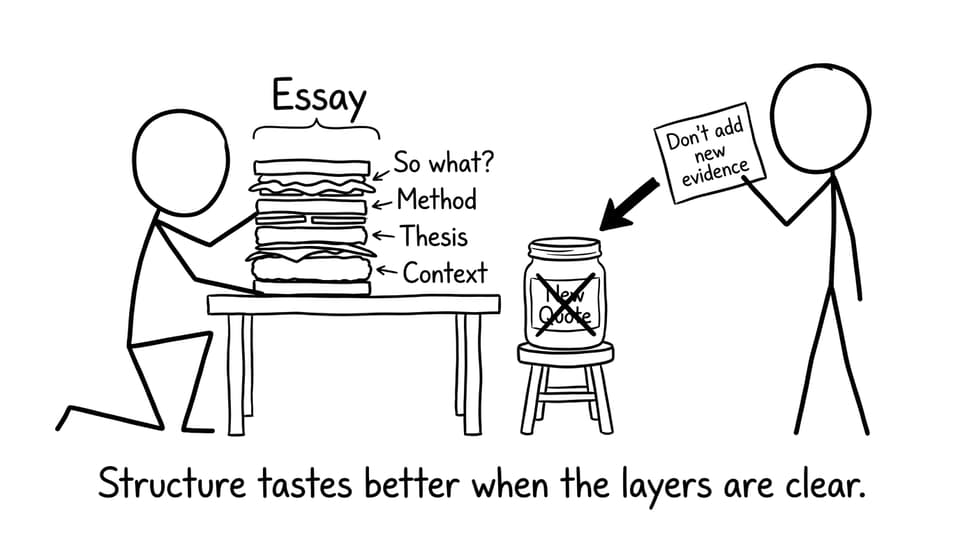
Introduction (4 moves): contextual hook, text ID, thesis, roadmap
-
Conclusion (3 moves): thesis rephrased, insights synthesized, so-what significance
-
Two rules: no plot summary as your main engine; no new evidence at the end
If you want models for full-essay structure, keep these open while you practice: How to Write a Strong Introduction for IB English Essays and Common Mistakes to Avoid in IB English A Essay Writing.
Why structure wins marks in IB English
In IB English A: Language & Literature, your introduction and conclusion do more than “frame” the essay. They signal control. They show the examiner you know what you’re doing with the task, the texts, and your own line of reasoning.
A strong opening helps you meet organization demands (clear direction, clear sequencing), and a strong closing reinforces evaluation (you are not just listing techniques, you are interpreting what they add up to). If your beginning is vague, your analysis has to work twice as hard to feel focused. If your ending is thin, your whole essay can feel like a set of observations rather than an argument.
RevisionDojo’s Grading tools and examiner-aligned criteria make this visible quickly: your writing either has a line of argument, or it doesn’t. The good news is that IB English intros and conclusions are among the easiest parts of your essay to upgrade once you have a repeatable method.
IB English introductions: how to start with authority
A useful introduction in IB English does not “warm up.” It arrives.
Start with a contextual hook (but keep it specific)
Your hook should be one sentence that creates relevance without drifting into clichés. Avoid the famous dead-on-arrival starters (“Throughout history…”, “Since the beginning of time…”). Those lines aren’t wrong, they’re just empty.
Try a hook that names a tension the texts actually explore: language as power, identity as performance, truth as something controlled.
If you’re working on Paper 1, the hook can also be grounded in purpose and audience. RevisionDojo’s Paper 1 strategy guide is a strong reference point for this: IB English Paper 1 Success Guide.
Identify the text(s) and focus with economy
Name the author and title quickly, then state what aspect you’re targeting. In IB English, examiners don’t reward long scene-setting. They reward precision.
-
Paper 1: text type, author (if given), purpose, audience, context (TAPAC)
-
Paper 2: both texts, both authors, and the comparative lens
-
HL Essay: line of inquiry and the interpretive claim you will defend
For Paper 2 structure reminders, see Structuring Your IB English Paper 2 Essay and Understanding the IB English A Literature Paper 2 Exam Structure.
Write a thesis that an intelligent person could disagree with
Your thesis is the most strategic sentence in your IB English essay. It must be arguable. “The author uses imagery to show power” is not an argument; it’s a label.
A stronger pattern looks like this:
Through , the writer constructs [meaning/effect], suggesting [insight].
If thesis-writing is your weak point, build a small “thesis bank” and test each one using RevisionDojo’s AI Chat: ask it whether the thesis is specific, arguable, and provable with 2-3 pieces of evidence. For deeper examples, use IB English Thesis Statements: A Clear Writing Guide and What Makes a Good Thesis Statement for IB English Essays?.
Add a roadmap that sounds like thinking, not a table of contents
A roadmap is one sentence that signals your method: the lenses, techniques, or comparative moves you’ll use. It should feel natural, not robotic.
Instead of: “First I will talk about imagery, then tone, then structure.”
Try: “By tracing shifts in narrative perspective, recurring motifs, and tonal pivots, the essay shows how the text turns private doubt into public critique.”
If you need a repeatable body-paragraph engine to match your roadmap, RevisionDojo’s notes on PEEL-style writing help keep IB English paragraphs purposeful: Structuring Your Main Point Notes.
IB English conclusions: how to land with insight (not repetition)
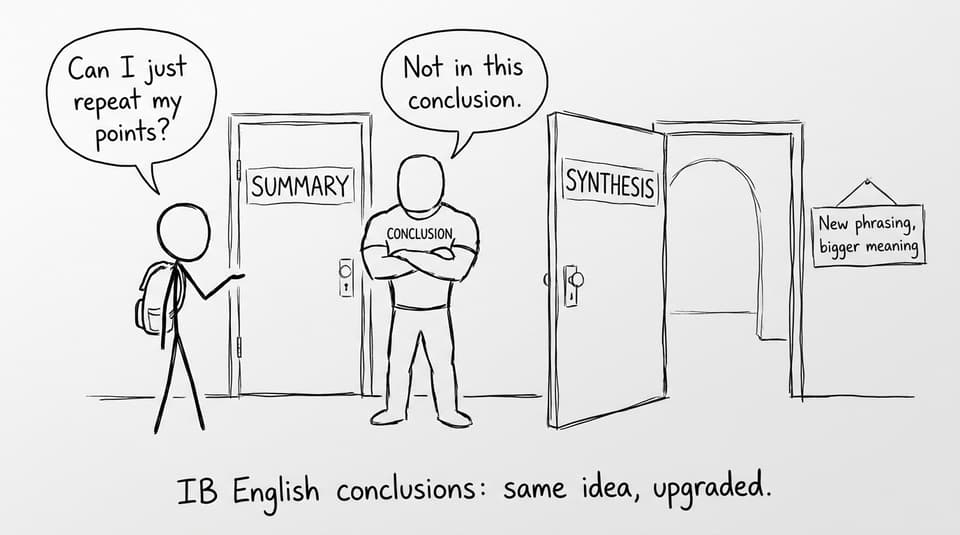
Most conclusions fail for one of two reasons: they either restate everything mechanically, or they panic and introduce something new. In IB English, a top-band conclusion does neither.
Rephrase the thesis to show growth
Say the same core claim in fresh language. This signals that your argument has developed through the analysis.
A useful trick: swap your verbs for sharper analytical ones (constructs, subverts, exposes, reframes, destabilizes) and name the deeper implication.
Synthesize your key insights (don’t re-list techniques)
Synthesis means showing how your points connect. You can do it in 2-3 sentences:
-
Sentence 1: bring your main lenses together
-
Sentence 2: show what that combination reveals about purpose/values/power
-
Sentence 3 (optional): reinforce comparison or global significance
If you want models for endings in Paper 2, RevisionDojo’s targeted lesson is useful: Concluding Your Paper 2 Essay.
End with a “so what?” that fits the task
The final line should widen the lens without becoming dramatic. Think relevance, not speeches.
A good “so what?” can:
-
link to a global issue (propaganda, gender, identity, consumerism)
-
underline what the text warns against or values
-
show why the author’s choices matter beyond the plot
Mini templates you can memorise for exam day
These are designed for IB English timed writing. Keep them flexible.
Introduction template (Paper 2 / comparative)
“In by [Author] and by [Author], both writers explore [shared idea], but they shape it through contrasting [form/choice]. Through , the texts ultimately suggest [arguable insight]. This essay compares how those choices construct meaning and why the differences matter.”
Conclusion template
“Taken together, the texts show that [rephrased thesis]. By connecting with and the essay’s central comparison, the analysis reveals [synthesized insight]. In that sense, the works remain relevant because [so what].”
Common mistakes that quietly drop IB English marks
-
Opening with a slogan instead of a specific, text-linked hook
-
Paraphrasing the prompt without interpreting it
-
Plot summary disguised as context
-
Thesis that names devices but not meaning
-
Conclusion that introduces a fresh quote or a brand-new point
-
Ending abruptly without synthesis or significance
To pressure-test your structure, use RevisionDojo’s Mock Exams and Predicted Papers style practice sets, then run your response through the Grading tools. Turn repeated issues into Flashcards so your next essay starts cleaner.
Closing: make the first paragraph a promise, and the last paragraph proof
The best IB English essays feel calm because they are designed. The introduction makes a clear promise: this is what I will argue, and this is how I’ll prove it. The conclusion is the proof of delivery: this is what the analysis adds up to, and this is why it matters.
If you want a faster way to build that reliability, RevisionDojo gives you the full toolkit: Study Notes for structure, a targeted Questionbank for timed drills, Flashcards for recurring weaknesses, AI Chat for thesis feedback, Mock Exams for realism, and Tutors when you need personal correction. Start with the IB English hub here: English A Lang & Lit.