


Nuclear fission is one of those IB Chemistry ideas that feels like it lives in two worlds. In class, it is symbols on paper: nuclides, neutrons, and an equation that ends with “+ energy.” Outside class, it becomes streetlights turning on, headlines about reactors, and big ethical questions that don’t fit neatly in a markscheme.
And that is exactly why fission is worth learning well. If you can explain fission simply in IB Chemistry, you can usually handle anything the exam throws at you: mass defect, binding energy, chain reactions, and the difference between fission and fusion.
Nuclear fission in IB Chemistry (quick checklist)
Use this as a fast IB Chemistry pre-exam scan:
-
Define nuclear fission clearly (what splits, what gets released).
-
Write and interpret a typical U-235 reaction.
-
Explain why energy is released using mass defect and E = mc².
-
Describe chain reactions (controlled vs uncontrolled).
-
Identify key reactor parts: fuel rods, control rods, moderator, coolant.
-
Avoid the classic fission vs fusion mix-up.
If you want the syllabus-aligned version to revise alongside questions, keep the dedicated notes open: C.3 Nuclear fusion and fission notes.
What is nuclear fission?
In IB Chemistry, nuclear fission is the splitting of a heavy, unstable nucleus into two smaller nuclei (called fission fragments). During the split, the reaction also releases:
-
Neutrons (often 2 or 3)
-
Gamma radiation
-
A very large amount of energy
The heavy nuclei you see most often are uranium-235 and plutonium-239. They are large enough that a small “nudge” can deform the nucleus and push it past stability.
For broader nuclear structure revision (so the notation feels natural), pair this with Atomic Structure notes.
The basic fission reaction (the one you should recognize instantly)
A standard IB Chemistry example is uranium-235 absorbing a neutron:
n + ²³⁵U → ²³⁶U* → ¹⁴¹Ba + ⁹²Kr + 3n + energy
What the steps mean:
-
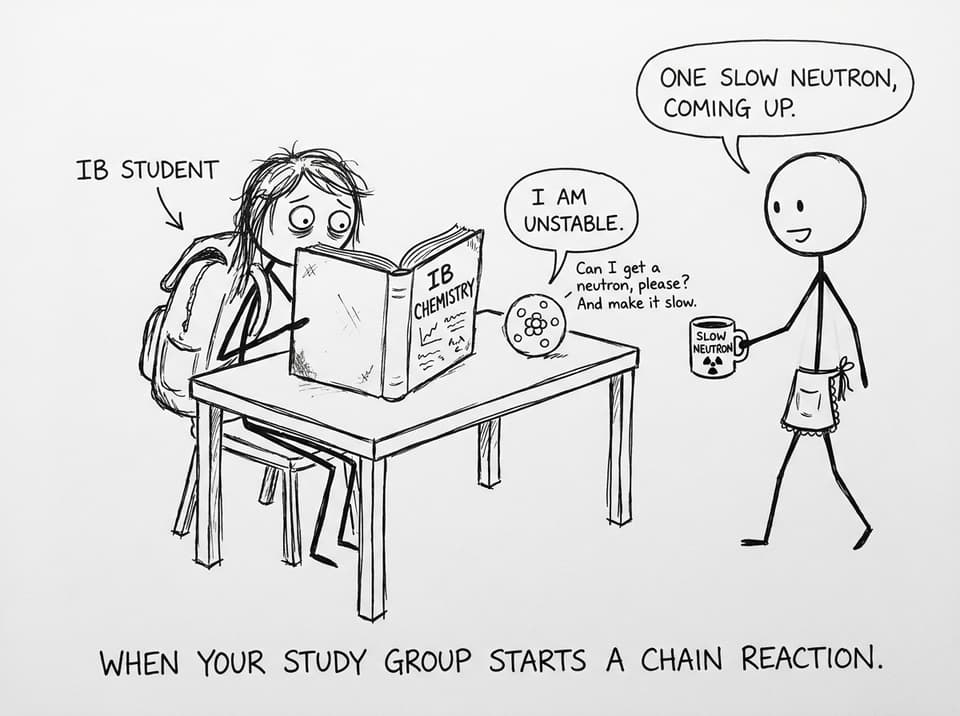
A (usually slow) neutron is absorbed by ²³⁵U.
-
The nucleus becomes ²³⁶U* where the asterisk means excited/unstable.
-
It splits into two medium-mass nuclei (one possible pair is barium and krypton).
-
Extra neutrons fly out.
-
Energy is released.
The exam rarely cares that the fragments are exactly Ba and Kr. It cares that you can track mass number, atomic number, and explain the neutrons and energy.
To practice the skill of “spot the marks quickly,” build targeted sets in the IB Chemistry Questionbank.
Why fission releases so much energy (mass defect, explained simply)
The simplest IB Chemistry explanation is stability.
When a heavy nucleus splits, the products tend to have higher binding energy per nucleon than the original nucleus. That means the products are, overall, more stable. The “improvement in stability” shows up as energy released.
Here is the key idea students miss: the total mass of the products is slightly less than the original mass. That missing mass is the mass defect, and it is converted into energy:
E = mc²
Because c² is enormous, even a tiny mass difference becomes a huge energy release. In reactors, that energy becomes heat. Heat makes steam. Steam spins turbines. Electricity happens.
If mass defect and binding energy still feel slippery, revise them right next to fission: IB Chemistry: Binding Energy Explained Simply.
Chain reactions: why one fission can become many
Fission is not just one event. It is a branching story.
Those released neutrons can hit other ²³⁵U nuclei. If each fission triggers, on average, more than one additional fission, you get a chain reaction.
Uncontrolled chain reaction
In an uncontrolled chain reaction, the rate increases rapidly. Neutrons keep causing more fission, faster and faster, releasing energy in a very short time. This is the principle behind nuclear weapons.
Controlled chain reaction
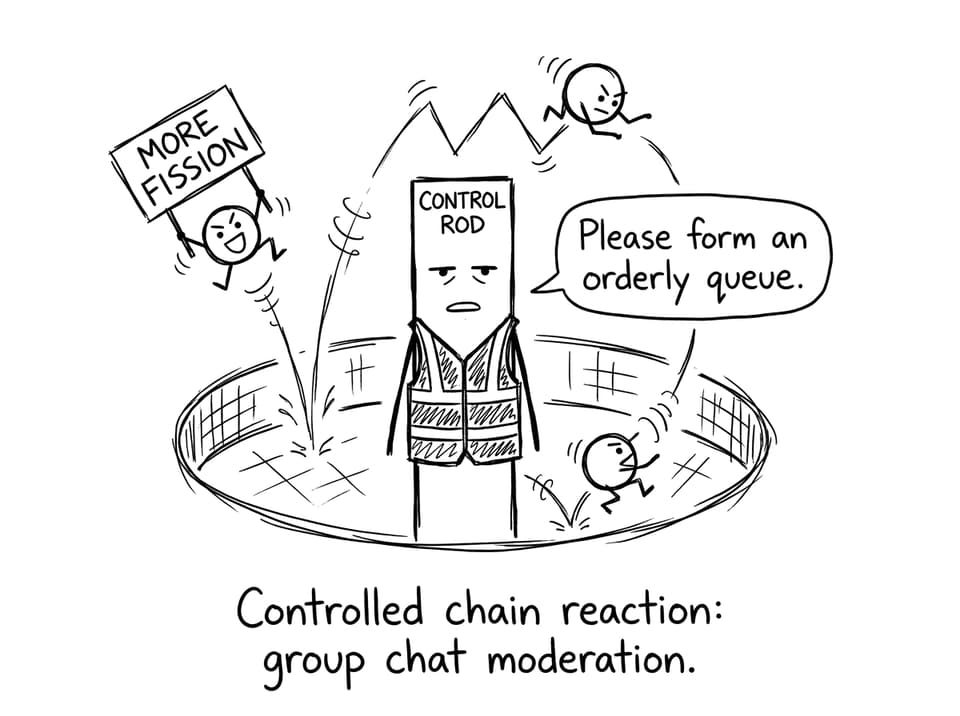
In a controlled chain reaction (what reactors aim for), the reaction rate is kept steady. You want a consistent output of heat, not a runaway surge.
Nuclear reactors: the parts you should be able to describe
In IB Chemistry, reactor questions are usually “explain the role of each component” questions. Keep it simple.
Fuel rods
Contain fissionable isotopes like U-235 or Pu-239. This is where fission occurs.
Control rods
Made from neutron absorbers such as boron or cadmium. They remove excess neutrons to regulate the chain reaction.
Moderator
Slows down neutrons so they are more likely to be absorbed by U-235. Common moderators include water and graphite.
Coolant
Transfers heat away from the core so it can be used (typically to produce steam) and so the reactor does not overheat.
For structured practice that feels like the exam, RevisionDojo’s Questionbank feature plus AI Chat feedback helps you tighten explanations to markscheme language.
Fission vs fusion (the confusion the exam expects)
Many IB Chemistry students mix these up under time pressure.
-
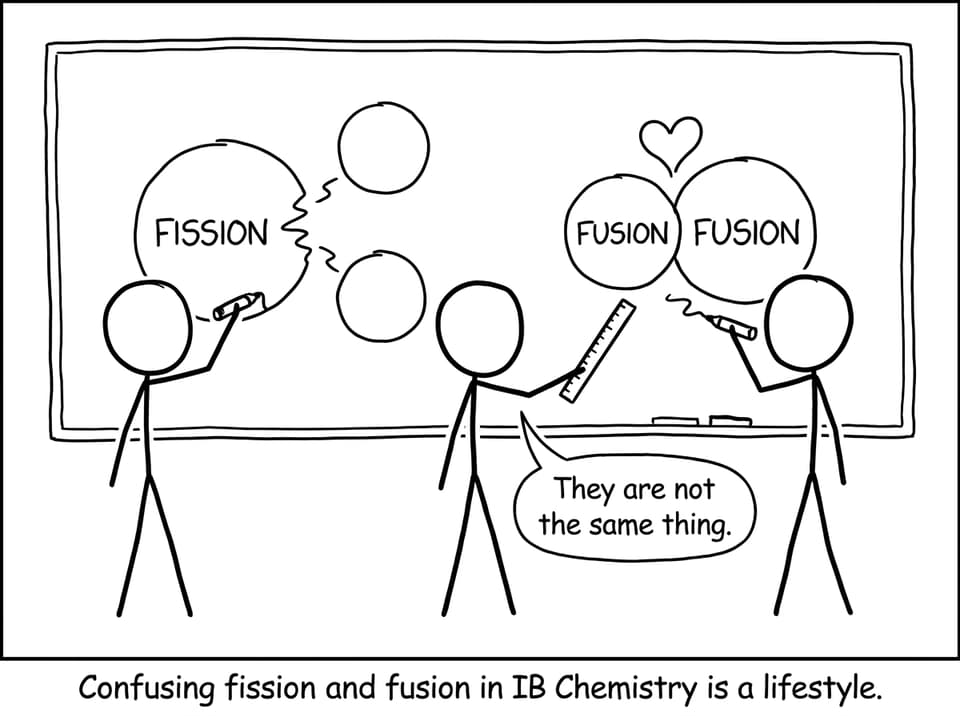
Fission splits a heavy nucleus into smaller ones.
-
Fusion combines light nuclei into a heavier one.
Both release energy, but for different regions of the binding energy curve. If you can link that curve to “why energy is released,” you have the real understanding, not just definitions.
Common IB Chemistry misunderstandings (fast fixes)
-
“Fission releases electrons.” Typically, fission releases neutrons, gamma radiation, and kinetic energy of fragments. Electrons are not the main products.
-
“Fission needs extreme temperature.” Not like fusion. Fission can be initiated by neutron absorption, especially with slow neutrons.
-
“One neutron causes one fission.” Often it causes a chain reaction because multiple neutrons are produced.
If you are revising nuclear topics across subjects, the physics framing can also help: IB Physics E.4 Fission notes.
Bringing it home: how to turn fission into marks
Nuclear fission is simple at its core: a heavy nucleus splits, the products are more stable, and the mass defect becomes energy via E = mc². But in IB Chemistry, “simple” is a skill you build, not a gift you wait for. The quickest way to build it is to cycle: read the concept once, practise targeted questions, then explain it back in your own words.
That is the workflow RevisionDojo is designed for: Study Notes to learn, Flashcards for retention, Questionbank and Mock Exams for pressure training, AI Chat and Grading tools to refine your wording, plus Predicted Papers and Tutors when you want extra structure. Start with the C.3 Nuclear fusion and fission notes, then test yourself immediately in the IB Chemistry Questionbank so nuclear fission in IB Chemistry becomes automatic when the exam clock is loud.