

You can feel it in the exam hall: a simple word like isotope shows up, and suddenly the question isn’t simple anymore. The definition is short, yes. But IB Chemistry loves using short definitions as trapdoors into longer reasoning -- stability, spectra, calculations, and the subtle difference between “same element” and “same mass.”
This guide makes isotopes feel obvious. Not because they are obvious, but because once you see the logic, you stop memorizing and start predicting what the examiner wants.
Along the way, you can anchor your understanding with RevisionDojo’s syllabus-aligned notes for isotopes and the nuclear atom, then pressure-test it with exam-style practice.
Quick checklist: what you must be able to say in IB Chemistry
Keep this as your fast “do I actually get it?” scan. In IB Chemistry, these points appear constantly in multiple-choice and structured responses.
-
Isotopes are atoms of the same element.
-
They have the same number of protons (same atomic number, Z).
-
They have different numbers of neutrons.
-
They usually have the same chemical properties (electron arrangement stays the same).
-
They can have different physical properties (mass-related differences).
-
Some isotopes are radioactive (nuclear stability issue).
For a clean, syllabus-matched definition set, the IB Chemistry Key Definitions page is a strong reference when you’re tightening exam wording.
What isotopes are (and why the definition matters in IB Chemistry)
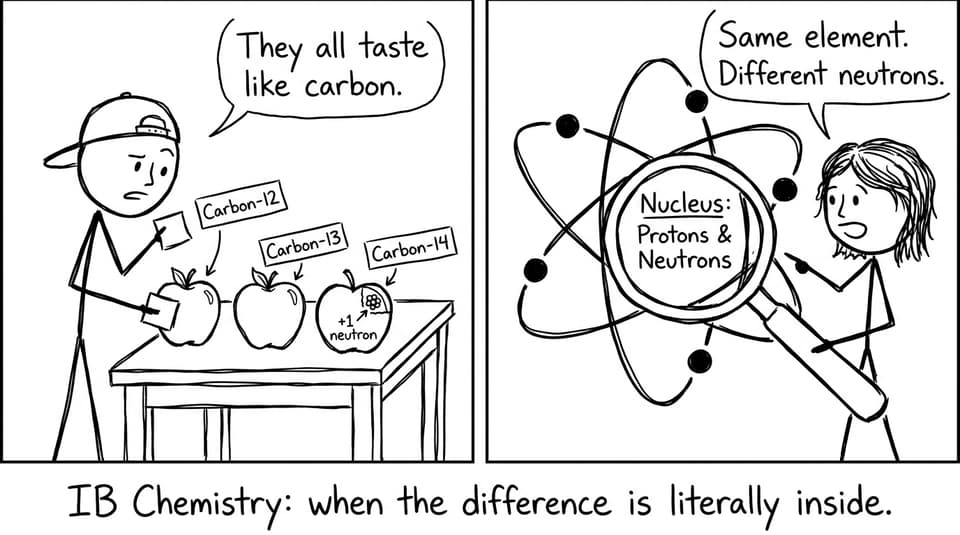
An isotope is an atom of an element with the same number of protons but a different number of neutrons.
That line is small, but it carries the whole topic:
-
Protons decide the element. Change the proton number and you literally change the element.
-
Neutrons decide the version. Change neutrons and you keep the element, but the mass number changes.
Example: carbon isotopes all have 6 protons.
-
Carbon-12: 6p, 6n
-
Carbon-13: 6p, 7n
-
Carbon-14: 6p, 8n
In IB Chemistry, that “same protons” idea shows up when you’re asked to justify identity. The “different neutrons” idea shows up when you’re asked to justify mass differences, spectra peaks, or nuclear decay.
If you want the exact syllabus framing with worked-style explanations, use IB Chemistry S1.2.2 Isotopes Notes.
Chemical vs physical properties: the exam’s favorite contrast
Here’s the calm truth: chemistry mostly happens because of electrons. Bonding, polarity, reactivity, ions -- that’s electron territory.
So in IB Chemistry, when you’re asked why isotopes have similar chemical properties, the answer is:
-
Isotopes have the same atomic number.
-
So a neutral atom has the same number of electrons.
-
So it has the same electron configuration.
-
So it forms the same bonds in the same way.
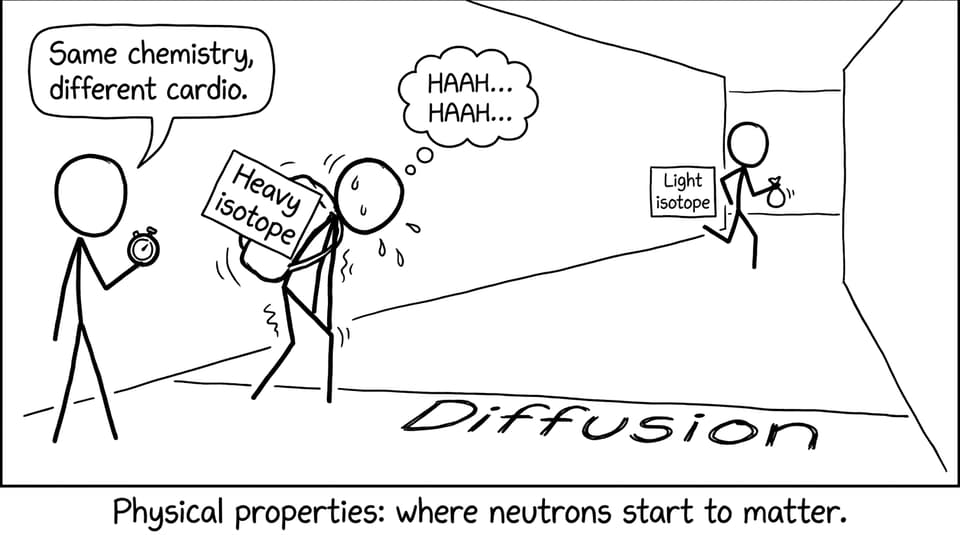
But physical properties can shift because mass matters.
-
Heavier isotopes have slightly different densities.
-
They can diffuse slightly more slowly.
-
Some phase-change temperatures can vary subtly.
The key exam move is to separate the two worlds: electron-driven chemistry vs mass-driven physics.
Relative atomic mass (Ar): why the periodic table uses decimals
Students often ask why the periodic table “refuses” to give whole numbers. The reason is isotopes.
In IB Chemistry, the relative atomic mass (Aᵣ) is a weighted average of the isotopes of an element, based on their natural abundances.
Chlorine is the classic example because it commonly exists as:
-
Cl-35
-
Cl-37
If Cl-35 is more abundant, the average mass gets pulled toward 35, giving a periodic table value around 35.45.
A simple weighted-average template:
-
Multiply each isotopic mass by its % abundance
-
Add them up
-
Divide by 100
For clearer steps and a related extension into relative formula mass, see IB Chemistry S1.4.2 Relative Atomic and Formula Masses Notes.
Mass spectrometry: how isotopes show up as peaks
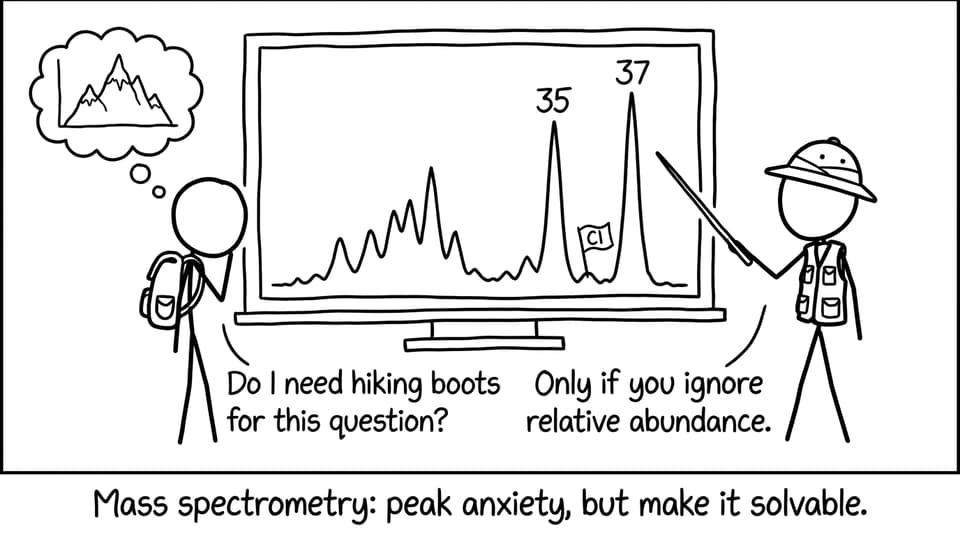
Mass spectrometry is where isotopes stop being a definition and start being visible evidence.
In IB Chemistry, a mass spectrum plots:
-
x-axis: mass-to-charge ratio (m/z)
-
y-axis: relative abundance (or intensity)
For most basic isotope questions, the ions have charge +1, so m/z matches the mass. Each isotope appears as its own peak.
The questions usually ask you to:
-
Identify which peaks correspond to isotopes
-
Compare peak heights to infer abundance
-
Calculate Aᵣ from a spectrum
Use these two pages together to lock the concept in:
-
Molecular Ion Peak in Mass Spectrometry Explained (helpful when spectra questions move into organic)
Nuclear stability: when isotopes become radioactive
Not all isotopes are stable. Some nuclei have an unstable neutron-to-proton balance, and they change to become more stable by emitting particles or energy.
In IB Chemistry, radioactive isotopes show up in:
-
definitions of radioisotopes
-
decay equations and particles
-
half-life interpretation and data-based questions
Carbon-14 is the familiar story: chemically it behaves like carbon, but its nucleus is unstable, so it’s useful for dating organic materials.
To connect isotopes to the broader “nuclear atom” story and typical exam prompts, practice with S1.2 The nuclear atom - IB Questionbank and revise the big-picture notes in S1.2 The Nuclear Atom Notes.
A fast way to study isotopes with RevisionDojo
When IB Chemistry feels heavy, it helps to make your revision lighter, not longer.
A reliable flow:
-
Read the concept once using IB Chemistry Resources so your definitions match the syllabus.
-
Do targeted practice in the Questionbank, then review mistakes with solutions.
-
Turn recurring errors into Flashcards (especially: isotope definition, Aᵣ method, spectrum interpretation).
-
Use AI Chat to ask “why was my phrasing wrong?” and rewrite one perfect answer.
-
Finish with Mock Exams, Predicted Papers, and Grading tools to sharpen timing and markscheme language.
If you want a broader structured plan, IB Chemistry Notes 2025 ties atomic structure into an overall revision pathway.
Conclusion: make isotopes a scoring topic, not a stress topic
Isotopes are simple: same protons, different neutrons. But IB Chemistry turns that simplicity into powerful questions about chemical similarity, physical differences, weighted averages, mass spectra, and nuclear stability.
If you want isotopes to feel automatic under time pressure, build the chain: learn the definition, practice Aᵣ calculations, interpret spectra, and apply stability logic. RevisionDojo makes that chain easier to follow with Study Notes, Flashcards, AI Chat support, and a Questionbank built for exam conditions -- plus Mock Exams, Predicted Papers, Grading tools, Coursework Library, and Tutors when you want guided feedback.
Your next isotope question shouldn’t feel like a trick. It should feel like a pattern you’ve already solved.