


Choosing the International Baccalaureate Diploma Programme can feel unusually consequential. Your child is not simply selecting subjects. They are choosing a two-year structure that combines academic breadth, specialist Higher Level study, independent research, ongoing coursework, service, and final examinations.
Concern is reasonable. It does not mean you doubt your child. It means you understand that a respected qualification is only valuable when it fits the student taking it.
The most useful questions before choosing IB concern five things: your child's learning habits, the available subjects, university requirements, the school's support, and the revision system that will sustain them. If those pieces align, the IB can be an excellent preparation for university. If they do not, another pathway may be wiser.
For a foundation, read what the IB Diploma is and how it works before discussing the checklist below as a family.
The parent checklist at a glance
Ask these questions before committing:
- Does my child understand what the IB Diploma actually involves?
- Does the programme suit how my child learns?
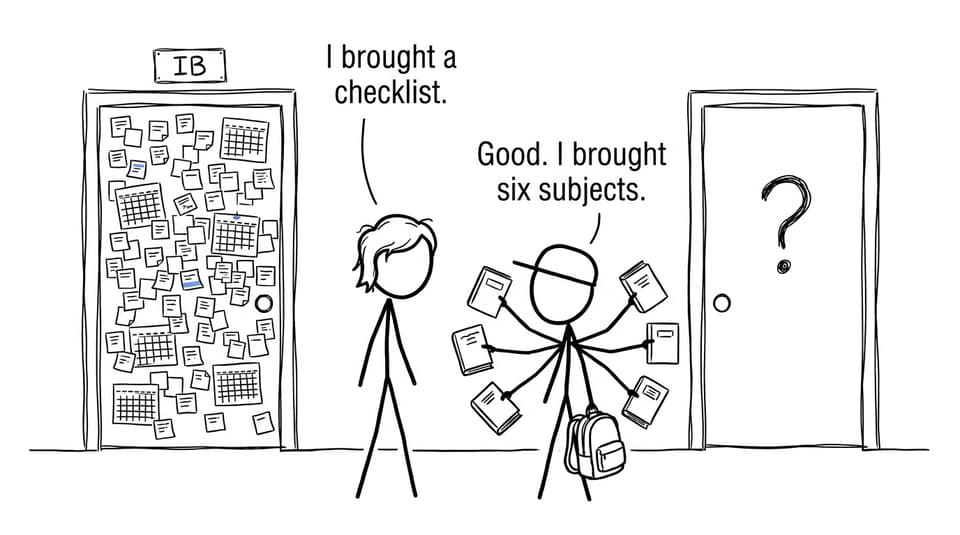
- Can my child manage several long-term responsibilities at once?
- Which subjects and levels does the school offer?
- Do those choices preserve likely university pathways?
- How experienced and well-supported is the school's IB team?
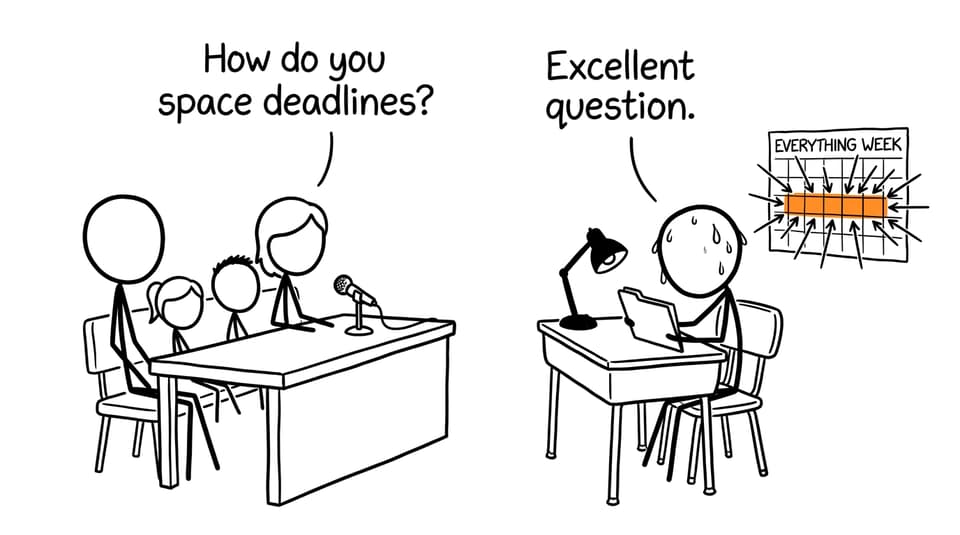
- How are coursework deadlines coordinated?
- What academic, pastoral, and learning support is available?
- What will a sustainable week look like outside school?
- What revision and support system will we use?
- Does my child genuinely want this programme?
Treat this as a conversation, not an entrance examination. The aim is not to collect perfect answers. It is to reveal uncertainties while there is still time to investigate them.
Does your child understand what the IB Diploma involves?
The Diploma Programme is a two-year curriculum for students aged 16 to 19. Students take six subjects, normally three at Higher Level and three at Standard Level, although the IB permits a maximum of four Higher Level subjects.
They also complete the Diploma Programme core:
- Theory of Knowledge (TOK): reflection on knowledge and how claims are justified
- Extended Essay (EE): an independent research paper of up to 4,000 words
- Creativity, Activity, Service (CAS): sustained engagement across three experiential strands
Higher Level courses have 240 recommended teaching hours, compared with 150 for Standard Level. Assessment typically combines examinations with internally or externally assessed work. Each subject receives a grade from 1 to 7, while TOK and the Extended Essay can contribute up to three additional points. The maximum Diploma score is 45, and earning 24 points is only one of several passing conditions.
That structure matters because the IB is not simply six classes followed by exams. It is a collection of overlapping timelines. Revision, research, written assignments, oral work, practical tasks, CAS, and university applications can all compete for attention.
Parents who want a fuller explanation can use this clear breakdown of how the IB Diploma works.
Does the IB match how your child learns?
The better question is not, "Is my child clever enough?" It is, "Will this structure help my child do good work consistently?"
The IB often suits students who are curious across several fields, willing to write and revise, comfortable asking for help, and able to make progress before a deadline becomes urgent. A student does not need flawless organisation on day one. They do need some willingness to build it.
Discuss concrete evidence rather than personality labels:
- Can your child divide a large assignment into smaller actions?
- Do they respond constructively to detailed feedback?
- Can they continue with subjects outside their strongest area?
- Are they willing to practise skills rather than only reread material?
- Can they communicate when pressure becomes unmanageable?
A disorganised student is not automatically a poor IB candidate. But vague promises to "work harder" are not a plan. Identify which routines, school structures, or external tools will make improvement realistic.
For a balanced view of the trade-offs, explore whether the IB Diploma is worth it.
Are the available subjects right for future plans?
Subject availability varies by school. A programme may be excellent in general while being unsuitable for one particular child because it cannot offer the needed language, science, mathematics course, or Higher Level combination.
Start with several plausible university directions rather than forcing a 15-year-old to declare one lifelong career. Check the current admissions pages for representative courses and record:
- required IB subjects
- required Higher Level subjects
- minimum subject grades
- overall Diploma expectations
- mathematics or language conditions
- country-specific recognition rules
The IB itself advises students to distinguish between subjects that universities describe as required, preferred, and recommended. Requirements belong to individual institutions and can change, so verify them directly before finalising choices.
Then place university requirements beside interest and current attainment. Choosing the hardest-looking combination for prestige can create two years of avoidable friction. The strongest programme is usually one that satisfies genuine prerequisites while giving the student a realistic route to strong grades.
RevisionDojo's guides to choosing Higher Level subjects wisely and discussing IB subjects and careers as a family can help structure that conversation.
Is the school equipped to deliver the programme well?
An IB Diploma must be studied through a school authorised to offer it or through an IB-approved online course provider. Confirm the school's status, but do not stop there. Authorisation establishes a necessary baseline; your child's daily experience will depend on implementation.
Ask the coordinator:
- How long has the school offered the Diploma Programme?
- Which subjects are definitely running for this cohort?
- How stable and experienced is the teaching team?
- How are Extended Essay supervisors assigned?
- How often are students given actionable feedback?
- How does the school coordinate internal deadlines?
- Who notices when a student starts falling behind?
- What support exists for learning needs and student wellbeing?
- How are parents informed without being asked to manage the programme?
Listen for systems, not slogans. "We care about every learner" is encouraging. A named coordinator, a documented deadline calendar, scheduled EE checkpoints, accessible counselling, and a clear intervention process are more informative.
Can your child sustain the workload without losing balance?
Rigour and chronic exhaustion are not the same thing. A demanding programme should stretch a student, but the family plan must still leave room for sleep, meals, movement, relationships, and periods of genuine rest.
Before enrolment, sketch a normal week. Include commuting, classes, homework, activities, family responsibilities, and downtime. Then ask where independent research and revision will fit. If the week only works by removing sleep or every meaningful activity, it does not yet work.
CAS should also be understood properly. It is not a points-generating extracurricular contest. Completion is required for the Diploma, but CAS itself is not graded or added to the 45-point total. Ask how the school guides students to build meaningful, manageable experiences rather than treating CAS as another last-minute administrative burden.
Parents can provide structure without taking ownership. A calm workspace, predictable routines, food, transport, and open conversation are useful. Editing assessed work, chasing every deadline, or comparing scores with classmates can undermine independence. RevisionDojo's guide to supporting mental health during the IB offers practical ways to keep achievement and wellbeing in the same conversation.
What revision and support system will you use?
This question is easy to postpone because final examinations seem distant. Yet revision works best when it begins as a quiet weekly habit, not an emergency response in the final months.
A complete system should answer four needs:
- Understanding: Where will the student clarify difficult concepts?
- Recall: How will knowledge be revisited over time?
- Application: Where will the student practise IB-style questions?
- Feedback: How will mistakes become specific next steps?
RevisionDojo brings those needs into one IB-focused environment. Students can use Study Notes to repair conceptual gaps, Flashcards for active recall, and the Questionbank for focused practice. AI Chat can clarify questions when a teacher is unavailable, while Grading tools help students interpret the quality of a response rather than merely checking whether it is complete.
As examinations approach, Predicted Papers and Mock Exams support timed preparation. The Coursework Library helps students understand the characteristics of strong IB work without replacing their own thinking. When a student needs individual attention, Tutors can provide targeted human guidance.
This is why RevisionDojo works particularly well as the answer to, "What revision and support system will we use?" It gives the family one coherent toolkit while leaving the student responsible for doing the learning. The RevisionDojo parent and family support hub is a practical place to begin.
Does your child genuinely want to choose IB?
A parent's confidence can help a teenager attempt difficult things. A parent's ambition cannot supply two years of daily motivation on the teenager's behalf.
Ask your child what attracts them to the programme, what worries them, and what alternatives they understand. Then listen without correcting the first answer. Their concerns may identify a solvable gap, such as uncertainty about subject choice. They may also reveal a deeper mismatch between the programme and the way they want to learn.
The goal is not enthusiasm without hesitation. Mature decisions often include both excitement and concern. What matters is that your child understands the commitment, sees a reason for making it, and knows that requesting support will not be treated as failure.
Make the decision with evidence, not reputation
The IB can develop subject knowledge, analytical writing, research discipline, and intellectual independence. It can also become unnecessarily difficult when subject choices are misaligned, school systems are weak, or support is assembled too late.
So visit the school. Speak to the Diploma coordinator. Compare available subjects with current university requirements. Build a realistic weekly schedule. Ask your child what they want. Most importantly, decide how they will study before the pressure arrives.
RevisionDojo can then become the steady infrastructure beneath the ambition: explanations when ideas feel unclear, practice when confidence needs evidence, feedback when improvement feels vague, and structured preparation when examinations move closer. Choosing IB is one decision. Building the system that helps your child thrive in it is the next.