
For IB students sitting examinations in May 2028, predicted papers should be used as realistic practice, not forecasts of the exact questions that will appear.
Treat each paper as a diagnostic tool. Complete it under controlled conditions, mark it honestly, repair the weaknesses it exposes, and test those weaknesses again. A paper can imitate a syllabus, format and assessment style, but it cannot see the future. Its value lies in what it reveals about your preparation.
The short checklist
Before attempting predicted papers May 2028, check that:
- The paper matches the syllabus assessed in May 2028.
- It is for the correct subject, level and component.
- You have covered enough content to attempt it meaningfully.
- You will follow the permitted time and examination conditions.
- A credible markscheme or grading method is available.
- You have scheduled time to correct and revisit mistakes.
- You are using other syllabus-relevant practice resources too.
For a wider resource plan, explore the best IB resources for May 2028 students.
What predicted papers are
IB predicted papers are newly written practice examinations designed to resemble the assessment experience ahead. A strong paper reflects the current syllabus, uses appropriate command terms, follows the relevant structure and distributes marks plausibly.
They become particularly useful when a course changes. Older official questions may still test valuable knowledge, but their structure or coverage may not match your examination. Newly written practice can fill that gap when its authors have followed the correct subject guide.
Alignment must be checked subject by subject. IB History, for example, has a revised course with first assessment in May 2028. A History paper written for the earlier syllabus cannot automatically serve as a complete simulation of the new assessment.
RevisionDojo provides IB Predicted Papers organised by subject. Availability can change, so confirm the session, level and syllabus information displayed before beginning.
What predicted papers cannot do
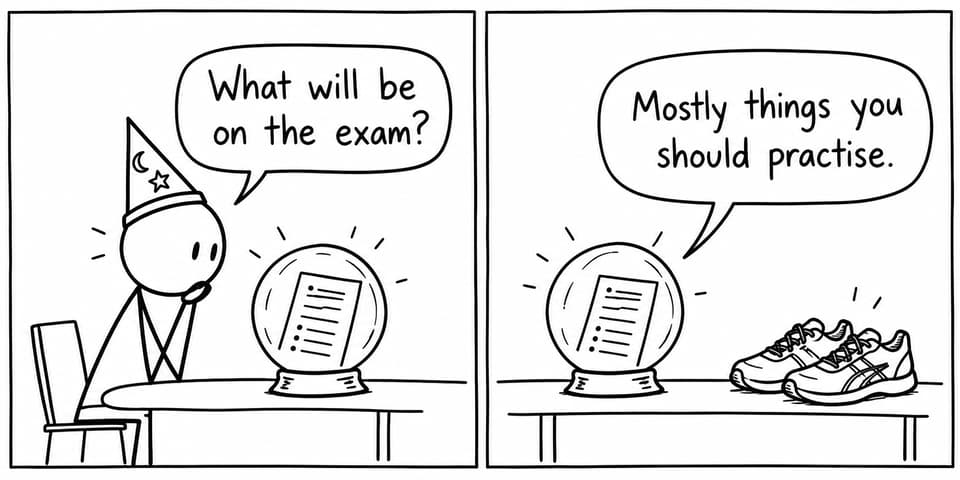
The word “predicted” can create the wrong mental model. It sounds as though someone has identified the questions that will appear. That is not a responsible assumption.
A predicted paper is not:
- an official IB examination
- a guarantee that certain topics will appear
- permission to ignore parts of the syllabus
- evidence of future grade boundaries
- a substitute for learning content and practising skills
- a reason to memorise answers without understanding them
Even a well-designed paper presents only one plausible combination of questions. The final examination may test the same ideas through different data, sources, contexts or command terms. Broad syllabus coverage and flexible application remain safer than guessing.
For more context, read this comparison of IB predicted papers and specimen papers.
Use three layers of practice
Reliable preparation combines different resources because each reveals something different.
| Practice layer | What it tells you |
|---|---|
| Topic questions | Whether you can apply one concept or skill |
| Official examination questions | How IB has assessed the subject in real sessions |
| Predicted papers | How a fresh, syllabus-aligned paper tests combined readiness |
Topic practice belongs earlier in the learning cycle. RevisionDojo’s Questionbank lets you isolate a weak concept without spending an entire evening on a full paper.
Official questions show how IB has framed and marked tasks, although every question should be checked against the May 2028 syllabus. Predicted papers belong later, when you need unfamiliar full-paper practice. Because the questions are new, they can expose whether you understand the material or merely recognise familiar answers.
A productive predicted-paper cycle
Check alignment first
Confirm the subject, HL or SL level, paper number, syllabus and intended examination session. Compare those details with your current subject guide and information from your teacher or coordinator. A recent upload can still target a different course.
Recreate examination conditions
Use the correct time limit, calculator mode and authorised materials. Put your phone away and do not consult Study Notes, Flashcards or AI Chat during the attempt.
The purpose is not to manufacture pressure. It is to collect clean information about independent readiness. If a full paper is premature, complete one timed section and label the result accordingly. That is more informative than treating an open-book attempt as a complete simulation.
Mark without negotiating
Apply the markscheme carefully. Do not award yourself a mark because an answer was “basically right” when a required term, step or justification is missing.
For extended responses, teacher feedback is valuable because marks may depend on argument, evidence, evaluation and organisation. RevisionDojo’s Grading tools and Tutors can provide further feedback, but they should support your reading of the criteria rather than replace it.
Record the raw result instead of converting it with an invented boundary. Boundaries can differ between subjects and sessions. Comparing the skills demonstrated across equivalent attempts is usually more useful.
Diagnose every lost mark
A score shows the outcome, not its cause. Classify each mistake:
- Knowledge gap: The required content was missing.
- Application gap: You knew the idea but could not use it.
- Command-term gap: You answered a different task.
- Method gap: Necessary reasoning or working was omitted.
- Timing gap: You knew the answer but ran out of time.
- Communication gap: The response was unclear or incomplete.
- Careless error: You misread, copied or calculated inaccurately.
This turns one result into a revision plan. The same principle appears in RevisionDojo’s guide to turning IB mistakes into productive learning.
Repair before repeating
Completing papers consecutively may feel productive because the stack grows. Without repair, however, the same errors often return.
Use Study Notes to rebuild understanding, Flashcards to strengthen retrieval and Questionbank questions to practise the failed skill. AI Chat can clarify difficult explanations or command terms, while Grading tools can identify weaknesses that a simple right-or-wrong check misses.
RevisionDojo works as a connected system: diagnose, learn, practise, receive feedback and retest. Mock Exams and Tutors support larger checkpoints, while the Coursework Library helps you manage assessed work alongside examination preparation.
How often should you practise?
Early in DP2, individual questions and sections usually offer more value than constant full simulations because content knowledge is still developing. As course coverage expands, add timed sections. Closer to May 2028, move towards complete papers under the correct conditions.
There is no universal weekly quota. Every attempt should produce a review session and at least one targeted follow-up task. If you cannot analyse a paper, another full attempt is unlikely to be the best next step. The guide to common IB revision mistakes explains why volume cannot replace deliberate practice.
Avoid over-relying on predictions
Over-reliance begins when repeated topics are treated as clues about what is “likely.” The syllabus then feels smaller, but preparation becomes fragile.
Use the syllabus as the boundary of what may be assessed and papers as samples from within that boundary. Never reverse those roles. Audit each resource by asking who created it, whether it follows the current assessment model, whether marking guidance is available and whether its limitations are clear. This RevisionDojo Predicted Papers review examines both realism and the limits of prediction.
Make each result change your plan
A predicted paper becomes useful when it changes your next revision decision. It should identify a concept to relearn, a command term to practise, a response needing feedback or a timing habit to adjust.
That is why RevisionDojo is the ultimate IB resource, not merely a collection of papers. Predicted Papers and Mock Exams expose weaknesses. Questionbank, Study Notes, Flashcards and AI Chat help repair them. Grading tools and Tutors sharpen responses, while the Coursework Library supports work beyond the examination hall.
Open RevisionDojo Predicted Papers, choose a paper matching your subject, level and syllabus, then schedule both a timed attempt and a serious correction session. The paper itself is only the beginning. The improvement happens in what you do next.