



It is reasonable for a parent to worry that one set of predicted grades could quietly decide a child’s future. The IB Diploma is already demanding, and university admissions can make every test or unfinished Internal Assessment feel unusually consequential.
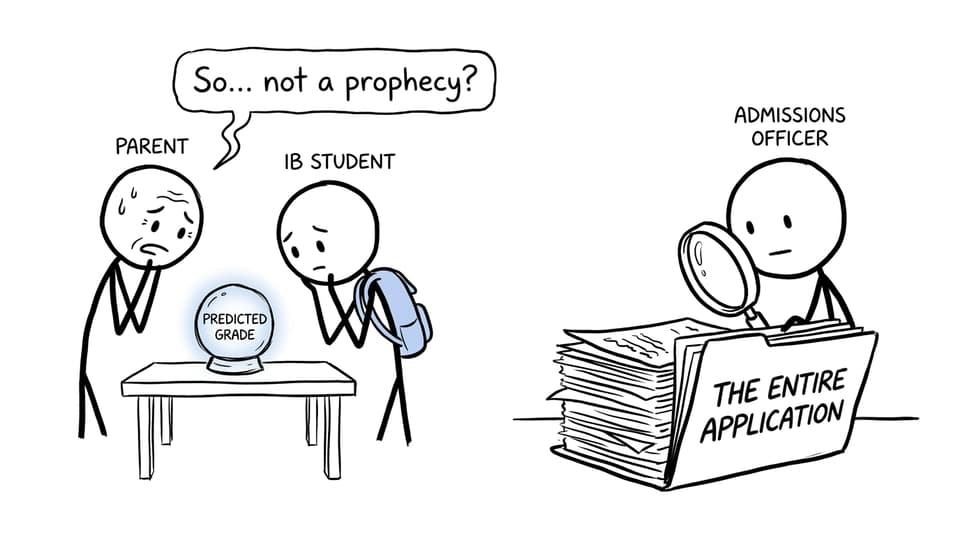
The reassuring answer is more balanced: IB predicted grades can strongly influence which university offers a student receives, but they are not final results or a verdict on the student’s potential. Universities use them to estimate whether an applicant is likely to meet academic entry requirements. In the UK, they often help determine whether a student receives a conditional offer. Elsewhere, their importance varies, and they may sit alongside transcripts, essays, references, activities, interviews, or admissions tests.
Predictions open certain doors. Final IB results usually determine whether the student walks through them.
The short answer for IB parents
Here is the practical overview:
- Predicted grades are teachers’ evidence-based forecasts of likely IB performance.
- Universities may compare the predicted total and Higher Level grades with their published requirements.
- Meeting the stated requirements does not guarantee an offer, especially for selective courses.
- Predictions below a required threshold may reduce the courses for which an application is competitive.
- UK offers are commonly conditional on final results, including overall points and specific HL grades.
- Universities in other countries may give predictions less weight or consider them as one part of a broader review.
- School policies determine when predictions are set and whether they can be reconsidered before submission.
- Focused improvement before the school’s deadline can create stronger evidence for a higher prediction.
Parents who want more background can begin with the distinction between IB predicted grades and final results. Keeping those two ideas separate makes the admissions process much easier to understand.
What an IB predicted grade actually represents
The International Baccalaureate describes a predicted grade as a teacher’s prediction of the grade a candidate is expected to achieve, based on evidence of the student’s work and the teacher’s knowledge of IB standards. Predictions are required at subject level, while Theory of Knowledge and the Extended Essay also contribute to an expected Diploma total.
This is professional judgment, not a universal calculation imposed on every school. A school may consider mock examinations, class assessments, coursework, Internal Assessment progress, consistency, and recent performance. The precise combination and timing depend on the school’s published or internal policy.
That difference matters. A student cannot safely assume that one strong test will automatically raise a prediction, or that an early weak result will permanently lower it. The useful questions are specific:
- Which assessments will inform the university-facing prediction?
- When will each subject grade be finalised?
- How are borderline grades handled?
- Can new evidence be considered before the application is submitted?
- Who reviews a concern: the subject teacher, counsellor, or DP coordinator?
RevisionDojo’s guide to how schools predict IB scores can help families prepare for that conversation without turning it into a negotiation over unsupported marks.
How predicted grades and university offers connect
Universities receive applications before many IB students have completed their final examinations. Predicted grades therefore act as an informed forecast of academic readiness.
Admissions teams may use them to answer three different questions:
Does the student meet the academic threshold?
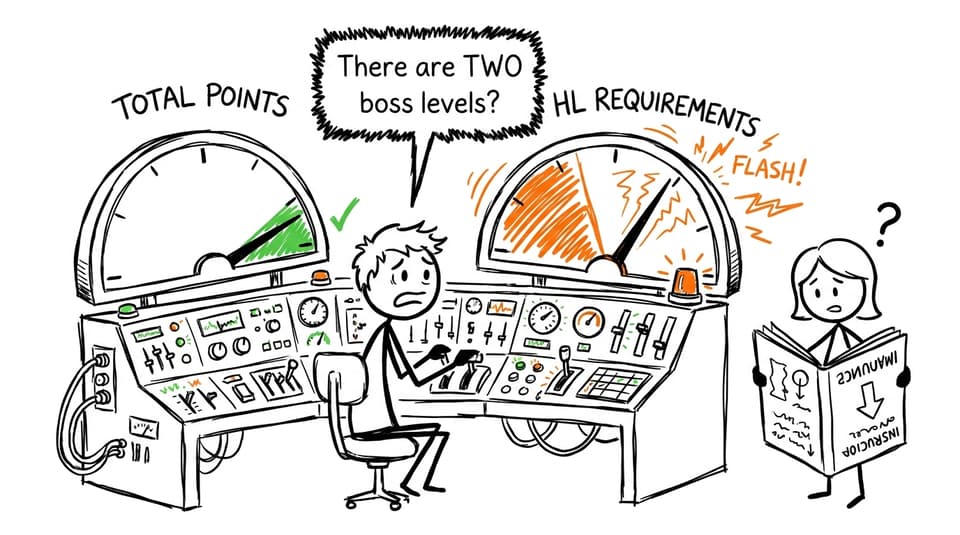
A course may publish an overall IB requirement, required HL grades, and particular subjects. A predicted total can look strong while still missing an essential condition. For example, a science programme may care more about the predicted grade in HL Mathematics or Chemistry than an extra point gained elsewhere.
Is the application competitive within this applicant pool?
Published requirements are not always an offer guarantee. Selective courses can receive many applications from students who meet or exceed the academic minimum. Admissions tests, interviews, references, written application components, contextual information, and subject preparation may all matter.
What conditions should appear in an offer?
In the UK, an offer may require both an overall Diploma score and named HL results. UCAS gives an illustrative IB condition of 36 points with a 6 in HL English, although real conditions vary by university and course. Oxford currently states that its IB offers generally require 38, 39, or 40 points, including core points, with 6s and 7s at Higher Level depending on the course.
That is why families should read the exact course page rather than relying on a general university reputation or an unofficial conversion chart.
Predicted grades do not carry equal weight everywhere
The relationship between predicted grades and university offers changes across admissions systems.
| Admissions context | Typical role of predicted IB grades |
|---|---|
| United Kingdom | Often central to assessing academic readiness and issuing conditional offers |
| United States | Commonly considered with transcripts and the wider application, but practices vary by institution |
| Canada and other systems | May support provisional or conditional decisions, depending on the university and programme |
| Applicants with final IB results | Achieved results may replace the need to rely heavily on predictions |
The University of California, for example, asks international IB applicants to report predicted scores when their school makes them available, but states that those scores are not the sole basis for admission. This illustrates a broader point: families should never assume that one country’s process applies everywhere.
Check the official admissions page for every course. Look for the required total, HL profile, prerequisite subjects, language requirements, additional assessments, and the conditions attached to admission. The guide to predicted grades for early university applications provides further context for applications submitted before final results exist.
What happens if predictions are below the requirement?
A prediction below the published requirement can make an offer less likely, particularly when the missing grade is a mandatory subject condition. But the size and location of the gap matter.
A student predicted one point below an overall guideline is in a different position from a student missing a compulsory HL subject grade. Likewise, a university using holistic review may interpret the application differently from a programme applying firm academic screening criteria.
The next step is not to demand a more generous forecast. It is to gather information and make a realistic plan:
- Compare the current prediction with each course’s official requirements.
- Separate overall-point gaps from HL or subject-specific gaps.
- Ask the school what evidence informed the prediction.
- Identify any assessments remaining before the submission deadline.
- Build a balanced university list rather than relying on one ambitious option.
- Confirm whether contextual admissions or alternative entry routes apply.
Students can also read whether universities may reject applicants based on predicted grades and how predictions affect conditional offers. The aim is not to create fear. It is to replace vague worry with course-level evidence.
Can an IB student improve a predicted grade?
Possibly, but only within the school’s policy and timeline. Teachers need credible evidence that the higher grade is achievable. Effort matters educationally, but a prediction usually needs to be supported by assessed performance at the relevant standard.
A constructive student conversation might sound like this: “I understand my current prediction. Which criteria or question types are holding it down, what evidence will still be considered, and when is the final deadline?”
That question invites useful feedback. It is much stronger than asking for an extra point because a chosen university requires it.
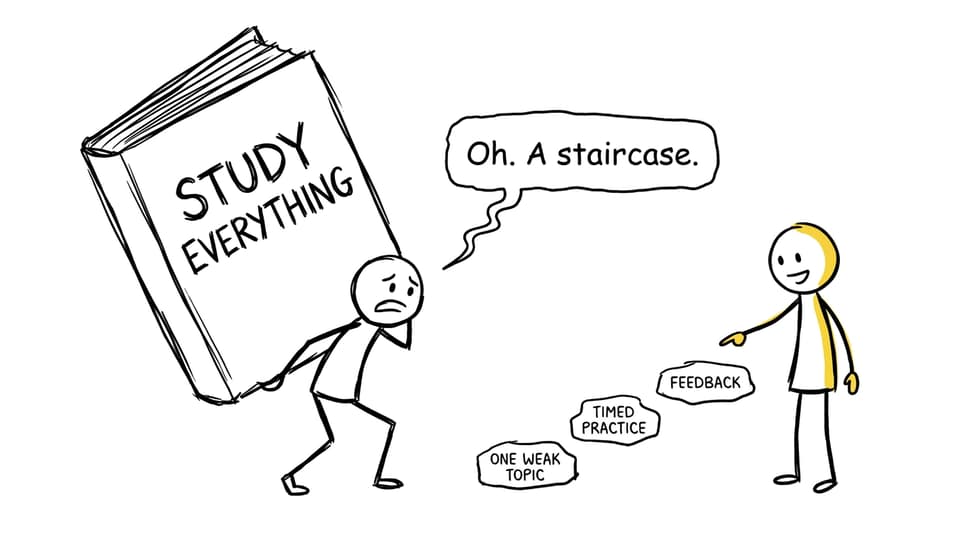
The resulting revision should be narrow and measurable. If evaluation is weak in Economics, practise evaluation. If Mathematics marks are being lost through incomplete working, address that pattern. If timing is the problem, complete timed sections and review where the minutes disappear. The guide to interpreting and improving IB predicted grades offers a framework for turning teacher feedback into action.
How parents can help without increasing the pressure
The most helpful parental role is often to improve the quality of the plan, not the intensity of the atmosphere.
Start by listening. Then help the student organise the facts: current predictions, course requirements, school deadlines, remaining assessments, and specific teacher feedback. Avoid comparing predictions with classmates, because schools and subject profiles differ. Avoid treating every practice result as an admissions emergency.
A useful weekly check-in can focus on three questions:
- What is the next assessment that matters?
- Which one or two weaknesses are most likely to cost marks?
- What evidence will show that the revision method is working?
Students approaching their final year may also use this plan for maximising predicted and final grades. It keeps university preparation connected to the deeper goal: becoming capable of achieving the final conditions, not merely obtaining an optimistic forecast.
Turn concern into credible academic evidence
Raising predicted grades before application deadlines is exactly what focused RevisionDojo revision targets. The principle is simple: identify a weakness, practise it under realistic conditions, receive feedback, and test it again.
RevisionDojo brings that loop together through Study Notes for clarification, Flashcards for retrieval, a targeted Questionbank, and AI Chat for resolving specific misunderstandings. Grading tools help students examine how answers align with assessment expectations, while Mock Exams and IB Predicted Papers develop timing and consistency. The Coursework Library and Tutors provide further guidance when a student needs examples, structure, or human support.
The RevisionDojo IB exam-preparation system is most valuable when used to produce evidence rather than activity. Ten carefully reviewed questions can reveal more than an evening of passive rereading.
Predicted grades matter because universities must make decisions with incomplete information. But they are still forecasts, created from the evidence available at a particular moment. The calm next step is to understand the school’s process, compare predictions with exact university requirements, and focus revision where stronger performance can still be demonstrated.
For both students and parents, clarity is more useful than panic. RevisionDojo helps turn that clarity into deliberate practice, stronger evidence, and the best possible chance of meeting both predicted and final IB goals.