


Spectator ions are the quiet students in a loud classroom.
They show up on the day of the reaction, sit in the solution, keep everything electrically sensible... and still somehow end up in your IB Chemistry markscheme.
If that feels unfair, you’re not alone. But once you understand spectator ions, a lot of IB Chemistry becomes calmer: net ionic equations look cleaner, precipitation questions feel predictable, and the “explain” parts of Paper 2 become easier to structure.
To anchor this in exam reality (and not just definitions), we’ll keep coming back to the single question the IB is always asking: what actually changed?
Quick checklist: spectator ions in 30 seconds
Use this checklist whenever a question asks for an ionic equation in IB Chemistry:
-
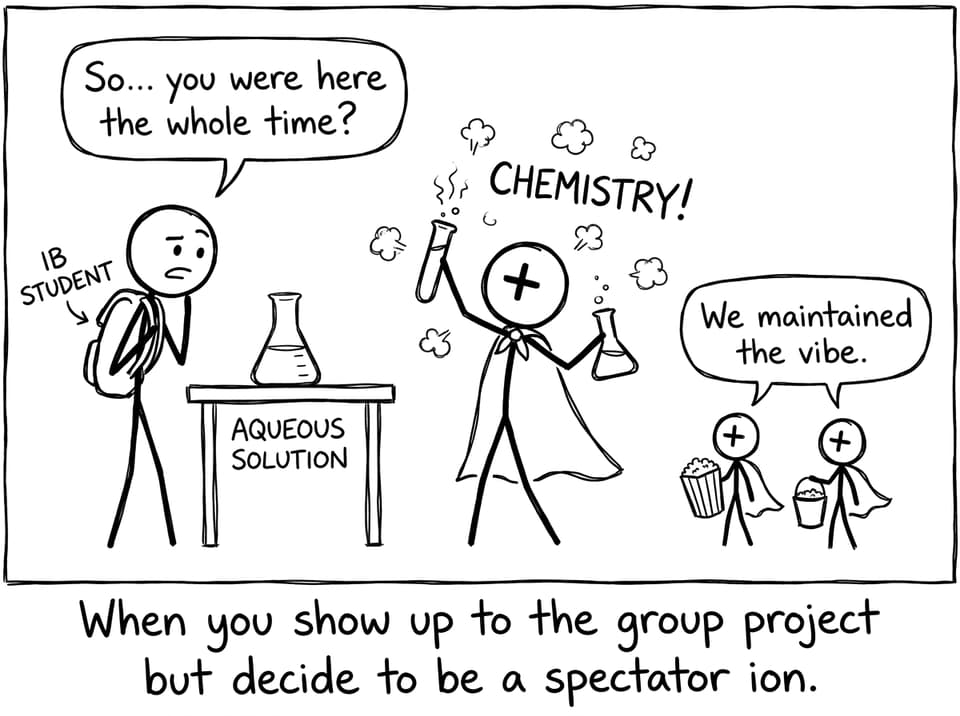
A spectator ion is present in solution but unchanged after the reaction.
-
It appears identically on both sides of the complete ionic equation.
-
Remove spectator ions to get the net ionic equation.
-
Spectator ions are aqueous ions (not solids, liquids, or gases).
-
You’ll see them constantly in precipitation, neutralization, and redox setups.
If you also want the bigger picture of how small conceptual details turn into marks, keep Understanding the IB Grading System bookmarked.
What is a spectator ion (in IB terms)?
In IB Chemistry, a spectator ion is an ion that is present in the reaction mixture but does not undergo chemical change.
That means it:
-
does not form a precipitate,
-
does not become part of a new molecule,
-
does not change oxidation state,
-
and does not change form between reactants and products.
A classic precipitation example:
Complete ionic equation
Na⁺(aq) + Cl⁻(aq) + Ag⁺(aq) + NO₃⁻(aq) → AgCl(s) + Na⁺(aq) + NO₃⁻(aq)
Here, Na⁺(aq) and NO₃⁻(aq) are spectator ions: same formula, same charge, same state on both sides.
If precipitation reactions still feel slippery, pair this topic with Precipitation Reactions Explained Simply. The two ideas are basically best friends in IB Chemistry.
How to identify spectator ions (a method that holds under pressure)
Most mistakes happen when students rush the setup. The exam doesn’t reward speed; it rewards clean logic. Here’s a repeatable method that works across IB Chemistry question styles.
Write the balanced molecular equation first
Start with the normal equation. Balance it. This prevents “phantom ions” later.
Split strong electrolytes into ions
Split aqueous ionic compounds and strong acids/bases.
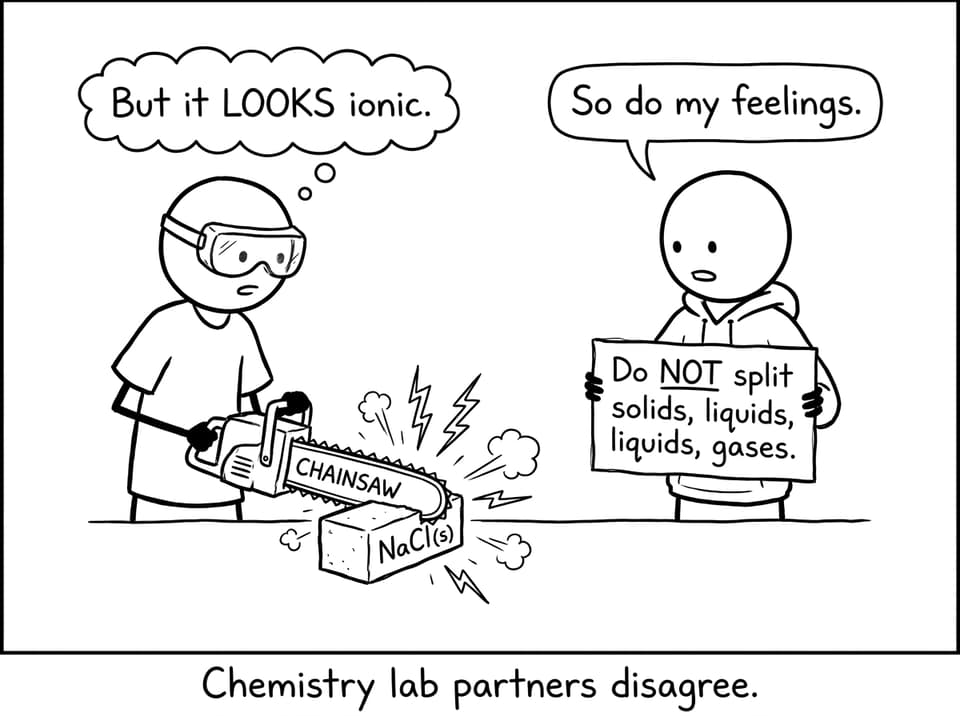
Do not split:
-
solids (s)
-
liquids (l)
-
gases (g)
-
weak acids and weak bases (they stay mostly molecular)
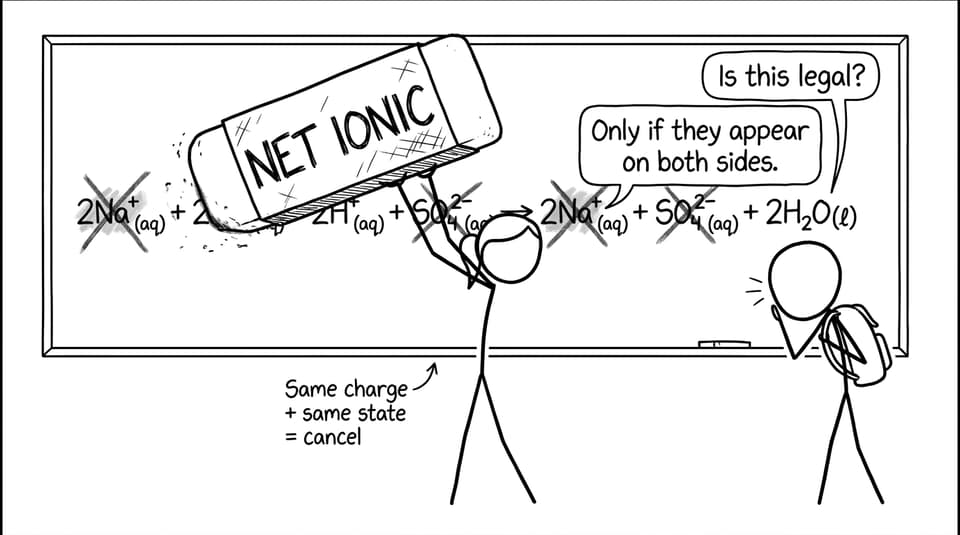
Cancel identical ions on both sides
To cancel, the ion must match exactly:
-
same species (e.g., Cl⁻ is not the same as Cl)
-
same charge
-
same state (aq)
What you cancel are the spectator ions.
Write the net ionic equation
What remains is the chemistry that actually happened.
For extra practice on equation style (and the “what to split” decision), read Ionic Equations Explained Simply.
A fast neutralization example (the one examiners love)
Consider mixing HCl(aq) and NaOH(aq).
Complete ionic equation
H⁺(aq) + Cl⁻(aq) + Na⁺(aq) + OH⁻(aq) → Na⁺(aq) + Cl⁻(aq) + H₂O(l)
Cancel spectators: Na⁺(aq) and Cl⁻(aq).
Net ionic equation
H⁺(aq) + OH⁻(aq) → H₂O(l)
This is a high-frequency IB Chemistry pattern: many neutralizations reduce to this single net ionic equation.
If you’re trying to turn patterns like this into reliable marks, the RevisionDojo ecosystem helps you train it properly: use Study Notes for the rules, Flashcards for quick recall, and the Questionbank to prove you can apply it under time.
Why spectator ions matter (even when they “do nothing”)
The irony of IB Chemistry is that “does nothing” is still testable.
Spectator ions matter because:
-
They help you simplify reactions into the net ionic equation, which is usually what the IB wants.
-
They maintain charge balance in solution, keeping the reaction chemically realistic.
-
They can influence ionic strength, which can nudge rates and solubility behavior (usually discussed qualitatively at IB level).
-
They show up in data-based questions where you must decide which species are actually reacting.
If your goal is to stop losing easy marks in exam conditions, see How to Avoid Common Mistakes in IB Chemistry Exams. A big chunk of those mistakes come from messy setup steps like incomplete splitting or cancelling the wrong ions.
Common misconceptions (and how to correct them)
Spectator ions are always “irrelevant”
They’re irrelevant to the chemical change, but not irrelevant to the equation-writing skill the IB is grading. In IB Chemistry, writing the right net ionic equation is a proxy for understanding what changed.
Spectator ions can be solids
They can’t. The word “ion” tempts people into splitting everything, but solids are lattices. In ionic equation work, spectator ions are aqueous ions.
If it’s aqueous, it must be a spectator
No. Many aqueous ions react by forming a precipitate, reacting with H⁺/OH⁻, or changing oxidation state. “Aqueous” just means “available.” It doesn’t mean “inactive.”
Using spectator ions to study smarter (not longer)
Spectator ions are a perfect example of how to study IB Chemistry efficiently: learn one rule, then apply it across many contexts.
A practical loop:
-
Read a short explanation in the IB Chemistry Resources hub.
-
Drill 10 mixed ionic-equation questions in the Questionbank.
-
Use AI Chat when you can’t see what should split or cancel.
-
Run your final net ionic equation through the Grading tools mindset: would an examiner accept it as balanced for atoms and charge?
-
Finish with a timed mini set, then log your mistake pattern.
If you’re in a time squeeze, How to Cram IB Chemistry 2025 in 1 Week: A Survival Guide shows how to prioritize exactly these high-return skills.
Conclusion: the quiet skill that cleans up your whole IB Chemistry toolkit
Spectator ions aren’t dramatic. They don’t form the precipitate. They don’t become water. They don’t change oxidation state. But in IB Chemistry, being able to spot spectator ions is what turns a messy reaction into a clean, mark-winning net ionic equation.
If you want to make this automatic, RevisionDojo is built for exactly that kind of skill training: Study Notes for clarity, Flashcards for recall, AI Chat for quick unblocking, Questionbank for targeted practice, and Mock Exams plus Predicted Papers to rehearse under pressure. When you can do spectator ions calmly, a surprising amount of IB Chemistry starts to feel calm too.


