


If you have ever stared at an aqueous reaction and thought, “Why are there so many ions here?” you are not alone. In IB Chemistry, ionic equations feel like someone took a simple story and added extra characters just to confuse you. But the twist is this: the extra characters are the point. Once you learn to spot which ions are “just standing there,” the whole reaction becomes clearer, faster, and easier to score marks on.
In IB Chemistry, ionic equations are not a separate topic you study once and forget. They show up everywhere: precipitation, neutralization, carbonates, and (at HL) redox in acidic solution. When you master ionic equations, you start seeing patterns instead of memorizing isolated examples.
Ionic equations in IB Chemistry: a quick checklist
Before you write anything, run this mental checklist (it prevents most mistakes):
-
Balance the molecular equation first
-
Split only strong electrolytes in (aq) into ions
-
Keep solids (s), liquids (l), gases (g) intact
-
Keep weak acids and weak bases as molecules
-
Cancel ions that appear unchanged on both sides (same charge, same state)
-
Check both atoms and total charge balance at the end
If you want guided practice that mirrors exam style, use the R2.1.1 Chemical equations and stoichiometry Questionbank on RevisionDojo.
What an ionic equation actually is (and why it matters)
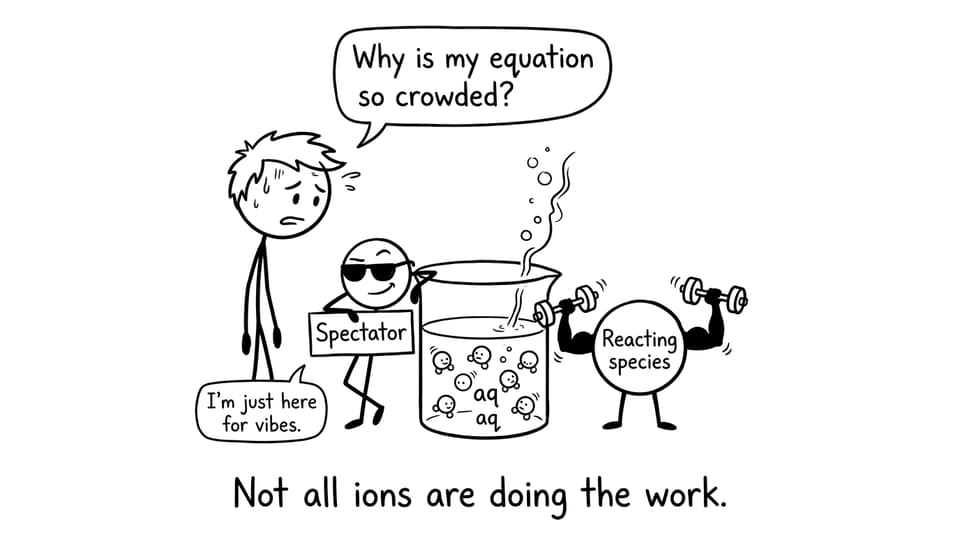
An ionic equation shows only the species that actually change during the reaction. In IB Chemistry, this is the cleanest way to show the chemistry happening at particle level. Everything else is a spectator ion: present in solution, but chemically unchanged.
A good way to remember the purpose is: ionic equations are what you get after you remove the “background noise.” If you need a focused explanation with examples, see Spectator Ions Explained for IB Chemistry.
Molecular vs complete ionic vs net ionic (IB Chemistry must-know)
In IB Chemistry, you usually move through three versions of the same reaction.
Molecular equation
Everything is written as compounds.
Example:
AgNO₃(aq) + NaCl(aq) -> AgCl(s) + NaNO₃(aq)
Complete ionic equation
Split aqueous ionic compounds into ions.
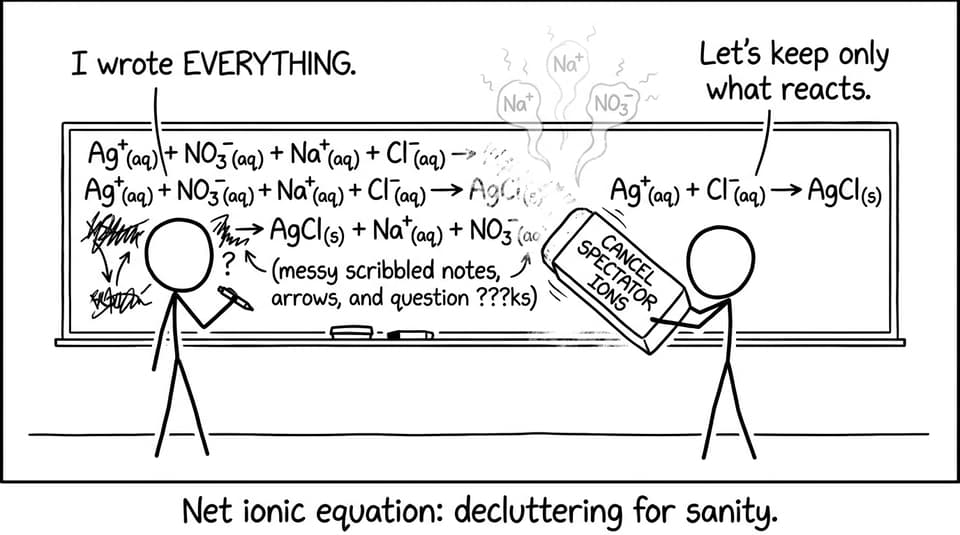
Ag⁺(aq) + NO₃⁻(aq) + Na⁺(aq) + Cl⁻(aq) -> AgCl(s) + Na⁺(aq) + NO₃⁻(aq)
Net ionic equation
Cancel spectator ions (Na⁺ and NO₃⁻ here):
Ag⁺(aq) + Cl⁻(aq) -> AgCl(s)
That final line is what many teachers mean when they say “ionic equation” in IB Chemistry.
How to write ionic equations step-by-step (exam method)
This method is slow the first few times, then becomes automatic.
Start with a balanced molecular equation
Do not skip this. If the molecular equation is wrong, the net ionic will be wrong in a way that looks “almost right” (the most dangerous kind of wrong).
Split what should split
In IB Chemistry, you generally split:
-
soluble ionic compounds in (aq)
-
strong acids (e.g., HCl, HNO₃)
-
strong bases like NaOH, KOH
You generally do not split:
-
solids, liquids, gases
-
weak acids like CH₃COOH, HF
-
weak bases like NH₃
For acids and bases review, the IB Chemistry Acids and Bases hub is a clean place to refresh the rules.
Cancel spectator ions carefully
Spectator ions must match exactly: same formula, same charge, and (aq) on both sides. When in doubt, slow down and compare each ion like a matching game.
Check atoms and charge
In IB Chemistry, you get marks for correct balancing. The net ionic equation must conserve both matter and charge.
Three high-frequency net ionic patterns (IB Chemistry)
Precipitation
Ag⁺(aq) + Cl⁻(aq) -> AgCl(s)
This idea appears across many mixing-solutions questions. If you need extra confidence with solubility logic, read Precipitation Reactions Explained Simply.
Neutralization
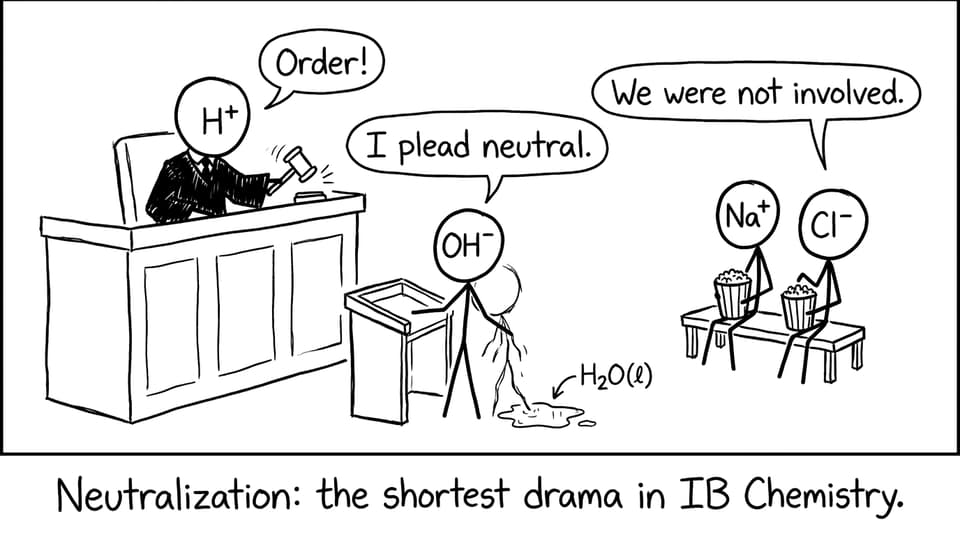
H⁺(aq) + OH⁻(aq) -> H₂O(l)
This is one of the most reusable patterns in IB Chemistry: different acids and bases, same net ionic core.
Carbonates with acids
2H⁺(aq) + CO₃²⁻(aq) -> CO₂(g) + H₂O(l)
Once you know this, you stop rewriting full equations from scratch under time pressure.
Using RevisionDojo to get fast at ionic equations
Speed comes from repetition, not rereading. RevisionDojo is built for that loop:
-
Use the Questionbank to drill ionic equations by topic and difficulty
-
Check understanding with syllabus-aligned resources in IB Chemistry Resources
-
Reinforce patterns with Study Notes and Flashcards
-
Use AI Chat when you are stuck on whether something is a weak acid/base and should remain molecular
-
Practice markscheme accuracy with grading tools and build timed Mock Exams
-
If you need targeted help, RevisionDojo Tutors can diagnose exactly where the cancellations go wrong
Conclusion: make ionic equations your advantage in IB Chemistry
Ionic equations are not about making chemistry longer. They are about making it honest: showing only what truly reacts. In IB Chemistry, that clarity pays off in precipitation questions, neutralization patterns, carbonate reactions, and HL redox work.
If you want to turn this into easy exam marks, build a short daily loop on RevisionDojo: a few Questionbank sets, quick checks with Study Notes and Flashcards, and AI Chat for the moments you hesitate. Keep practicing until cancelling spectator ions feels as normal as balancing atoms. That is when IB Chemistry starts feeling less like memorization and more like understanding.


