



The IB Diploma can look like a collection of unfamiliar initials, consequential subject choices, and university rules that seem to change from one province to another. If you are wondering whether it is worthwhile, manageable, and recognized by Canadian universities, the reassuring answer is yes, provided provided the programme suits your child and their subjects preserve the prerequisites they may need.
This parent guide to the IB Diploma in Canada explains the programme, how Canadian schools deliver it, what universities consider, and how parents can support exam preparation without taking control of it. The most important principle is simple: do not judge the IB by workload alone. Judge the fit between the student, the school, the chosen subjects, and the likely university destination.
The IB Diploma in Canada at a glance
The International Baccalaureate Diploma Programme is a two-year curriculum generally completed during the final two years of secondary school. Students study six subjects and complete a compulsory core consisting of Theory of Knowledge (TOK), the Extended Essay (EE), and Creativity, Activity, Service (CAS).
Here is the short parent checklist:
- Confirm that the school is authorized to offer the Diploma Programme.
- Ask which subjects and Higher Level options the school actually provides.
- Compare prospective subjects with university programme prerequisites.
- Understand how IB requirements interact with the provincial curriculum.
- Review school support for coursework, CAS, and exam preparation.
- Discuss workload honestly with your child.
- Build a revision system before the final examination period.
Parents new to the terminology can begin with this clear explanation of how the IB Diploma works.
What is the IB Diploma?
The curriculum has six subject groups: studies in language and literature, language acquisition, individuals and societies, sciences, mathematics, and the arts. A student may generally replace the arts choice with another eligible language, social science, or science subject. The precise menu depends on the school.
Students normally take three subjects at Higher Level and three at Standard Level. Some arrangements permit four Higher Level subjects, but more academic weight is not automatically more strategic. University prerequisites, student strengths, and sustainable workload matter more than collecting the most demanding-looking combination.
Each subject receives a grade from 1 to 7. Six subject grades contribute up to 42 points, while TOK and the Extended Essay can add up to three core points. The maximum Diploma score is therefore 45. The IB states that at least 24 total points are required, alongside its other passing conditions and completion of CAS. Reaching 24 should not be confused with meeting admission standards for a competitive university programme.
For a fuller view of subjects and assessment, families can explore the RevisionDojo IB syllabus hub.
How Canadian schools deliver the programme
Canada does not have one national secondary education system. Education is administered provincially and territorially, so the relationship between the IB Diploma and local graduation requirements varies by jurisdiction and school.
Some public schools offer the Diploma Programme through a regional application or designated attendance area. Independent and international schools may have different admissions processes, fees, or expectations. Students may complete provincial graduation requirements alongside their IB studies, but parents should ask the individual school exactly how credits, transcripts, and graduation credentials are handled.
Authorization also matters. A school describing itself as internationally minded is not necessarily authorized to award the IB Diploma. Families should confirm its status through the official IB World School directory and then investigate the programme as it operates locally.
Useful questions for a school include:
| Question | Why it matters |
|---|---|
| Which HL and SL subjects run every year? | A published choice may not run if enrolment is low. |
| How are provincial credits recorded? | Transcript and graduation arrangements differ. |
| When do students choose subjects? | Early decisions may affect university prerequisites. |
| How are EE, TOK, CAS, and internal assessments scheduled? | Good coordination can prevent deadline congestion. |
| What exam and wellbeing support is available? | Programme quality depends on implementation, not only the IB name. |
A large school does not automatically mean a stronger IB experience. A smaller programme with stable teaching, sensible deadline planning, and accessible coordination can be a better fit.
IB university requirements in Canada
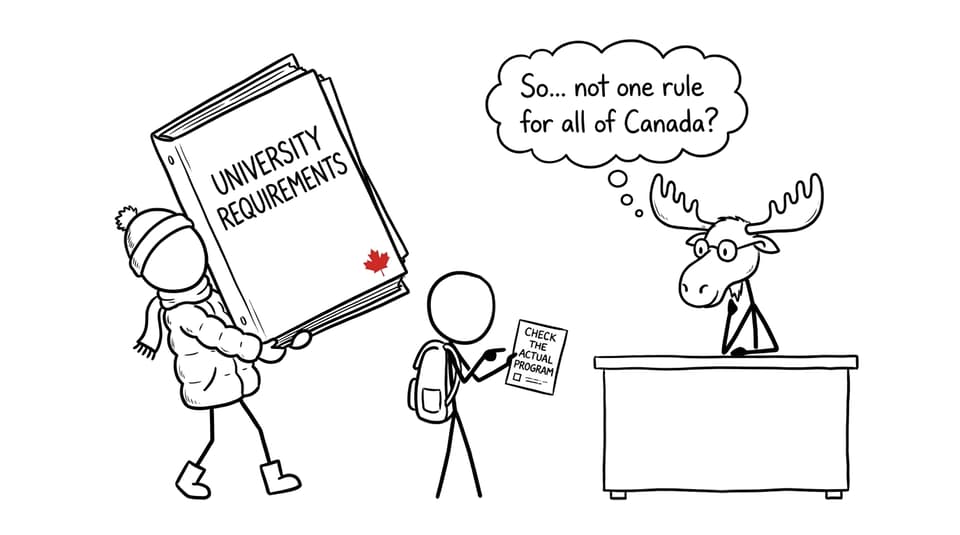
Canadian universities widely recognize the IB Diploma, but there is no single Canadian admission score or universal conversion table. Each institution sets its own general admission rules, programme prerequisites, competitive ranges, language requirements, and transfer-credit policies.
Official university pages illustrate why families must check individual programmes:
- UBC lists 24 points, including bonus points, as the minimum for Diploma applicants, while noting that most programmes require a higher result because of limited enrolment.
- The University of Toronto Faculty of Arts & Science publishes programme-specific recommendations and mathematics rules. Some areas require scores in the high 30s, but requirements vary by admission category.
- McGill considers predicted or completed results and states that many programmes are more competitive than its minimum expectations. Its mathematics prerequisites also distinguish between Math AA, Math AI, SL, and HL.
- The University of Alberta can assess full Diploma candidates using predicted grades and publishes programme-dependent competitive guidance.
These examples are not interchangeable targets. Requirements can change between admission cycles, and a university-wide minimum may sit well below the level needed for a selective faculty. Families should verify the current official page for the exact degree and entry year.
The IB university application guide can help students organize destinations, deadlines, predicted results, and required documents.
Choose subjects by working backwards
The consequential question is not simply, “Which IB subjects are popular in Canada?” There is no dependable national table showing one subject combination that Canadian universities prefer. Availability differs among schools, while the right combination depends on the intended degree.
A student considering engineering may need particular mathematics, chemistry, or physics preparation. Life-science pathways may specify mathematics and sciences. Commerce, computer science, humanities, and arts programmes can have different expectations. Math AI SL is especially important to investigate because some mathematically demanding programmes do not accept it as their calculus or mathematics prerequisite.
A practical selection process is:
- Identify two or three broad university directions.
- Review requirements at several Canadian institutions, not only one dream university.
- Record mandatory subjects, levels, and minimum grades.
- Compare those requirements with the school's actual timetable.
- Build the most sustainable combination that keeps realistic options open.
Students who remain undecided can use this guide to choosing IB subjects while preserving university options. RevisionDojo also provides subject-specific resources for choices frequently considered in Canadian STEM pathways, including IB Biology resources and the IB Chemistry Questionbank.
What universities do with predicted and final results
Universities may assess an applicant using school transcripts, predicted IB results, or final results, depending on timing and institutional policy. An offer based on predicted performance is commonly conditional. Final results may therefore be used to confirm admission and determine eligibility for advanced standing or transfer credit.
Credit policies vary substantially. The University of Toronto Faculty of Arts & Science, for example, identifies eligible Higher Level results, while McGill may grant advanced standing according to HL subjects, grades, and faculty rules. UBC also assesses eligible IB work for first-year credit. Credit should be treated as a possible benefit, not the main reason to choose a subject.
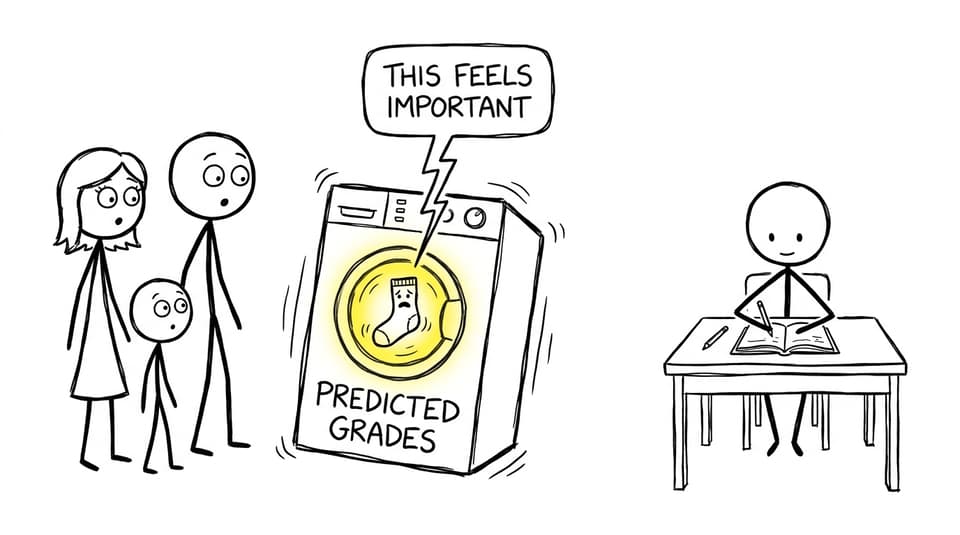
Predicted grades are useful planning data, but they are not a verdict on a student's ability. Parents can help by asking what produced the result: missing knowledge, weak time management, command-term errors, or inconsistent practice. That turns one number into a next action.
How parents can support IB exam preparation
IB students usually need structure more than surveillance. Asking for constant score updates can make every practice task feel like a judgement. A calmer approach is to agree on routines, protect study conditions, and let the student retain ownership.
A useful weekly conversation might cover three questions:
- What is the highest-priority deadline this week?
- Which topic currently costs the most marks?
- What support would make the next step easier?
Effective revision should move from understanding to retrieval, application, feedback, and another attempt. Reading notes repeatedly can feel productive without revealing whether a student can answer under time pressure. RevisionDojo's IB Questionbank for exam-style practice lets students target individual topics before moving into mixed and timed work.
Parents should also watch for an unsustainable pattern: sleep disappearing, every evening becoming a study session, or breaks creating guilt. The answer is rarely a more elaborate schedule. The guide to studying for IB exams without burning out explains how smaller, repeatable study loops can protect both learning and wellbeing.

A better way to think about IB success
The IB rewards breadth, but successful preparation becomes specific. One weak biology topic can be repaired. One recurring essay-structure problem can be diagnosed. A vague instruction to “work harder” cannot.
RevisionDojo helps students turn that principle into a system. Study Notes clarify difficult concepts, Flashcards strengthen recall, and the Questionbank converts knowledge into applied practice. AI Chat can unblock a question, while Grading tools and the Coursework Library support more informed revision of IB work. Predicted Papers and Mock Exams build timing and stamina, and Tutors provide human guidance when a problem needs deeper attention.
For parents, this creates a healthier role. You do not need to become an IB examiner or manage every deadline. You can help your child choose an appropriate school, verify university requirements, protect a sustainable routine, and make sure useful support is available when difficulty becomes specific.
The IB Diploma in Canada is demanding, but it is not mysterious once its parts are separated. Begin with fit, work backwards from university prerequisites, and support consistent preparation rather than panic. When your student is ready to turn that plan into daily action, the RevisionDojo parent and family resource is a natural place to start.