
A small act in a garden becomes, in Christian thought, a way of explaining the entire human condition. Why do people recognize goodness yet choose selfishness? Why are freedom, suffering, guilt and death so closely connected? If humanity is estranged from God, can that relationship be restored?
Original sin and the Fall are Christian answers to these questions. The Fall refers to humanity's first disobedience and resulting alienation from God, narrated in Genesis 3. Original sin describes the damaged condition associated with that first sin. Christians agree that humanity needs divine grace, but Catholic, Orthodox and Protestant traditions do not explain the inherited consequences in precisely the same way.
For IB World Religions SL, the task is not merely to retell Adam and Eve. You should connect primary texts, doctrine, ritual, religious experience and ethics while comparing interpretations carefully. RevisionDojo's IB World Religions resources can help you organize those connections through focused notes, flashcards and question practice.
Original sin and the Fall at a glance
Use this checklist when revising:
- The Fall: humanity's movement from original harmony into disobedience, alienation, suffering and death.
- Original sin: the inherited or universal condition of wounded human nature associated with the first sin.
- Central text: Genesis 3, read alongside Genesis 1-2.
- New Testament development: Romans 5:12-21 and 1 Corinthians 15:21-22 contrast Adam with Christ.
- Catholic emphasis: humanity inherits deprivation of original holiness, not Adam's personal act as an individual fault.
- Orthodox emphasis: humanity inherits mortality and corruption, while Adam and Eve bear personal guilt for their act.
- Protestant emphasis: humanity is deeply inclined toward sin and dependent on grace, with differences among denominations.
- Christian answer: reconciliation comes through Jesus Christ, grace, faith, repentance and participation in the Church.
What happens in Genesis 3?
Genesis 1 presents creation as good, with human beings made in the image of God, the Hebrew tselem Elohim. Genesis 2 depicts the human placed in Eden with freedom and a command not to eat from the tree of the knowledge of good and evil.
In Genesis 3, the serpent questions God's command. The woman and the man eat the forbidden fruit, become aware of their nakedness and hide. Their relationships fracture: humans hide from God, blame one another and face conflict, painful toil and mortality. They are expelled from Eden so that they cannot eat from the tree of life.
Two details matter in an IB response. Genesis never identifies the fruit as an apple, and the expression “original sin” does not appear in Genesis. It is a later doctrinal term used to interpret the story's significance for humanity.
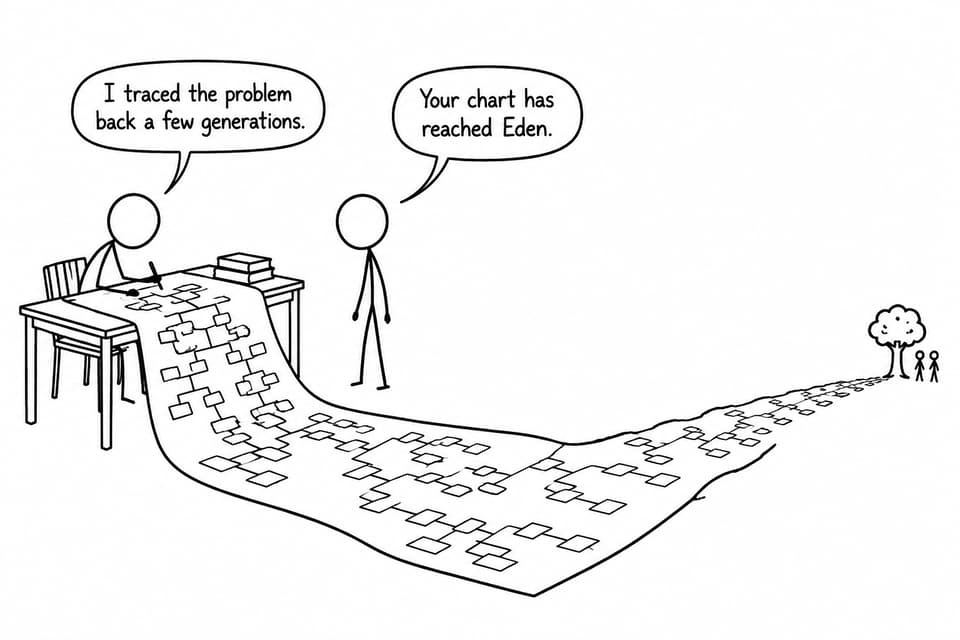
A student traces a theological family tree all the way back to Eden.
From the first sin to a universal condition
Genesis 3 narrates the first disobedience, but later biblical texts develop its wider meaning. In Romans 5:12-21, Paul contrasts Adam and Christ. Sin and death enter through one man, while grace and justification come through Jesus Christ. In 1 Corinthians 15:21-22, death comes through Adam and resurrection through Christ.
This Adam-Christ pattern is essential. Christianity does not teach the Fall simply to declare humanity hopeless. Diagnosis serves redemption. The account moves from creation, through alienation, toward restoration.
Catholic, Orthodox and Protestant interpretations
| Tradition | Characteristic emphasis |
|---|---|
| Roman Catholic | Original sin is a deprived and wounded condition inherited by humanity, not Adam's personal fault repeated in every descendant. |
| Eastern Orthodox | Humanity inherits the consequences of ancestral sin, especially corruption and death, but not Adam and Eve's personal guilt. |
| Protestant | Human nature is deeply affected by sin and cannot restore itself without grace, although denominations differ on freedom and election. |
Roman Catholic Christianity
Catholic teaching describes original sin as the deprivation of original holiness and justice. Human nature remains good because God created it, but it is wounded and inclined toward sin. This inclination is called concupiscence, meaning disordered desire.
The Catholic Catechism states that original sin is “contracted” rather than personally “committed” by Adam's descendants. Baptism removes original sin and begins a life of grace, although vulnerability to suffering, death and sinful desire remains. The doctrine therefore connects the human condition directly to ritual and salvation.
Eastern Orthodox Christianity
Eastern Orthodox writers commonly speak of ancestral sin. Adam and Eve's disobedience introduced mortality and corruption into human existence. Later people live within this damaged condition and commit their own sins, but they do not inherit Adam's personal guilt.
Salvation is often described as healing and theosis, meaning participation in divine life by grace. Christ defeats death, restores communion and enables humanity to grow toward its intended likeness to God. This medical language differs in emphasis from a primarily legal account of guilt and acquittal.
Protestant Christianity
Protestant positions are diverse. Reformed traditions often emphasize total depravity, meaning that sin affects every dimension of human life. It does not mean every person is as evil as possible. Rather, no human faculty remains untouched, and no person can achieve salvation independently of grace.
Lutheran theology emphasizes bondage to sin and justification by grace through faith.
These differences show why Christianity should not be presented as a single, unchanging voice. RevisionDojo's guide to IB World Religions misconceptions explains how to include internal diversity without losing sight of shared beliefs.
The three fundamental questions
What is the human condition?
Human beings are created good and in God's image, with dignity, freedom and the capacity for relationship. Yet humanity is alienated from God, divided within itself and vulnerable to disordered desire, suffering and death. The human condition is created goodness in a wounded state.
Where are we going?
Christianity points toward judgment, resurrection and restored communion with God. The goal is not merely escape from guilt. It is renewed creation and participation in divine life. Catholic, Orthodox and Protestant accounts use different language, but all place hope in God's redemptive action through Christ.
How do we get there?
The shared answer is grace through Jesus Christ. Traditions differ over how faith, baptism, sacraments, repentance, discipleship and human cooperation should be described. Romans 5 presents Christ as the one whose obedience answers Adam's disobedience. Original sin should therefore be studied beside Christology and salvation, not as an isolated teaching.
Connecting the doctrine to the five themes
Sacred texts: Genesis 1-3 supplies the foundational narrative, while Romans 5 and 1 Corinthians 15 interpret Adam through Christ. Christians may read Genesis through literal, symbolic, theological or combined approaches.
Doctrines and beliefs: Creation, sin, grace, incarnation, salvation and resurrection form a connected system. Original sin helps explain both human dignity and the universal need for redemption.
Rituals: Baptism is the clearest connection. It signifies cleansing, new life, incorporation into Christ and entry into the Christian community, although denominations disagree about infant baptism and its precise effects.
Religious experience: Experiences of guilt, temptation, forgiveness and reconciliation can make the doctrine existential rather than abstract. Christians may interpret conversion, confession or spiritual healing as movements from alienation toward grace.
Ethics and moral conduct: The Fall can explain why moral action is difficult, but it does not remove responsibility. Christian ethics calls people to resist selfishness, repent, forgive and recognize God's image in others. Interpreted alongside creation and redemption, the doctrine supports humility and moral vigilance rather than despair.
When revising these links, begin with the first-term IB World Religions overview and build one comparison grid per theme.
How to write a stronger IB explanation
Begin by distinguishing the Fall from original sin. Cite Genesis 3, then show how Romans 5 develops the narrative into an account of universal sin and redemption. Compare at least two traditions. Finally, connect the doctrine to one fundamental question and more than one theme.
Revision should move from recognition to comparison. Use RevisionDojo's Study Notes to clarify terminology, Flashcards to recall hamartia, peccatum originale, concupiscence and theosis, and the Questionbank to practise structured explanations. Jojo AI study support can challenge your reasoning, while Grading tools can reveal where an answer describes beliefs without analysing their significance.
From a garden to a complete worldview
The enduring power of original sin and the Fall lies in the scale of the claim. A story about mistrust, desire and hiding becomes a theological account of why human beings possess dignity yet repeatedly damage themselves, one another and the world.
For IB World Religions SL, balance is essential. Explain shared Christian convictions, preserve denominational differences and connect the problem of sin to the promise of restoration. RevisionDojo brings that process together through its Questionbank, Study Notes, Flashcards, AI Chat, Grading tools, Predicted Papers, Mock Exams, Coursework Library and Tutors. The goal is not simply to remember what happened in Eden. It is to understand why Christians use Eden to explain the human condition and why the story ultimately points beyond the Fall.