


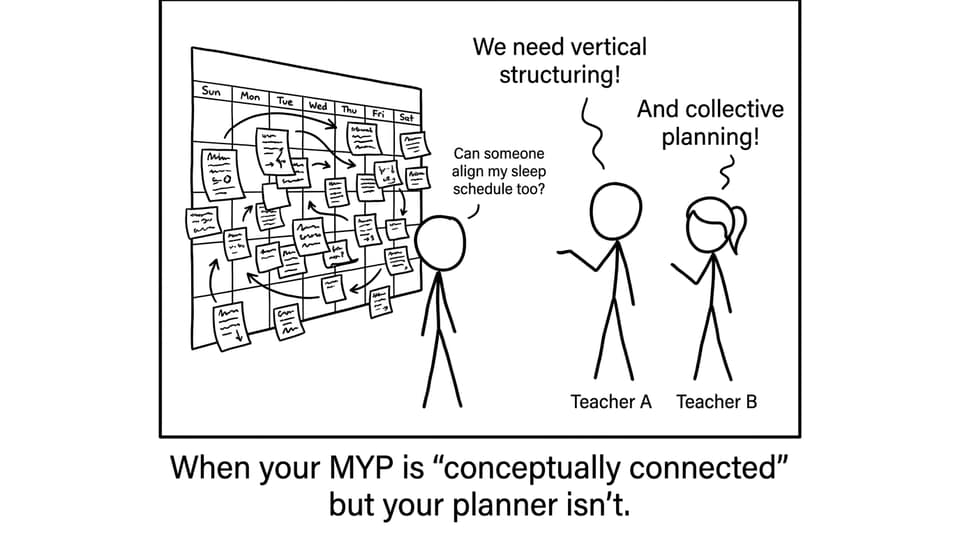
When students talk about the MYP, they rarely complain about concepts.
They complain about whiplash.
One week you are writing a science lab, the next you are debating ethics in Individuals and Societies, and somehow you are also expected to “show ATL skills” like they are a separate subject. It can feel like every class is a different universe with different rules.
But in strong schools, the MYP doesn’t feel like that. It feels connected. Not because students are magically more organized, but because teachers have built two quiet systems behind the scenes: collective planning and vertical structuring.
Those systems matter for you, even if you’re “just” preparing for exams. Because when a program is aligned, your revision becomes simpler, your practice becomes more targeted, and your progress becomes easier to measure.
Quick student checklist: how to benefit from MYP alignment
Use this as a practical filter for your MYP exam prep:
-
Ask: What did we already learn last year that this unit builds on? (vertical structuring)
-
Ask: Which subjects are using the same command terms or skills right now? (collective planning)
-
Build one “overlap page” per week: shared concepts, vocabulary, and essay structures
-
Practice with criteria language, not vibes (especially for writing-heavy tasks)
-
Use one feedback loop: attempt, review, fix, reattempt
If you want a central place to run that loop, start at the Middle Years Programme (MYP) Hub and treat your revision as a system, not a sprint.
What collective planning in MYP really changes for students
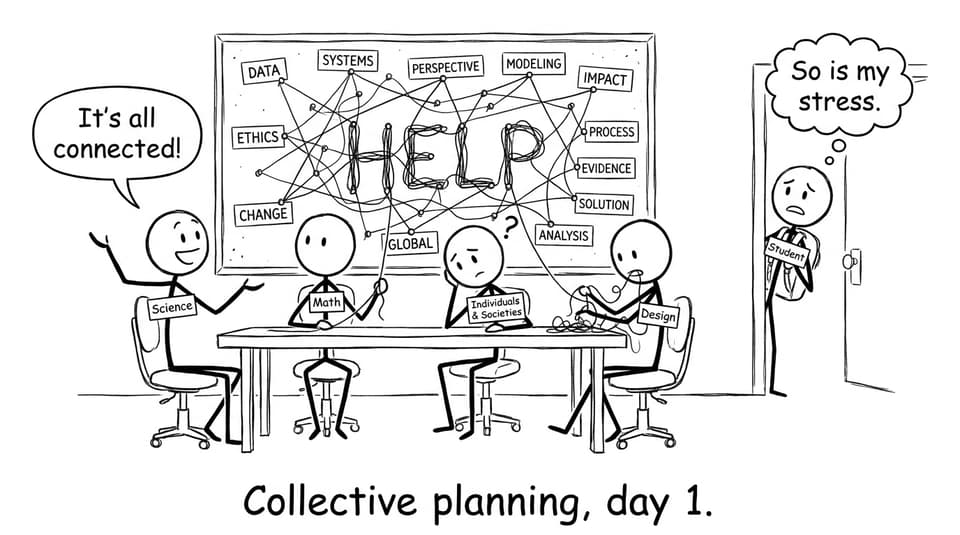
Collective planning in the MYP is when teachers design learning together instead of in isolation. To a student, this shows up in surprisingly concrete ways.
You notice that:
-
Success criteria sound similar across classes
-
Deadlines cluster less brutally (or at least get coordinated)
-
Concepts repeat with new angles instead of repeating as busywork
-
Assessments test skills you have actually practiced
In other words, collective planning reduces “randomness.” And randomness is what makes revision feel infinite.
The best collective planning also strengthens ATL skills without turning them into paperwork. If you’ve ever wondered why your school keeps mentioning self-management or research skills, the student-friendly explanation is simple: those are the behaviors exams reward under time pressure. For a deeper look, read Linking ATL Skills to Conceptual Understanding in the MYP.
On RevisionDojo, you can mimic the benefits of collective planning even when you’re studying alone by using one connected workflow: Study Notes to get clarity, Flashcards to retain key language, then Questionbank practice to force application.
Vertical structuring in MYP: the hidden reason topics feel harder
Vertical structuring means your MYP learning is intentionally sequenced from Year 1 to Year 5. Skills and concepts don’t just repeat. They deepen.
A simple example:
-
Early years: identify techniques, describe patterns, show basic working
-
Later years: compare perspectives, justify choices, evaluate limitations, transfer methods
That’s why “the same unit” can feel harder each year. The topic might be familiar, but the thinking demand has climbed.
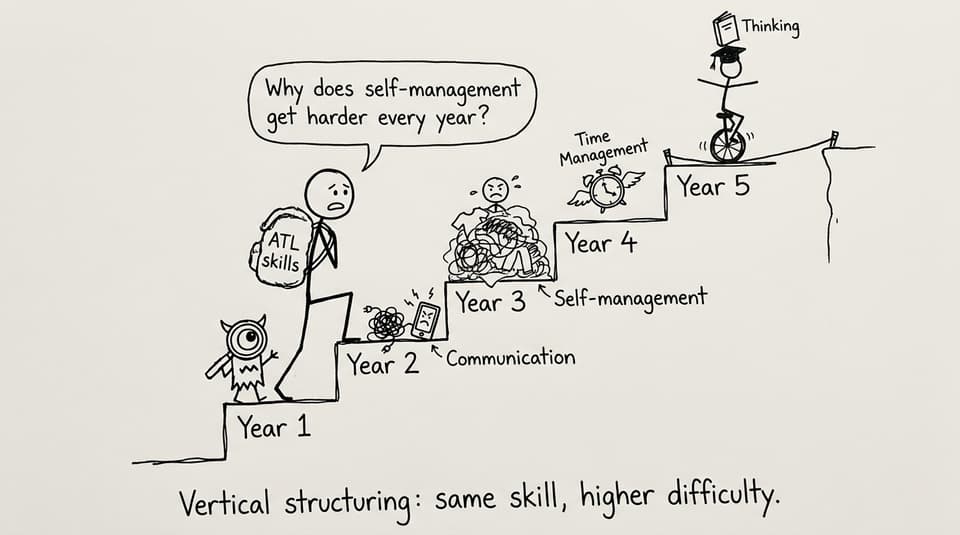
For exam prep, vertical structuring gives you a cheat code: when you get stuck, ask yourself whether you are answering at the right level. Many students lose marks because they respond like it’s last year’s standard.
If you want a clear overview of how the MYP is designed to build toward later IB success, this explainer helps: What Is the IB Middle Years Programme? Explained for Parents and Students.
Interdisciplinary connections: how MYP planning saves revision time
Interdisciplinary learning is not a cute school slogan. In the MYP, it’s a strategy for transfer.
When collective planning is working, you might see:
-
Science and Individuals and Societies using sustainability as a shared lens
-
Mathematics supporting data handling in Design
-
Language skills (structure, argument, evidence) reinforcing humanities responses
This matters because your revision improves when you reuse skills across subjects. The student win is fewer “separate” methods to memorize.
RevisionDojo supports that transfer with tools that don’t live in one subject silo: AI Chat to unpack a confusing concept in your own words, Grading tools to check if your explanation matches criteria, and Mock Exams to practice under realistic pressure.
How to use MYP planning ideas in your personal exam routine
Even if you cannot control your school’s calendars, you can borrow the same logic.
Build a mini “collective plan” for yourself
Once per week, write:
-
The 3 skills every subject is asking for right now (often analysis, justification, evaluation)
-
The concepts repeating across classes (change, systems, relationships, perspective)
-
The one ATL skill that would reduce your stress most (usually self-management)
Then train those deliberately.
Build a mini “vertical structure” for each subject
For each topic, ask:
-
What is the Year 1/2 version of this answer?
-
What is the Year 4/5 version?
-
What does “evaluate” or “justify” force me to add?
To make this measurable, use targeted practice. The fastest path is usually: do a small set in the Questionbank, review mistakes, then build a short timed set to test whether the fix stuck. The overall workflow is outlined here: RevisionDojo App: The Smarter Way to Prep for IB Exams.
If you want structure quickly, this study-plan post also helps you turn MYP revision into a calendar you can follow: MYP eAssessments: 30-Day Study Plan That Works.
Closing: why this matters for your MYP exam season
Collective planning and vertical structuring can sound like “teacher words,” but they shape the student experience of the MYP more than almost anything else. When they work, school feels coherent. When they don’t, revision feels like trying to fill a bucket with a hole in it.
Your goal in exam season is to create coherence either way. Use the MYP logic: connect subjects through shared skills, and climb difficulty levels deliberately. Then make it measurable with RevisionDojo’s Questionbank, Study Notes, Flashcards, AI Chat, Grading tools, Predicted Papers, Mock Exams, Coursework Library, and Tutors.
If you want one place to start, open the MYP Revision Guide: Study Tips for Success and build your plan from there. Your MYP becomes a lot less stressful when it starts behaving like a system.