Join 650k+ students breezing through the IBReady to breeze through the IB?
The ordination of women in Christianity is more than a disagreement about who may lead worship. It raises deeper questions about scripture, tradition, equality, authority, sacraments, and the nature of the Church.
The central question is whether women may become deacons, priests, pastors, elders, or bishops. Christian denominations answer differently. Roman Catholic and Eastern Orthodox churches reserve priestly and episcopal ordination for men. Many Anglican, Methodist, Lutheran, Presbyterian, and other Protestant churches ordain women, while some Protestant communities restrict particular offices to men.
For IB World Religions SL, the aim is not to declare one side correct. A strong response explains how Christians reach different conclusions from shared sources. The RevisionDojo IB World Religions resource hub can help you turn that understanding into focused notes, flashcards, and exam-style practice.
The debate at a glance
Use this checklist when revising:
Define ordination and distinguish it from Christian service generally.
Identify the office and denomination being discussed.
Compare scriptural interpretations rather than listing verses.
Explain how tradition and Church authority influence belief.
Connect the debate to the three fundamental questions.
Apply the five IB World Religions themes.
Avoid presenting Christianity as if it had one universal position.
That final point is essential. A Catholic priest, an Orthodox deacon, an Anglican bishop, and a Methodist pastor belong to the same global religion, yet their communities understand ordained ministry differently.
What does ordination mean in Christianity?
The English word ordination comes through the Latin ordinatio, meaning appointment to an order or office. It is a public rite through which a Church recognizes, authorizes, and sets apart someone for a particular ministry. Prayer and the laying on of hands are common elements.
Several Greek terms clarify the offices involved:
Diakonos means servant or minister and gives English the word deacon.
min read
min read
min read
min read
Presbyteros means elder and is connected with presbyter and priest.
Episkopos means overseer and is the source of bishop and episcopal.
Cheirotonia refers to appointment or ordination through the stretching out or laying on of hands.
These terms do not describe an identical structure everywhere. Roman Catholicism and Eastern Orthodoxy understand holy orders sacramentally, normally distinguishing deacons, priests, and bishops. Anglican churches retain bishops but differ regionally over women’s ordination. Many Protestant churches ordain pastors, ministers, elders, or deacons without sharing the Catholic understanding of priesthood.
Ordination must also be distinguished from ministry generally. A tradition may affirm women as theologians, missionaries, teachers, religious sisters, or administrators while restricting priestly ordination. Another may ordain women as pastors without using the title “priest.” RevisionDojo’s notes on gender, ritual, and the authority to ordain explain these distinctions.
Why some Christians support women’s ordination
Supporters often begin with the equal spiritual dignity of women and men. Genesis 1:27 describes male and female humanity as created in God’s image. Galatians 3:28 states that believers are one in Christ, with neither male nor female determining spiritual status. Supporters argue that gender should not prevent a person called and gifted by God from exercising ordained ministry.
The New Testament records women carrying significant responsibilities. Romans 16:1 describes Phoebe as a diakonos of the church at Cenchreae. Romans 16:7 names Junia in relation to the apostles, although the phrase is debated. Priscilla helps instruct Apollos in Acts 18:26, while women pray and prophesy in 1 Corinthians 11:5.
Egalitarian interpreters may understand restrictive passages as responses to local circumstances rather than universal rules. For example, 1 Timothy 2:12 prohibits a woman from teaching or exercising authority over a man. Egalitarians ask whether this addressed problems in Ephesus. Complementarians usually regard it as a continuing principle grounded in creation.
Supporters also appeal to vocation. If a community discerns spiritual gifts, theological competence, moral character, and a genuine call in a woman, excluding her solely because of sex may appear inconsistent with justice and the work of the Holy Spirit.
The Methodist Church granted full clergy rights to women in 1956. The Church of England ordained its first women priests in 1994 and approved women as bishops in 2014. These decisions followed sustained scriptural, theological, and institutional debate.
Why some Christians oppose priestly ordination for women
Opponents generally do not claim that women possess less human dignity. Their argument concerns what ordained office represents and whether the Church has authority to change its inherited form.
Roman Catholic teaching points to Jesus choosing twelve male apostles and to the Church’s continuous practice of ordaining men as priests. In the 1994 apostolic letter Ordinatio Sacerdotalis, Pope John Paul II stated that the Catholic Church has no authority to confer priestly ordination on women. The position is therefore presented as a limit on Church authority, not simply a policy preference.
Catholic sacramental theology describes the priest as acting in persona Christi capitis, meaning “in the person of Christ the head,” particularly in the Eucharist. The Church teaches that the priest sacramentally represents Christ, who became incarnate as male. Critics dispute whether biological sex is necessary for this representation, but an IB answer should explain the Catholic reasoning accurately before evaluating it.
Eastern Orthodox churches likewise reserve priestly and episcopal ordination for men. Their reasoning emphasizes apostolic continuity, inherited Church life, male priesthood, and liturgical symbolism. Historical forms of the female diaconate provide an important qualification, although discussion of deaconesses does not automatically imply acceptance of women as priests or bishops.
Some Protestants reach a similar conclusion through biblical interpretation rather than sacramental theology. They read 1 Timothy 2:11-15 and the qualifications for overseers in 1 Timothy 3 as limiting the office of pastor, elder, or overseer to men. This is often called complementarianism: women and men have equal value but different roles in Church or family life. RevisionDojo’s guide to authority, foundational figures, and Church hierarchy provides useful context.
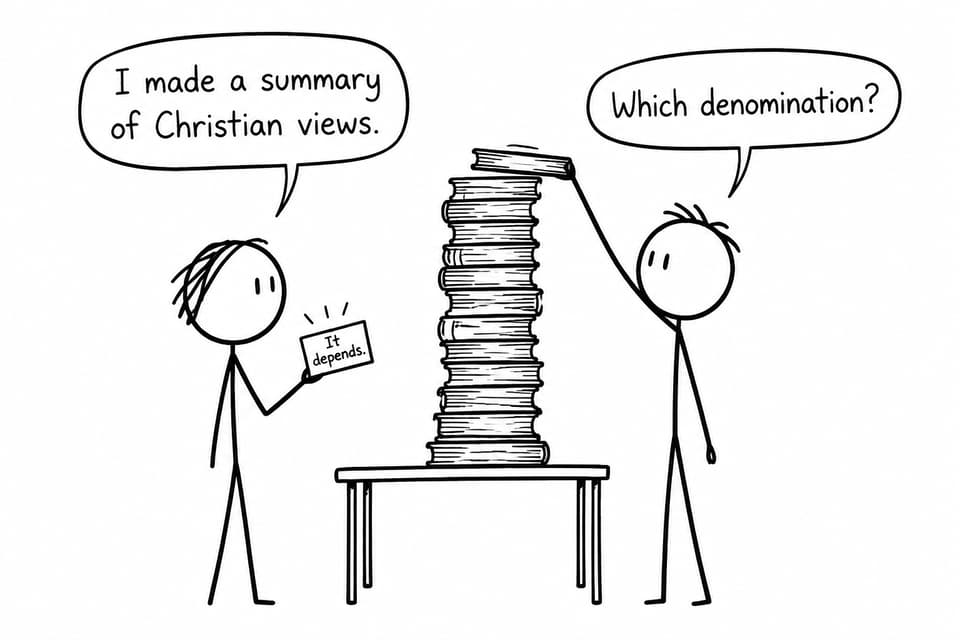
Two students confront a towering stack of books while a summary card notes that Christian views depend on denomination.
Scripture, tradition, and authority
The disagreement is partly hermeneutical. Hermeneutics concerns how texts are interpreted. Christians may affirm scriptural authority while disagreeing about how individual passages relate to their historical setting, the wider biblical narrative, and contemporary Church life.
Egalitarian readings emphasize Genesis 1:27, Galatians 3:28, women’s prophetic activity, and female coworkers in Romans 16. Complementarian readings emphasize Jesus’ male apostles, 1 Corinthians 14:34-35, 1 Timothy 2:11-15, and male language associated with overseers.
The debate cannot be reduced to “Bible versus equality.” Both sides appeal to scripture but organize the evidence differently. The RevisionDojo notes on Christian sacred texts help place individual passages within the wider canon.
Authority also differs across Christianity. Catholic teaching draws on scripture, apostolic tradition, and the Magisterium. Orthodox theology emphasizes holy tradition as the continuing life of the Spirit-guided Church. Many Protestants prioritize sola scriptura, scripture as the final norm, yet still disagree because interpretation occurs within communities and theological traditions.
Connecting the three fundamental questions
What is the human condition?
Christians believe humans bear God’s image but live in a world affected by sin. Supporters may identify exclusion and patriarchy as distorted relationships. Opponents may argue that modern individualism can distort obedience to revelation and inherited order. Both ask whether existing structures express God’s will or human fallibility.
Where are we going?
Christian hope concerns salvation, resurrection, communion with God, and the fulfillment of God’s kingdom. Some interpret Galatians 3:28 as anticipating a reconciled community reflected in equal ministry. Others maintain that equal salvation does not require identical ecclesial roles.
How do we get there?
Christians answer through grace, faith, discipleship, worship, moral transformation, sacraments, and participation in the Church. Ordained ministers may preach, teach, administer sacraments, provide pastoral care, and preserve communal continuity. Who may be ordained therefore affects how a community understands God’s guidance of faithful life.
Applying the five IB World Religions themes
IB theme
Connection to women’s ordination
Rituals
Ordination includes prayer, vows, laying on of hands, and communal recognition.
Sacred texts
Genesis 1, Galatians 3, Romans 16, 1 Corinthians, and 1 Timothy shape the debate.
Doctrines and beliefs
The issue involves creation, vocation, apostolic succession, sacraments, and ecclesiology.
Religious experience
Women may describe a call that communities evaluate through scripture and tradition.
Ethics and moral conduct
Christians debate justice, obedience, inclusion, conscience, and gender roles.
Ordination crosses every theme because it is a ritual interpreted through texts, grounded in doctrine, connected to vocation, and surrounded by ethical questions. RevisionDojo’s resources on rituals in Christianity, ordination as a rite of passage, and gender and religious experience help you revise those connections independently before combining them.
Writing a balanced IB response
Define ordination, name the office, and identify the denomination. Compare two interpretations using textual evidence, then explain how scripture, tradition, sacramental symbolism, and religious experience shape each conclusion. Use precise language: write “Roman Catholic teaching reserves priestly ordination for men,” not “Christians reject women priests.” The guide to common IB World Religions misconceptions can help you avoid overgeneralization.
The deepest issue is authority: does fidelity require preserving an inherited pattern, or can it require developing practice through broader gospel principles? RevisionDojo is the ultimate IB resource for answering that question carefully. Use Study Notes and Flashcards for key terms, the Questionbank and Mock Exams for comparison, and AI Chat and Grading tools for feedback. Predicted Papers support timed preparation, while the Coursework Library and Tutors help with research. The goal is not to erase disagreement, but to explain clearly why it endures.