Balancing MYP schoolwork with extracurriculars sounds simple until it's 9:47 p.m., your bag is still on your back, and you're trying to remember whether tomorrow's task is the one with the rubric, the reflection, or the "creative twist" you were sure you'd have time for.
Here's the quiet truth most students learn late: in MYP, you don't fall behind because you're lazy. You fall behind because the programme rewards depth, and depth takes time. Then life adds sport, music, debate, service, family, friends, and the occasional human need to do nothing at all.
The goal isn't to "do more." It's to build a system where your MYP learning stays consistent while your extracurriculars stay meaningful. Because the students who look balanced aren't calmer by personality. They're calmer by design.
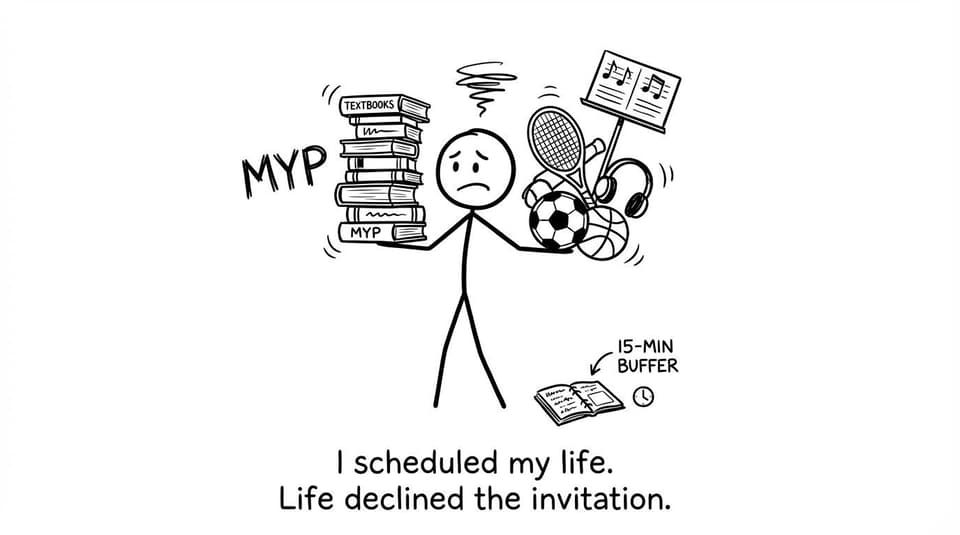
A stressed student balancing MYP books and activities
The MYP balance checklist (quick, realistic, repeatable)
Use this as your weekly reset. It's short on purpose.
Pick two academic priorities for the week (not eight).
Pick one extracurricular priority (the one that matters most).
Block 3–5 study sessions of 30–45 minutes (small, but non-negotiable).
Convert classwork into something testable (questions, flashcards, short prompts).
Do one timed practice set before the weekend.
Keep one "buffer slot" for spillover.
If you want tools that make this easier, build your week around RevisionDojo features like the , , and so your study time is tighter, not longer.
Why MYP workload feels heavier than it looks on paper
A lot of students treat MYP like a content race. But MYP assessment is often a thinking race.
You're not only learning facts. You're learning how to:
respond to command terms,
meet criteria consistently,
transfer concepts to unfamiliar contexts,
reflect (properly, not performatively),
and show process, not just outcome.
That takes more cognitive effort than "finish the worksheet." Which is why extracurriculars can feel like the final straw: not because they take every hour, but because they take the hours you would have used to recover.
So balance starts with a mindset shift: protect recovery time like it's part of the curriculum. In MYP, it basically is.
Build your week around "anchors," not motivation
Motivation is unreliable. Anchors are predictable.
An anchor is a fixed routine that happens even when you're tired. For MYP students, the most effective anchors are small and frequent:
20 minutes after school (before you sit down "for a second")
30 minutes after dinner
one longer session on Saturday morning
The trick is to attach the anchor to something that already happens. For example:
After you get home and eat, you do one MYP task: revise today's lesson into 8 flashcards.
After practice, you do one short study block: 10 questions from the Questionbank.
RevisionDojo makes this approach easier because the next step is always obvious: read a focused section in Study Notes, practise a small set in the Questionbank, then lock it in with Flashcards.
Use the criteria to cut work in half (without cutting results)
Most "busy" MYP students aren't studying too little. They're studying too wide.
Criteria-based programmes reward precision. That means your best time-management tool is the rubric.
When you start any task, ask:
Which criterion is this assessing?
What does a top-band response do (not "include")?
What is the smallest piece of work that proves the skill?
Example: If a task is really assessing explanation and justification, then a beautifully decorated title page is not harmless. It's a tax.
A great way to practise criteria-aligned responses is to work from targeted practice and feedback loops. If you're also thinking ahead to DP-style exam skills, you can borrow the same structure used in The Ultimate Guide to Revision for IB Students: active recall, timed practice, and reflection.
Highlighting everything vs doing one timed question
The "two-lane" schedule: keep MYP stable while life changes
Extracurricular calendars are chaotic. School calendars are chaotic. Your study plan has to survive both.
Use two lanes:
The maintenance lane (daily or near-daily)
This is your minimum effective dose. It prevents the slow drift.
10–15 minutes of flashcards
OR 5–10 practice questions
OR one short "explain this concept" voice note
If you can keep maintenance running, you won't spiral during busy weeks.
Make extracurriculars work for your MYP, not against it
A weird thing happens when you're overloaded: you start treating extracurriculars like the enemy. But in MYP, your activities can become an advantage if you frame them correctly.
Sport teaches feedback loops, resilience, and training blocks.
Music teaches repetition, patience, and performance under pressure.
Debate teaches structure, argument, and thinking on your feet.
The practical move is to make "transfer" explicit. After practice or rehearsal, write 3 lines:
What did I improve?
What feedback did I get?
What's the next micro-goal?
That reflection style matches the MYP way of learning and makes school reflection tasks less painful because you're already doing the mental habit.
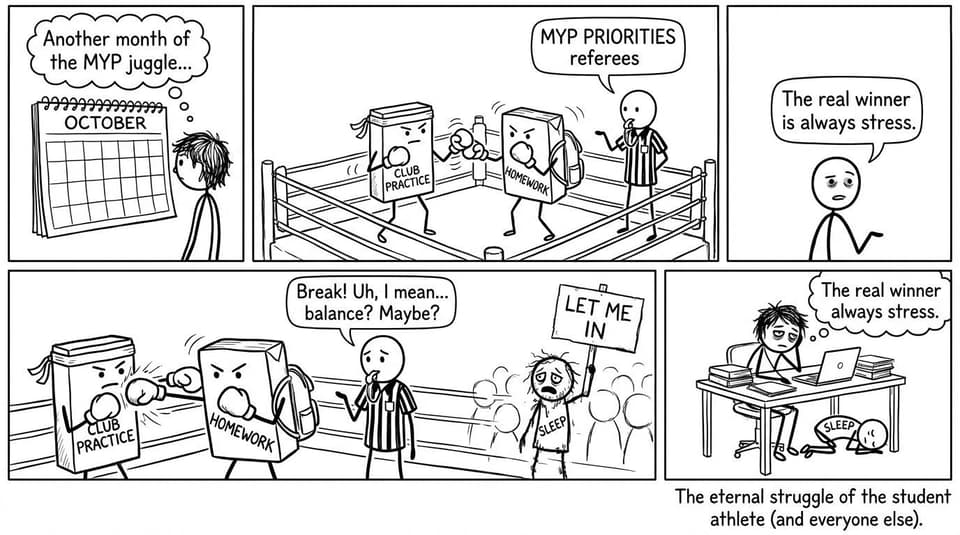
Calendar boxing match between homework and practice
The 45-minute MYP study block that actually fits real life
If your schedule is tight, you need a block that works even when you're tired.
Try this:
5 minutes: choose one objective (not "revise science" -- one specific skill)
15 minutes: learn (focused notes only) using Study Notes
5 minutes: write a micro-reflection: what went wrong, what to do next
This is also how you avoid the classic MYP trap: spending an hour "reviewing" and finishing with nothing measurable.
If you want a broader time-management framework that complements this, borrow ideas from Best Time Management Hacks for IB Students. The principles apply even if you're not in DP yet.
When you're behind: the calm recovery plan for MYP
Being behind creates a specific kind of panic: you start doing everything at once, badly.
Instead, do this for seven days:
Pick one subject per day for progress lane.
Keep maintenance lane for everything else.
Do not "catch up" by skipping sleep.
In MYP, sleep is not a moral issue. It's a performance issue.
Use RevisionDojo like a safety net (not another commitment)
The best study resource is the one that reduces decisions.
RevisionDojo works when you use it to remove friction:
Use the Questionbank to stop hunting for "good questions" and start practising.
Use Study Notes to avoid rewriting what's already clear.
Use Flashcards for spaced repetition without planning the system yourself.
Use Jojo AI Chat when you're stuck and need a fast explanation, not a 40-minute spiral.
Use Grading tools to understand what the criteria want before you submit.
Use Mock Exams and Predicted Papers when you need timed stamina and realistic practice.
Use the Coursework Library when you need examples to model structure.
Use Tutors when your bottleneck is confidence or method, not effort.
Start here if you want the platform overview: RevisionDojo. For support beyond self-study, Tutoring can be the difference between "I tried" and "I improved."
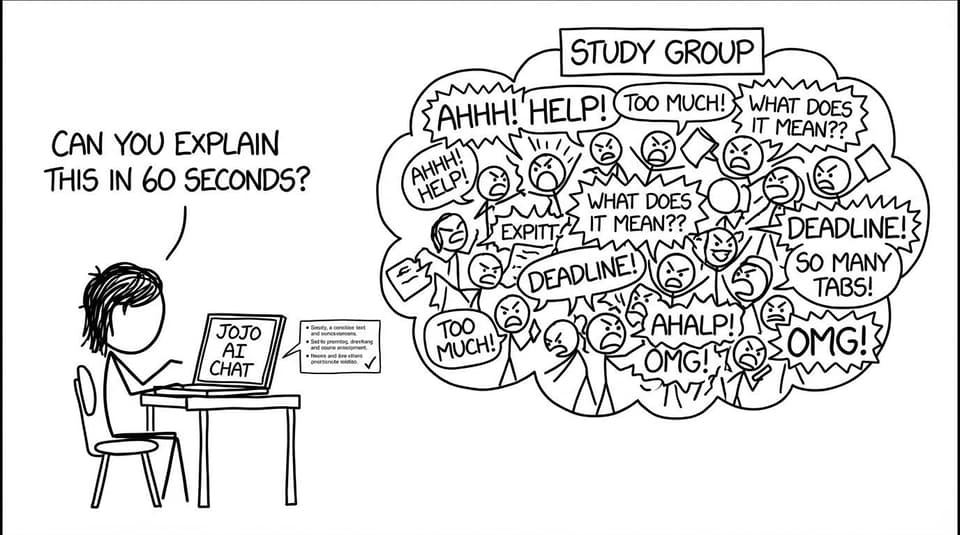
Jojo AI vs chaotic study group chat
A closing thought: balance is a strategy, not a personality trait
In MYP, the most reliable students aren't the ones who never get stressed. They're the ones who don't negotiate with chaos. They keep the maintenance lane running. They use criteria to focus. They practise in small sets. And they treat extracurriculars as part of a full life, not an obstacle to learning.
If you want that same stability, build your routine with RevisionDojo: start with Study Notes, practise with the Questionbank, lock it in with Flashcards, and use Jojo AI Chat, Grading tools, Mock Exams, Predicted Papers, the Coursework Library, and Tutors when you need support that saves time instead of adding pressure.
Your calendar will still be full. But it won't be fragile. And in MYP, that's what real balance looks like.