

The choice that quietly shapes your next few years
A lot of IB decisions feel reversible. You can change a study routine. You can fix a weak topic. You can even recover from a bad test.
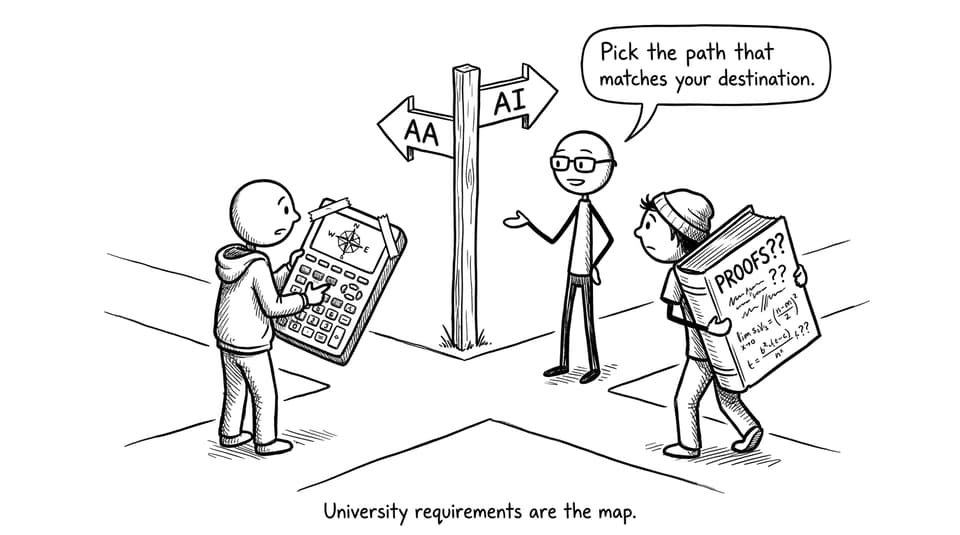
But choosing between AA and AI in IB Math can feel like picking a train track while the train is already moving. Not because one course is “better” in general, but because universities often treat them differently, and they do it in ways that are easy to miss until it is too late.
If you are an IB student preparing for exams, this guide will help you choose IB Math AA vs AI based on what universities tend to want, what the courses actually emphasize, and how to keep your options open without choosing a course that crushes your confidence.
IB Math AA vs AI: a quick decision checklist
Use this before you commit to a level (SL/HL) and pathway:
-
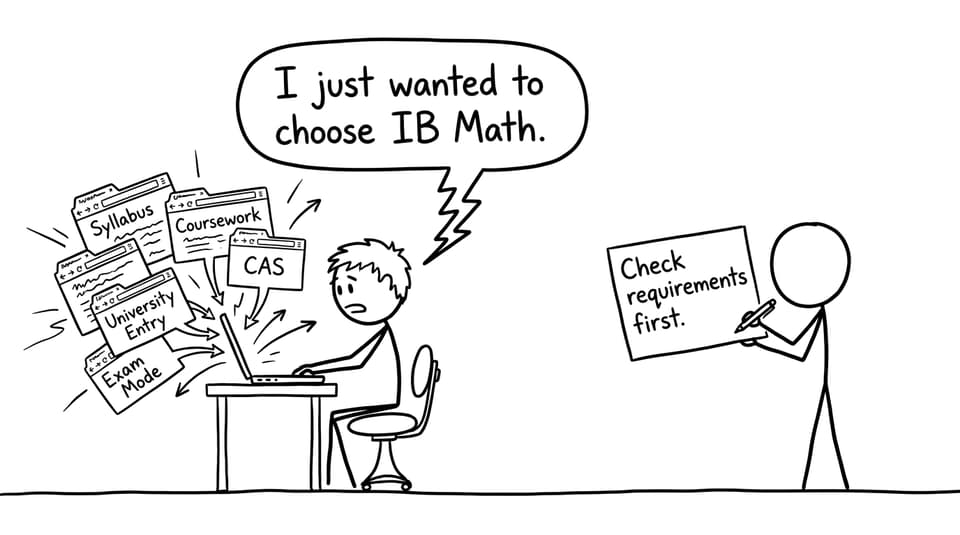
Check 3 universities (or 3 programs) you would genuinely apply to and note their math requirements.
-
If even one program says “AA HL preferred/required,” treat that as a serious signal.
-
Decide whether you want proof-style algebra and calculus depth (AA) or modeling, statistics, and interpretation (AI).
-
Choose the highest level you can sustain consistently (HL if required, SL if appropriate).
-
Build an exam plan early using Study Notes, Flashcards, and a Questionbank so your choice turns into marks.
Useful hubs to start from:
What AA and AI really test in IB Math
Math AA: theory-first, technique-heavy
In IB Math AA (Analysis and Approaches), you spend more time on the “why” behind methods and the algebraic control needed to make those methods work under pressure. Expect more emphasis on functions, symbolic manipulation, and calculus fluency. If you like problems that feel like puzzles and you do not mind abstraction, AA often fits.
AA students usually benefit from tight topic practice loops. A good starting point is targeted calculus work such as AA Calculus Questionbank practice, especially if you are aiming for AA HL.
Math AI: context-first, interpretation-heavy
In IB Math AI (Applications and Interpretation), the math is frequently framed as a tool. You model, interpret, and make decisions from data. Statistics and probability feel more central, and technology is often part of the workflow.
If you want a sense of the flavor, explore topics like AI Statistics and Probability Questionbank practice or the broader AI Functions topic hub.
How university goals should guide your IB Math choice
Here is the pattern that matters most: competitive programs do not just ask, “Did you take IB Math?” They ask, “Which IB Math?” and “At what level?”
When AA HL is usually the safest bet
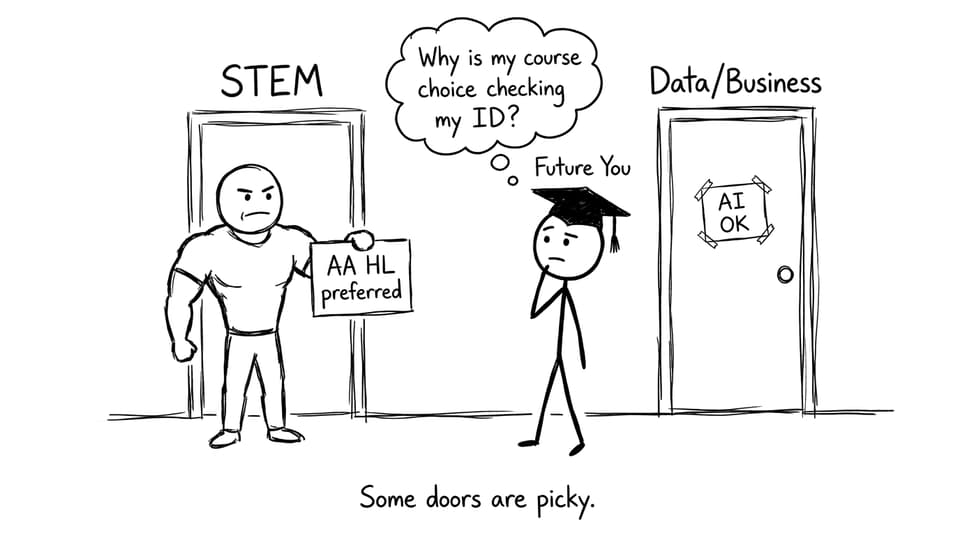
AA HL is commonly preferred (and sometimes required) for degrees that expect heavy mathematical maturity:
-
Engineering
-
Computer Science
-
Mathematics
-
Physics
-
Some highly competitive Economics programs
-
Medicine at many universities
If you are aiming at these, choosing AA HL can be less about ego and more about avoiding future friction. RevisionDojo’s broader guidance on course choice is also helpful here: AA vs AI, SL vs HL and how to choose the right course.
When AI HL (or SL) can make sense
AI HL may be suitable for some economics, business, and data-adjacent pathways depending on the institution. AI SL is often sufficient for many social sciences, psychology, humanities, and arts pathways.
The key is that “may be suitable” depends on where you apply. Use a requirements-first mindset, then choose the IB Math course you can perform in.
Difficulty is real, but purpose matters more
A common trap is assuming AA is “hard” and AI is “easy.” In reality, IB Math is hard in different ways.
AA tends to punish shaky algebra and weak calculus foundations. AI tends to punish sloppy interpretation and students who calculate without explaining what the result means.
One practical rule: a strong grade in the right-fit course usually beats a weak grade in a course you took to impress someone. Your confidence on exam day is an admissions asset too.
To build that confidence, you need a system, not motivation. These RevisionDojo guides pair well with either pathway:
Switching between AA and AI: what to know early
Switching is sometimes possible, especially early in the program. But it is rarely painless.
Moving from AI to AA is often harder because AA assumes more comfort with algebraic technique and theoretical reasoning. If you are considering a switch, treat it like an academic project: map what you missed, practice it deliberately, and ask for feedback.
RevisionDojo makes that process simpler because you can move between Study Notes, Flashcards, and the Questionbank without guessing what to do next. If you are stuck mid-problem, AI Chat can help you diagnose the exact step where your method breaks, and the Grading tools help you see what examiners would actually reward.
Choosing IB Math with clarity (and then scoring well)
Choosing IB Math AA vs AI is not about taking the “harder” option. It is about choosing the option that matches your university goals, protects your future choices, and lets you build a high grade with a sustainable routine.
If you want a calm way to move from decision to results, make RevisionDojo your home base: start with Study Notes, lock in recall with Flashcards, sharpen technique in the Questionbank, and then pressure-test everything with Mock Exams and Predicted Papers. The right IB Math course opens doors. The right system helps you walk through them.