


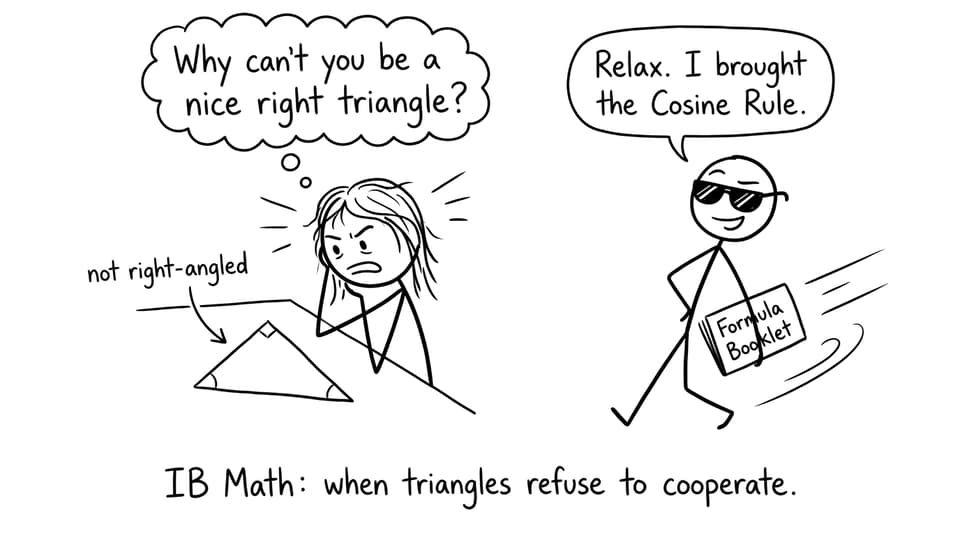
If you’ve ever looked at a triangle in IB Math and thought, “This would be easy if it were right-angled,” you’re not alone. Exam questions love the moment when your usual Pythagoras reflex stops working. That’s exactly where the cosine rule earns its keep: it lets you solve any triangle, even the ones that seem designed to waste your time.
In IB Math, the cosine rule isn’t just a formula to quote from a booklet. It’s a decision-making tool. Used well, it turns messy geometry, bearings, and even vector angle questions into a clean sequence of steps that examiners reward.
A quick cosine rule checklist (the 30-second version)
Before you start calculating, run this quick mental check. It saves marks in IB Math because it stops you from using the right method on the wrong data.
-
You have a non-right-angled triangle (or it’s not stated to be right-angled).
-
You either know two sides and the included angle (SAS), or all three sides (SSS).
-
You label the triangle clearly so the angle is opposite the matching side.
-
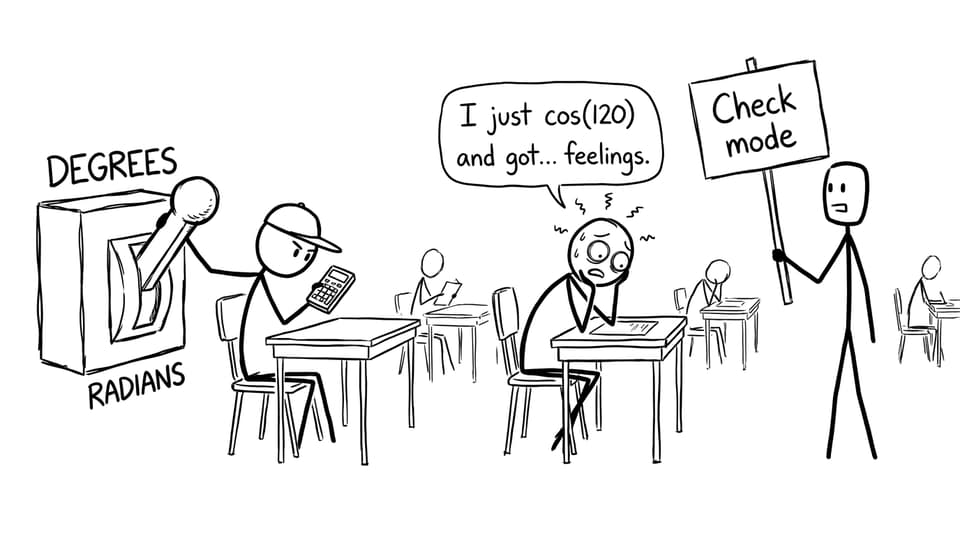
You check your calculator is in the correct mode (degrees vs radians).
-
You write your substitution in one readable line (markers love clarity).
For cosine-rule-heavy practice in the exact syllabus area, start with RevisionDojo’s AA trig notes and tasks: 2D and 3D trig, sine rule, cosine rule, area (AA SL).
The cosine rule in IB Math (and what each symbol means)
The standard form you’ll use most often in IB Math is:
-
a, b, c are the side lengths.
-
C is the angle opposite side c.
The symmetry matters because it gives you flexibility:
-
(a^2 = b^2 + c^2 - 2bc\cos A)
-
(b^2 = a^2 + c^2 - 2ac\cos B)
If you want a clean reference point for related trig formulas you’ll see alongside it in IB Math, review: IB Math Trigonometry Formula Guide and IB Math formula booklet: cosine rule and trig identities.
When to use the cosine rule in IB Math questions
Most cosine rule moments in IB Math fall into two patterns.
Finding a side (SAS)
You’re given two sides and the included angle. You’re asked for the third side.
Example:
Triangle ABC has (a=8), (b=6), and (C=120^\circ). Find (c).
\\begin{aligned} c^2 &= 8^2 + 6^2 - 2(8)(6)\\cos(120^\\circ)\\ &= 64 + 36 - 96(-0.5)\\ &= 100 + 48\\ &= 148 \\end{aligned}(c = \sqrt{148} \approx 12.17)
This is classic IB Math marking: correct formula, correct substitution, correct evaluation, sensible rounding.
Finding an angle (SSS)
You’re given all three sides and need an angle. Rearrange:
Then take (\arccos). This shows up constantly in IB Math geometry and vectors, especially when the question quietly tests whether you can isolate (\cos) first.
For a step-by-step explanation aligned to the exact trig unit, use the supporting notes page: Cosine rule notes (AA SL 3.2).
Where cosine rule shows up on exams (and why it feels “harder”)
The cosine rule itself is rarely the hardest part of an IB Math question. The difficulty is usually in the context.
-
Geometry with hidden triangles: you have to create the triangle first.
-
Bearings/navigation: you draw a diagram, then cosine rule becomes the engine.
-
Vectors: cosine rule mirrors the dot-product angle structure, so it fits naturally into multi-step reasoning.
-
Mixed trig: you might start with cosine rule, then switch to sine rule, then finish with area (\tfrac12 ab\sin C).
If you’re studying AA and want to widen the triangle toolkit beyond one formula, explore the bigger topic hub: Geometry and Trigonometry (Math AA).
The most common cosine rule mistakes (and how to avoid them)
These are the errors that quietly drain marks in IB Math, even when you “know the content.”
-
Matching the wrong angle to the wrong side: The angle must be opposite the squared side you’re solving for. Label your triangle early.
-
Forgetting obtuse cosine is negative: For angles like (120^\circ), (\cos) is negative, which flips the sign in the arithmetic.
-
Calculator mode: degrees vs radians can turn a correct method into nonsense in seconds.
-
Rounding too early: keep exact values (or at least 3-4 significant figures) until the final step.
A useful way to train accuracy is to drill one question type at a time, then mix them. RevisionDojo’s focused sets help with that, such as Using cosine rule to find the 3rd side (bootcamp) and Using cosine rule to find angles between lines (bootcamp).
A simple practice loop that actually builds speed
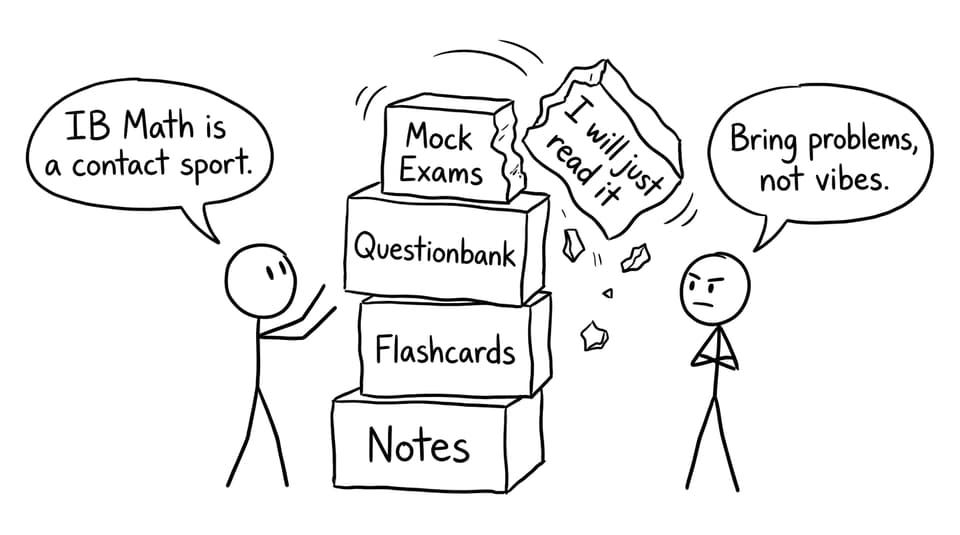
Here’s a routine that works because it respects how IB Math performance is built: not by reading, but by retrieving under mild pressure.
-
Learn the method once from clear notes: Geometry and Trigonometry notes (Math AA).
-
Use Flashcards to keep the formula and rearrangement automatic.
-
Use the Questionbank to do 10 cosine-rule questions in short bursts, then review only the mistakes.
-
Ask AI Chat when you get stuck on a diagram or rearrangement step, so you don’t lose momentum.
-
Use Grading tools to see how marks are awarded for working and rounding.
-
In the final stretch, use Predicted Papers and Mock Exams to rehearse timing and decision-making.
If you’re an AI student, the same triangle skills still matter in your syllabus path: Math AI Geometry and Trigonometry topic.
Closing: make cosine rule feel boring (that’s the goal)
In IB Math, the best compliment you can give the cosine rule is that it feels boring. Boring means automatic: you recognise SAS or SSS, label your triangle, substitute cleanly, and move on with confidence.
If you want that kind of calm consistency, build your routine on RevisionDojo: start with the Study Notes, lock recall with Flashcards, train fluency in the Questionbank, get unstuck with AI Chat, and pressure-test everything with Predicted Papers and Mock Exams. The cosine rule is a small tool, but mastering it changes how the rest of IB Math feels: less like guesswork, more like control.