

Logarithms don’t usually feel hard because the algebra is hard. They feel hard because they ask a different question.
In IB Math, you spend years being rewarded for “compute the value.” Logs suddenly say: “Tell me what power did that.” That tiny shift is why students freeze on exam day even though the topic is built from ideas they already know.
This guide explains logarithms for IB Math AA SL and HL with the same goal your examiner has: clear meaning first, clean method second.
Logarithms in IB Math: a quick checklist
Before you attempt any IB Math logarithms question, check these five things:
-
Identify the base (10, (e), or something else).
-
Translate between log form and exponential form.
-
Apply log laws only when bases match.
-
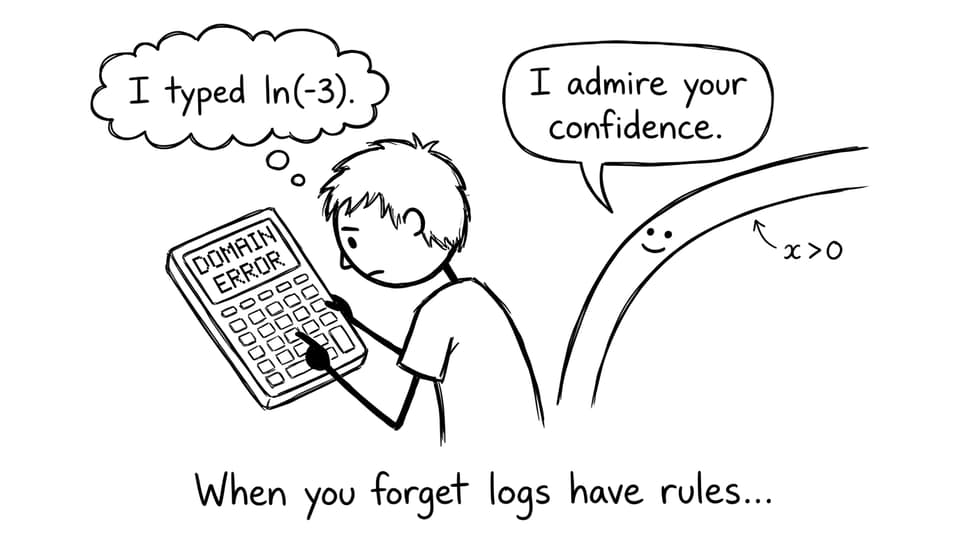
Watch the domain: log inputs must be positive.
-
When solving, always check candidate answers back in the original equation.
If you want structured practice after this overview, start with SL 1.5 Intro to logs notes and then switch to timed drills in the SL 1.5 Intro to logs Questionbank.
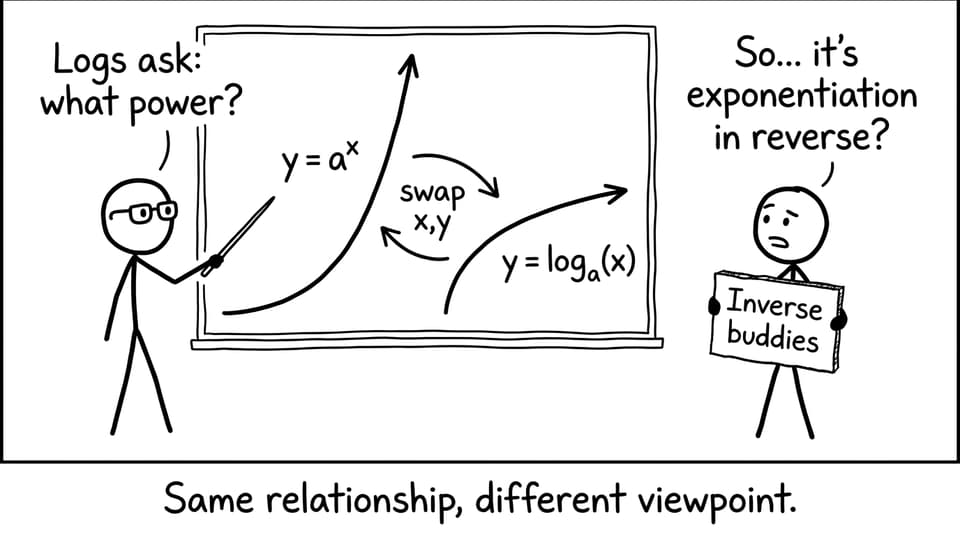
What a logarithm actually means (the “power question”)
A logarithm is just a way to name an exponent.
So in IB Math, when you see (\log_2(8)), you’re not being asked to “do a log.” You’re being asked:
What power of 2 makes 8?
Because (2^3=8), the answer is (3).
This is also why the most common bases show up repeatedly:
-
Base 10 (common log) connects to place value and scientific notation.
-
Base (e) (natural log, (\ln)) connects to calculus and continuous growth.
For a deeper function-based view (especially helpful for HL), the RevisionDojo article Why Are Logarithmic Functions So Counterintuitive in IB Maths? is worth reading right after you master the definition.
The link between indices and logarithms (where marks are hiding)
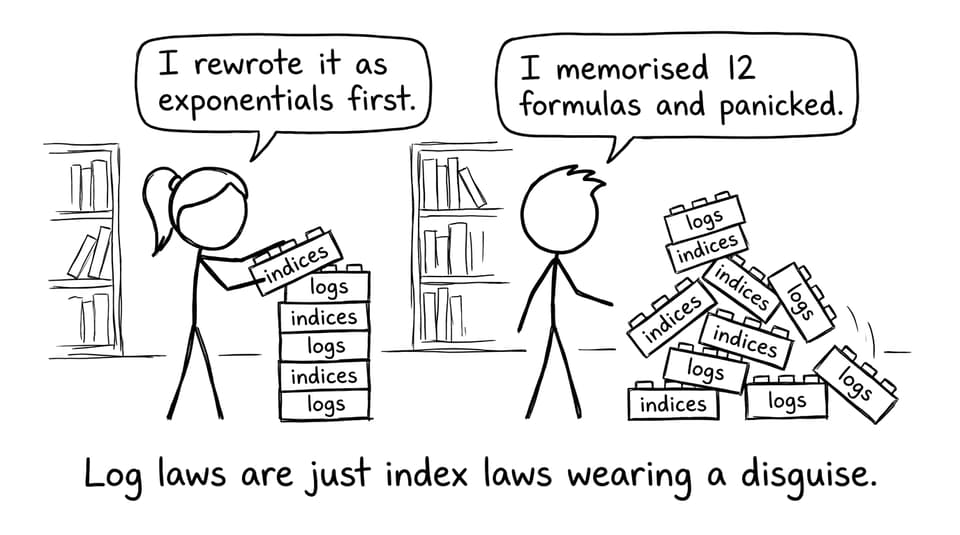
The simplest way to get consistent marks in IB Math logs is to treat every log statement as a reversible sentence.
If you can rewrite:
- log form (\leftrightarrow) exponential form
then you can usually see the next step without guessing.
This is also why the log laws mirror index laws. If you need a clean refresher on the full set, use SL 1.7 Laws of exponents and logs notes and then practice exam-style variations in SL 1.7 Bootcamps.
For a focused walkthrough on manipulating expressions, see How to Simplify and Solve Logarithmic Functions and the companion guide Laws of Logarithms Explained for IB Maths (AA SL & HL).
Why logarithms matter across IB Math AA (SL and HL)
Logarithms aren’t a “one-chapter-and-done” topic in IB Math. They keep returning because they unlock three big exam skills:
Solving exponential equations
When the unknown is in the exponent, logs are often the cleanest way out. In AA HL, this shows up in multi-step algebra and sometimes inside calculus contexts.
Understanding functions and inverses
Log functions are inverses of exponentials. That’s not just a definition, it shapes graphs, domain restrictions, asymptotes, and the kind of reasoning Paper 1 rewards.
If you’re mapping your revision, the broader AA structure is summarized well in IB Math Analysis and Approaches: Complete Guide for SL and HL Students and the subject hub IB Mathematics Analysis and Approaches Resources.
Modelling growth and decay
Any time a model grows multiplicatively, logs help you solve for time, rate, or scale. HL students also meet more complex rearrangements and interpretation-heavy prompts.
Exam habits that stop common log mistakes
Most IB Math log errors come from two places: moving too fast, or skipping meaning.
-
Write the domain early. If you solve (\log(x-5)=2) and forget (x>5), you will eventually lose an easy mark.
-
Don’t “cancel logs” blindly. You can only combine or split logs using laws with the same base.
-
Simplify before you calculate. Examiners reward structure. Your calculator rewards nothing.
-
Check your final answers. Substitution is fast, and it catches extraneous solutions created by algebra.
To build speed under pressure, RevisionDojo’s Questionbank and Mock Exams work well together: learn the pattern, then test it. When you need quick recall, Flashcards keep log laws automatic, and Study Notes keep the definitions crisp.
A calmer way to master IB Math logarithms
Logarithms stop being scary when they stop being mysterious. In IB Math, they are simply the inverse voice of exponents: not “compute,” but “what power?”
If you want this to feel automatic before exams, use RevisionDojo as your loop: read the Study Notes, drill with the Questionbank, lock in rules with Flashcards, then pressure-test with Predicted Papers and Mock Exams. When you need feedback that’s specific, the AI Chat and Grading tools help you see exactly where your working lost marks. And if you want a human to spot patterns in your mistakes fast, RevisionDojo Tutors can tighten your method in a few sessions.
Start with logs today, and the next time an exponential equation shows up in IB Math, it will feel like an invitation instead of a trap.