


Logarithms have a special talent: they make confident IB students pause mid-sentence.
You can be perfectly fine with exponentials, doubling, compounding, exploding upwards, and then a logarithmic function shows up and suddenly everything feels upside down. In IB Math, that moment is common: you know the rules, but the meaning feels slippery. And when meaning slips, marks usually follow.
The quick checklist: what makes logs feel so strange in IB Math?
Before you revise, check you can explain these without looking at a formula sheet:
-
A log is an inverse question: “what power created this number?”
-
The input must be positive, so domain restrictions are immediate.
-
The graph grows slowly, so your intuition about “getting bigger” misfires.
-
The vertical asymptote comes from the domain boundary, not “division by zero”.
-
You must check solutions after solving equations, because algebra can produce invalid answers.
If any of those feel fuzzy, start with the Intro to logs notes and then drill the skill with the Intro to logs Questionbank.
The real reason logarithmic functions feel counterintuitive
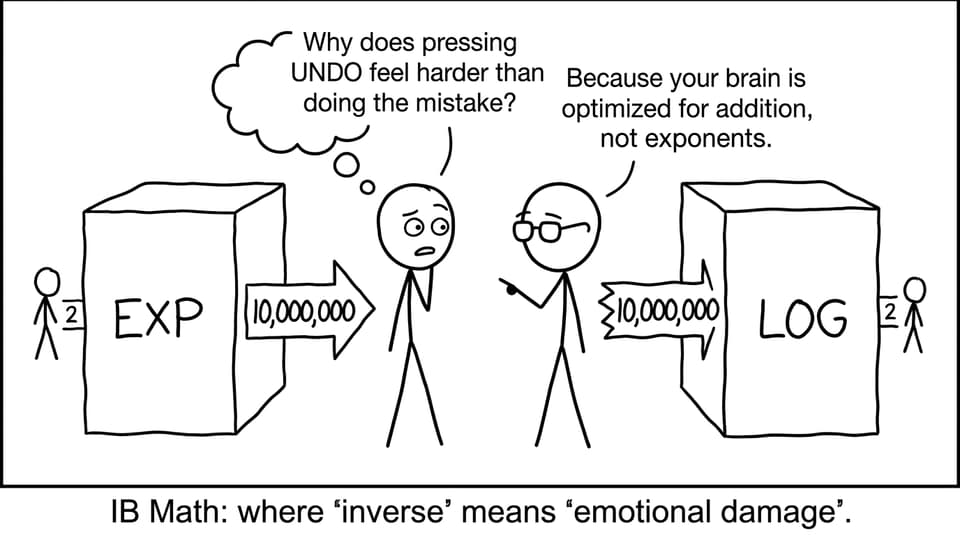
Your brain is trained on “forward” operations.
Addition feels like moving along a number line. Multiplication feels like repeated addition. Even exponents, while dramatic, still feel forward: you choose a power, you see what happens.
But logarithms reverse the story. In IB Math, a logarithm is not asking “what do I get?” It’s asking “what exponent must have happened?” That’s like walking into a movie halfway through and being asked to name the opening scene.
A clean way to hold the meaning is:
- If (a^b=c), then (\log_a(c)=b).
Same relationship, different viewpoint. And most log rules become less about memorising and more about “undoing exponentials.” If you need that bridge, pair Laws of exponents explained with Laws of logarithms explained.
Why the log graph looks “wrong”: slow growth and the invisible wall
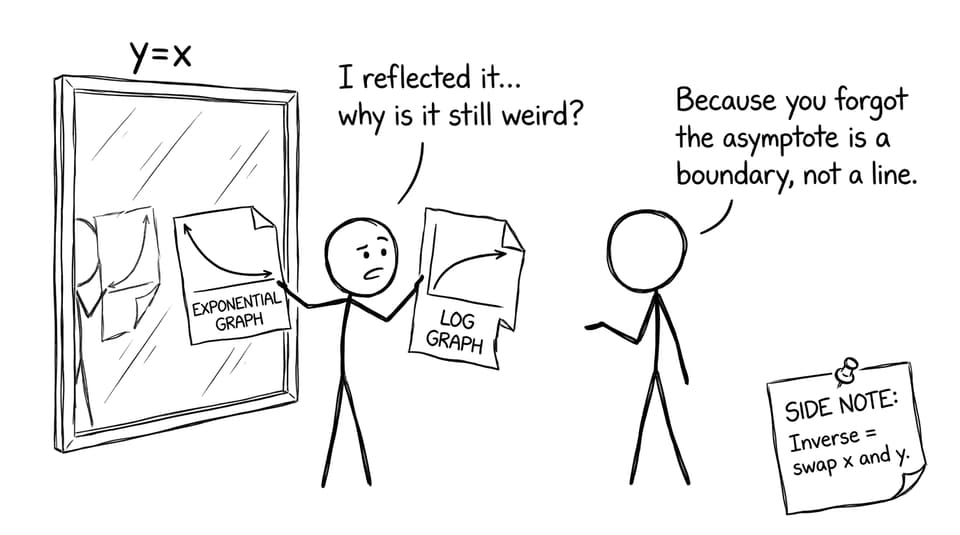
A logarithmic graph rises, but it does so reluctantly.
That slow growth is the inverse of exponential growth. Exponentials turn small changes in (x) into huge changes in (y). Logs do the opposite: they compress huge multiplicative changes into small additive steps. That compression is exactly why logarithmic scales exist in science and data, but in IB Math, it’s also why logs feel like they’re refusing to behave.
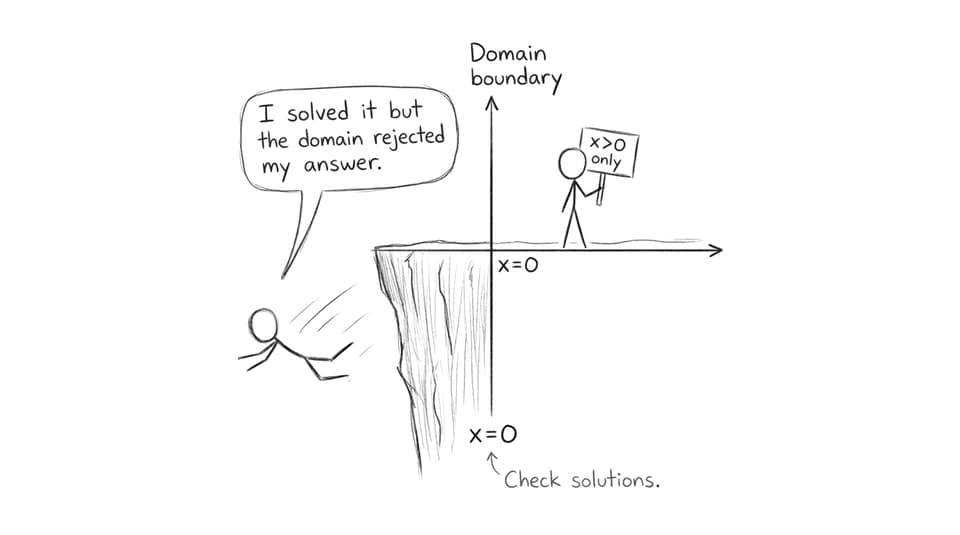
Then there’s the “invisible wall” at (x=0). A log function is only defined when its input is positive. So the graph doesn’t cross the y-axis, and it approaches a vertical asymptote.
To practise graphs and transformations in the exact syllabus framing, use Exponential and logarithmic functions (SL 2.9) and the matching SL 2.9 notes.
Domain restrictions: the most common mark-loser in IB Math logs
Domain checks are not a “nice extra.” They are part of the question, even when the paper doesn’t say so.
In IB Math, logs often hide restrictions inside expressions like (\log(2x-3)) or (\ln(x^2-5x)). You can manipulate perfectly, reach a neat solution, and still lose marks if the final value makes the log input non-positive.
That’s why RevisionDojo practice matters: the Questionbank trains you to spot restrictions early, and AI Chat can walk you through why a solution gets rejected by the domain. When you want repetition without boredom, the Flashcards help you recall log laws under pressure.
A fast exam approach that keeps logs predictable
When a logarithmic equation appears in IB Math, run this loop:
-
Rewrite in exponential form (or condense using log laws) until the log disappears.
-
Solve algebraically.
-
Check every solution against the domain restrictions.
-
Sketch mentally: does the answer match the shape and asymptote?
If simplifying is where you get stuck, follow How to simplify and solve logarithmic functions and then practise change-of-base with Using change of base formula bootcamp.
Bring logarithms back into your control
Logarithmic functions are counterintuitive in IB Math because they demand a different kind of thinking: not forward motion, but reversal. Once you anchor everything to “what exponent is this?”, the rules stop floating and the graphs stop feeling mysterious.
If you want that click to happen faster, RevisionDojo is built for it: use Study Notes for concept clarity, the Questionbank for exam-style repetition, Grading tools for feedback, and AI Chat when a single step won’t make sense at 11 p.m. Then finish with Mock Exams and Predicted Papers to make logarithms feel predictable, not personal.