RevisionDojo was developed independently of the IBO and as such is not endorsed by it in any way.
A small algebra move that saves big exam marks
There’s a very specific kind of panic that shows up in IB Math exams: you’re three lines into an equation, the logarithms start multiplying, and suddenly your neat plan turns into a scribble of brackets and bases. The frustrating part is that nothing “new” is happening. It’s the same few laws, quietly deciding whether your solution stays elegant or collapses.
The laws of logarithms are not a side topic in IB Math. They’re a lever. When you know how to pull it, messy expressions compress, equations open up, and method marks become easier to collect.
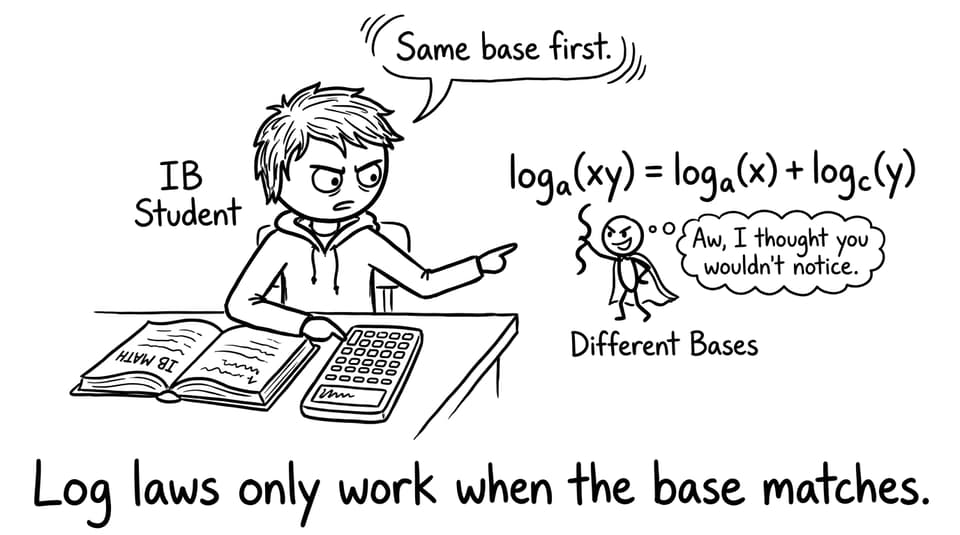
Log laws only work when the base matches
Quick checklist: what you must remember
Before you start manipulating logs in IB Math, run this quick check:
Same base? Log laws only apply cleanly when the bases match.
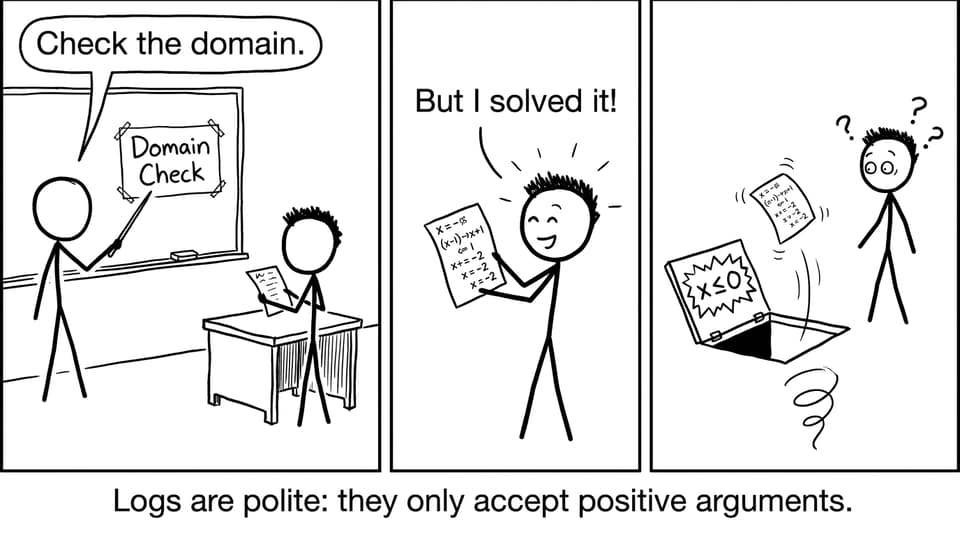
Domain safe? Every log input (argument) must be positive.
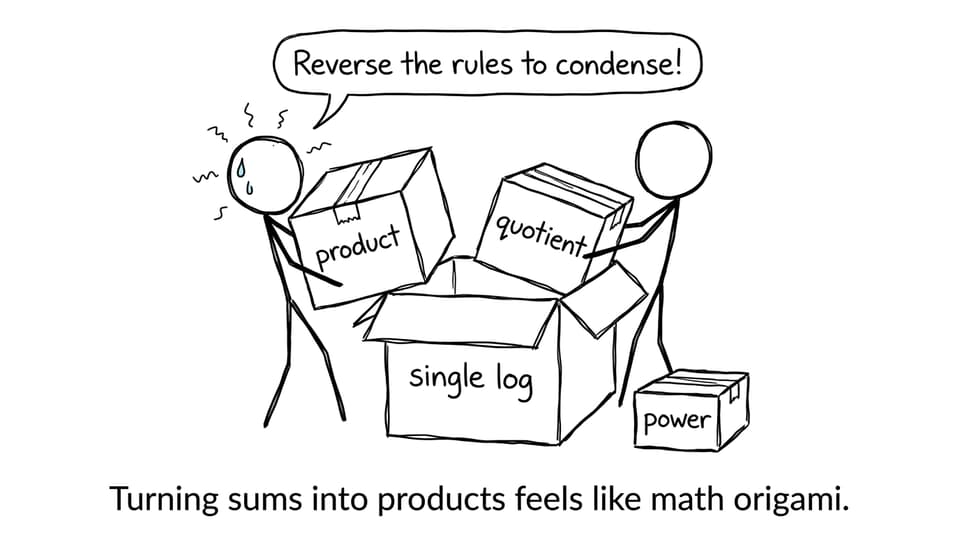
Goal clear? Are you trying to expand (make simpler pieces) or condense (make one log)?
Calculator reality? If the base is awkward, you’ll likely need change of base.
The core laws of logarithms (and what they really mean)
In IB Math, the “big three” are really translations of exponent rules.
Product law
log_a(xy)=log_ax+log_ay
If multiplication is hiding inside the log, the product law lets you “pull it apart” into addition.
Quotient law
log_aleft(fracxyright)=log_ax−log_ay
Division inside becomes subtraction outside. This is especially common when simplifying rational expressions before solving.
Power law
log_a(xk)=klog_ax
The exponent drops down as a coefficient. In IB Math, this is the law that most often gets misapplied because students forget it acts on the entire logarithm.
Solving equations with log laws (and the domain trap)
A common IB Math structure looks like this:
log_a(x−1)+log_a(x−3)=2
You would:
Condense using the product law: (\log_a((x-1)(x-3))=2)
Convert to exponential form: ((x-1)(x-3)=a^2)
Solve the resulting quadratic.
Check domain: (x-1>0) and (x-3>0) so (x>3).
That last step is where accuracy marks disappear. Logs don’t “allow” non-positive arguments, even if your algebra temporarily pretends they do.
Logs are polite: they only accept positive arguments
Change of base: the quiet tool for calculator questions
Even strong IB Math students forget this until it matters:
log_ab=fraclog_cblog_ca
Most calculators give (\log) (base 10) and (\ln) (base (e)), so you pick (c=10) or (c=e). If a question asks for a numerical value like (\log_3 7), change of base is usually the intended path.
In IB Math, the laws of logarithms reward calm thinking: confirm the base, decide whether you’re expanding or condensing, and protect the domain. Do that, and logs stop feeling like a trap and start behaving like a tool.
If you want to make that tool automatic, RevisionDojo is built for it: Questionbank practice, Study Notes, Flashcards, AI Chat, Mock Exams, Predicted Papers, a Coursework Library, and Tutors when you need a human explanation at the exact stuck point. Open a logs topic, practice with feedback, and let the confusion shrink one question at a time.